
High-temperature vacuum furnaces function as the critical control environment for the thermal hydrogen treatment of Ti–6Al–4V alloys. To successfully treat these alloys, the furnace must provide three specific process conditions: precisely controlled heating rates, a constant holding temperature (typically 800 °C for durations such as 1 hour), and a maintained low hydrogen overpressure (specifically around 700 Pa).
Core Takeaway: By creating a strictly regulated thermal and pressure environment, these furnaces enable hydrogen to act as a temporary alloying element, diffusing uniformly into the titanium matrix to modify its microstructure and improve processability.
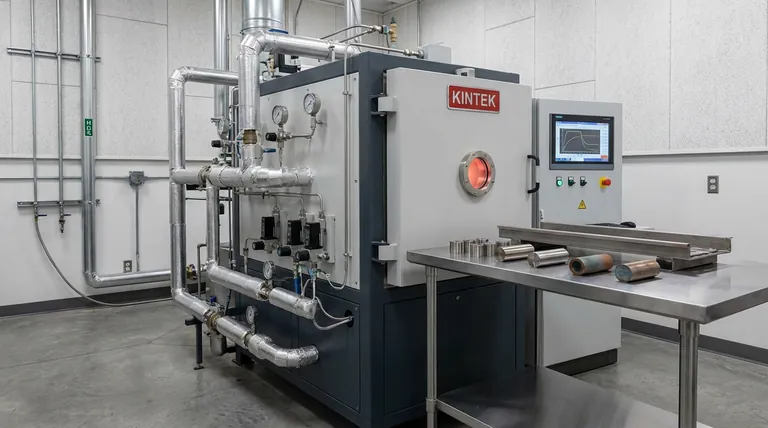
The Critical Thermal Environment
To alter the properties of Ti–6Al–4V effectively, the furnace must move beyond simple heating and establish a stable thermal field.
Precise Temperature Regulation
The primary requirement is maintaining a constant temperature, often set at 800 °C.
This stability is essential for the thermal hydrogen treatment (THT) process. It ensures the alloy reaches the necessary energy state for atomic movement without exceeding thermal limits that could damage the material.
Controlled Heating Rates
The furnace does not simply "turn on" to the target temperature; it follows a specific ramp-up profile.
Controlling the rate at which the alloy is heated prevents thermal shock. It also ensures that the material temperature remains uniform throughout the cross-section before the hydrogenation phase begins.
Uniform Thermal Soak
Once at temperature, the furnace maintains the heat for a set duration, such as 1 hour.
This "holding time" allows for the complete homogenization of the temperature within the part. It ensures that the center of the alloy is at the exact same thermal state as the surface, which is a prerequisite for uniform hydrogen diffusion.
Managing Atmosphere and Pressure
The "vacuum" aspect of the furnace is used to create a clean baseline, but the introduction of hydrogen is where the active processing occurs.
Low Hydrogen Overpressure
Unlike high-pressure vessel treatments, this process utilizes a low overpressure environment, specifically around 700 Pa.
This specific pressure parameter is critical. It provides enough potential to drive hydrogen into the material but avoids the complications or safety hazards associated with high-pressure hydrogen environments.
Facilitating Atomic Diffusion
The combination of heat and pressure creates the driving force for hydrogen diffusion.
The furnace environment allows hydrogen atoms to permeate the titanium alloy matrix. This transforms the microstructure from the outside in, effectively using the atmosphere itself as a chemical processing tool.
The Mechanics of Microstructure Modification
Understanding why these conditions are applied helps in optimizing the furnace parameters.
Hydrogen as a Temporary Alloy
The furnace conditions allow hydrogen to act as a temporary alloying element.
As noted in broader research on tube furnaces and titanium, introducing hydrogen into the lattice lowers the deformation temperature. This improves the alloy's processing performance, making it easier to work with before the hydrogen is eventually removed.
Preventing Phase Instabilities
Titanium alloys like Ti–6Al–4V and TiAl are extremely sensitive to temperature deviations.
As highlighted in supplementary data regarding phase transformations, precise temperature control determines the final microstructure. High-temperature furnaces must keep the sample within specific phase regions to ensure the desired duplex or lamellar structures are achieved.
Understanding the Trade-offs
While high-temperature vacuum furnaces are precise, the process requires a careful balance of variables.
Temperature Sensitivity
If the furnace fails to maintain the strict 800 °C setpoint, the results can be detrimental.
Minor deviations can lead to drastic changes in phase content ratios. If the temperature drifts too high, you risk excessive grain coarsening, which degrades the mechanical properties of the final part.
Time-Pressure Dependency
The relationship between the holding time (e.g., 1 hour) and pressure (700 Pa) is non-linear.
Insufficient time or pressure will result in shallow diffusion, leaving the core of the alloy untreated. Conversely, excessive exposure without proper controls can lead to hydrogen embrittlement if not properly managed during the subsequent dehydrogenation steps.
Making the Right Choice for Your Goal
When configuring your furnace process for Ti–6Al–4V, align your parameters with your specific metallurgical objectives.
- If your primary focus is Uniformity: Prioritize the holding time and stable thermal field to ensure hydrogen diffuses evenly to the core of the matrix.
- If your primary focus is Processability: Focus on maintaining the precise hydrogen overpressure (700 Pa) to effectively lower the deformation temperature for subsequent shaping.
- If your primary focus is Microstructure Integrity: strict adherence to temperature limits is required to prevent grain coarsening and unwanted phase transformations.
Success in thermal hydrogen treatment relies not just on reaching high temperatures, but on the rigorous stability of the hydrogen atmosphere and thermal soak.
Summary Table:
| Process Parameter | Specification | Functional Importance |
|---|---|---|
| Target Temperature | 800 °C | Enables atomic energy states for diffusion without damaging the material. |
| Holding Time | 1 Hour (Typical) | Ensures uniform thermal soak and complete homogenization of the alloy. |
| Hydrogen Overpressure | ~700 Pa | Provides the chemical potential to drive hydrogen into the titanium matrix. |
| Atmosphere Control | Low Overpressure | Uses hydrogen as a temporary alloying element to improve processability. |
| Critical Risk Factor | Temperature Drift | Failure to maintain 800 °C can lead to grain coarsening or phase instability. |
Optimize Your Titanium Processing with KINTEK
Precise control over thermal and atmospheric variables is the difference between material failure and peak performance. Backed by expert R&D and world-class manufacturing, KINTEK offers a comprehensive range of Muffle, Tube, Rotary, Vacuum, and CVD systems.
Our laboratory high-temperature furnaces are fully customizable to meet the rigorous demands of thermal hydrogen treatment and advanced metallurgy. Whether you are treating Ti–6Al–4V or developing new alloys, our systems provide the stability and uniformity your research requires.
Ready to enhance your lab's efficiency and precision?
Contact KINTEK today to discuss your unique project needs
Visual Guide

References
- Zdeněk Weiss, Dalibor Vojtěch. Analysis of hydrogen in a hydrogenated, 3D-printed Ti–6Al–4V alloy by glow discharge optical emission spectroscopy: sample heating effects. DOI: 10.1039/d3ja00434a
This article is also based on technical information from Kintek Furnace Knowledge Base .
Related Products
- 2200 ℃ Tungsten Vacuum Heat Treat and Sintering Furnace
- Molybdenum Vacuum Heat Treat Furnace
- 2200 ℃ Graphite Vacuum Heat Treat Furnace
- Vacuum Heat Treat Sintering Furnace Molybdenum Wire Vacuum Sintering Furnace
- 1700℃ High Temperature Laboratory Tube Furnace with Alumina Tube
People Also Ask
- How does a tungsten-heated vacuum sintering furnace prepare (TbxY1-x)2O3 ceramics? Achieve 99%+ Density & Purity
- What wear-resistance enhancements are achieved by powder coating? The Role of Vacuum Sintering Furnaces
- How do compaction pressure and vacuum sintering optimize porous ceramics? Maximize Density & Toughness
- What role does a high-temperature vacuum sintering furnace play in the densification of WC-10(Ni, Ni/Co) alloys?
- How does high-temp vacuum sintering influence Y-TZP mechanical properties? Achieve Max Toughness



















