Knowledge Why do the crucible residues remaining after the vacuum distillation of magnesium alloys possess high recycling value?
Author avatar

Tech Team · Kintek Furnace

Updated 7 hours ago

Why do the crucible residues remaining after the vacuum distillation of magnesium alloys possess high recycling value?


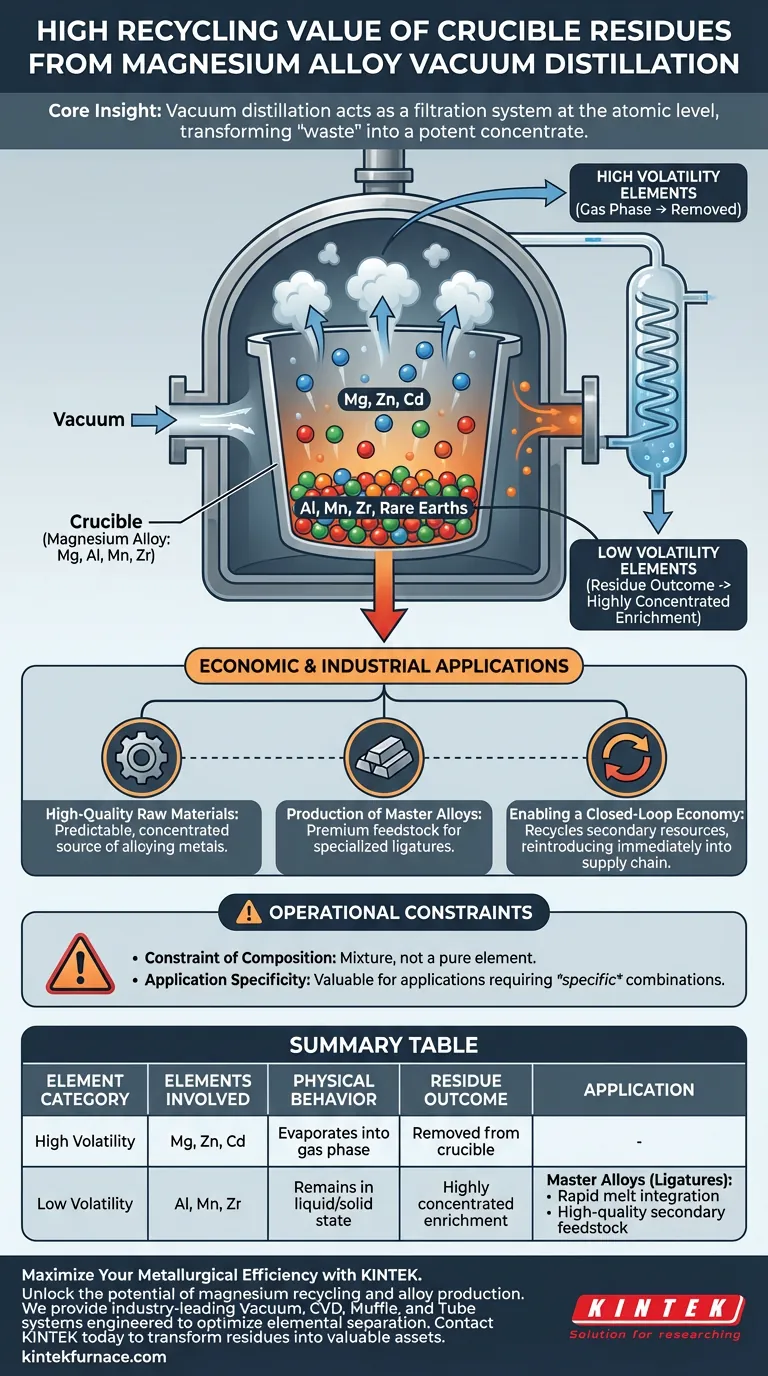
The high recycling value of crucible residues stems from the selective concentration of low-volatility alloying elements. When magnesium alloys undergo vacuum distillation, the volatile magnesium matrix evaporates, leaving behind a chemically enriched byproduct that is chemically superior for downstream manufacturing.

Core Insight: Vacuum distillation acts as a filtration system at the atomic level. By removing the bulk magnesium, the process transforms the remaining "waste" into a potent concentrate of aluminum, manganese, and zirconium, which serves as a premium feedstock for producing master alloys.

The Mechanics of Elemental Separation

Segregation by Volatility

The fundamental principle driving this value is the difference in vapor pressure between elements.

During vacuum distillation, highly volatile elements—specifically magnesium, zinc, and cadmium—transition into the gas phase. These are removed from the crucible and condensed elsewhere.

Enrichment of the Residue

As the volatile elements evaporate, the relative concentration of the remaining materials increases drastically.

Elements with low volatility cannot escape the crucible under these processing conditions.

This results in a residue that is heavily enriched with aluminum, manganese, zirconium, and rare earth elements.

Economic and Industrial Applications

High-Quality Raw Materials

The residue is not a random mixture of scrap; it is a predictable, concentrated source of alloying metals.

Because these elements are already integrated into a metallic matrix, they serve as high-quality raw materials.

Production of Master Alloys

The primary application for these residues is the preparation of specialized magnesium-based master alloys (also known as ligatures).

Master alloys are concentrated mixtures used to introduce specific elements into a melt more quickly and precisely than adding pure metals.

Enabling a Closed-Loop Economy

Utilizing these residues facilitates the recycling of secondary resources.

Instead of discarding the crucible contents or requiring complex chemical extraction, the material is immediately reintroduced into the supply chain, creating a closed-loop system.

Understanding the Operational Constraints

The Constraint of Composition

It is critical to note that the residue is a mixture, not a pure element.

The value of the residue is dependent on the specific combination of elements left behind (e.g., Al mixed with Mn).

Application Specificity

Because the elements are mixed, the residue is valuable only for applications that require that specific combination of alloying agents.

You cannot easily separate the aluminum from the manganese once they are in this enriched residue state without further, likely expensive, processing.

Making the Right Choice for Your Goal

To maximize the value of these residues, align your objectives with the material's properties:

  • If your primary focus is Resource Efficiency: View the vacuum distillation process not just as magnesium purification, but as a dual-stream production method that yields both pure magnesium and valuable alloy concentrates.
  • If your primary focus is Alloy Manufacturing: Utilize these residues as a cost-effective substitute for virgin master alloys to introduce aluminum, manganese, or zirconium into new melts.

By treating distillation residues as engineered concentrates rather than waste, you unlock a critical pathway for sustainable and cost-effective metallurgy.

Summary Table:

Element Category Elements Involved Physical Behavior Residue Outcome
High Volatility Magnesium, Zinc, Cadmium Evaporates into gas phase Removed from crucible
Low Volatility Aluminum, Manganese, Zirconium Remains in liquid/solid state Highly concentrated enrichment
Application Master Alloys (Ligatures) Rapid melt integration High-quality secondary feedstock

Maximize Your Metallurgical Efficiency with KINTEK

Unlock the full potential of your magnesium recycling and alloy production. At KINTEK, we provide industry-leading laboratory high-temperature furnaces—including Vacuum, CVD, Muffle, and Tube systems—engineered to optimize elemental separation and resource recovery.

Whether you are refining pure metals or creating specialized master alloys, our customizable solutions are backed by expert R&D to meet your unique manufacturing needs. Contact KINTEK today to discover how our advanced thermal technology can transform your distillation residues into valuable assets and streamline your closed-loop production.

Visual Guide
Why do the crucible residues remaining after the vacuum distillation of magnesium alloys possess high recycling value? Visual Guide

References

  1. В. Н. Володин, Alexey Trebukhov. On the Problem of the Distillation Separation of Secondary Alloys of Magnesium with Zinc and Magnesium with Cadmium. DOI: 10.3390/met14060671

This article is also based on technical information from Kintek Furnace Knowledge Base .

Related Products

People Also Ask

Related Products

1400℃ Muffle Oven Furnace for Laboratory

1400℃ Muffle Oven Furnace for Laboratory

KT-14M Muffle Furnace: Precision 1400°C heating with SiC elements, PID control, and energy-efficient design. Ideal for labs.

1800℃ High Temperature Muffle Oven Furnace for Laboratory

1800℃ High Temperature Muffle Oven Furnace for Laboratory

KINTEK Muffle Furnaces: Precision 1800°C heating for labs. Energy-efficient, customizable, with PID control. Ideal for sintering, annealing, and research.

1700℃ High Temperature Muffle Oven Furnace for Laboratory

1700℃ High Temperature Muffle Oven Furnace for Laboratory

KT-17M Muffle Furnace: High-precision 1700°C lab furnace with PID control, energy efficiency, and customizable sizes for industrial & research applications.

High Temperature Muffle Oven Furnace for Laboratory Debinding and Pre Sintering

High Temperature Muffle Oven Furnace for Laboratory Debinding and Pre Sintering

KT-MD Debinding & Pre-Sintering Furnace for ceramics - precise temperature control, energy-efficient design, customizable sizes. Boost your lab efficiency today!

Laboratory Muffle Oven Furnace with Bottom Lifting

Laboratory Muffle Oven Furnace with Bottom Lifting

Boost lab efficiency with KT-BL Bottom Lifting Furnace: precise 1600℃ control, superior uniformity, and enhanced productivity for material science and R&D.

1400℃ High Temperature Laboratory Tube Furnace with Quartz and Alumina Tube

1400℃ High Temperature Laboratory Tube Furnace with Quartz and Alumina Tube

KINTEK's Tube Furnace with Alumina Tube: Precision high-temperature processing up to 2000°C for labs. Ideal for material synthesis, CVD, and sintering. Customizable options available.

1700℃ High Temperature Laboratory Tube Furnace with Quartz or Alumina Tube

1700℃ High Temperature Laboratory Tube Furnace with Quartz or Alumina Tube

KINTEK's Tube Furnace with Alumina Tube: Precision heating up to 1700°C for material synthesis, CVD, and sintering. Compact, customizable, and vacuum-ready. Explore now!

1200℃ Split Tube Furnace Laboratory Quartz Tube Furnace with Quartz Tube

1200℃ Split Tube Furnace Laboratory Quartz Tube Furnace with Quartz Tube

Discover KINTEK's 1200℃ Split Tube Furnace with quartz tube for precise high-temperature lab applications. Customizable, durable, and efficient. Get yours now!

2200 ℃ Tungsten Vacuum Heat Treat and Sintering Furnace

2200 ℃ Tungsten Vacuum Heat Treat and Sintering Furnace

2200°C Tungsten Vacuum Furnace for high-temperature materials processing. Precise control, superior vacuum, customizable solutions. Ideal for research & industrial applications.

Vacuum Heat Treat Furnace with Ceramic Fiber Liner

Vacuum Heat Treat Furnace with Ceramic Fiber Liner

KINTEK's Vacuum Furnace with Ceramic Fiber Lining offers precise high-temperature processing up to 1700°C, ensuring uniform heat distribution and energy efficiency. Ideal for labs and production.

1200℃ Controlled Inert Nitrogen Atmosphere Furnace

1200℃ Controlled Inert Nitrogen Atmosphere Furnace

KINTEK 1200℃ Controlled Atmosphere Furnace: Precision heating with gas control for labs. Ideal for sintering, annealing, and material research. Customizable sizes available.

Vacuum Heat Treat Sintering Furnace Molybdenum Wire Vacuum Sintering Furnace

Vacuum Heat Treat Sintering Furnace Molybdenum Wire Vacuum Sintering Furnace

KINTEK's Vacuum Molybdenum Wire Sintering Furnace excels in high-temperature, high-vacuum processes for sintering, annealing, and material research. Achieve precise 1700°C heating with uniform results. Custom solutions available.

1400℃ Controlled Inert Nitrogen Atmosphere Furnace

1400℃ Controlled Inert Nitrogen Atmosphere Furnace

KT-14A Controlled Atmosphere Furnace for labs & industry. 1400°C max temp, vacuum sealing, inert gas control. Customizable solutions available.

1700℃ Controlled Inert Nitrogen Atmosphere Furnace

1700℃ Controlled Inert Nitrogen Atmosphere Furnace

KT-17A Controlled Atmosphere Furnace: Precise 1700°C heating with vacuum & gas control. Ideal for sintering, research & material processing. Explore now!

High Pressure Laboratory Vacuum Tube Furnace Quartz Tubular Furnace

High Pressure Laboratory Vacuum Tube Furnace Quartz Tubular Furnace

KINTEK High Pressure Tube Furnace: Precision heating up to 1100°C with 15Mpa pressure control. Ideal for sintering, crystal growth, and lab research. Customizable solutions available.

Multi Zone Laboratory Quartz Tube Furnace Tubular Furnace

Multi Zone Laboratory Quartz Tube Furnace Tubular Furnace

KINTEK Multi-Zone Tube Furnace: Precise 1700℃ heating with 1-10 zones for advanced material research. Customizable, vacuum-ready, and safety-certified.

Laboratory Quartz Tube Furnace RTP Heating Tubular Furnace

Laboratory Quartz Tube Furnace RTP Heating Tubular Furnace

KINTEK's RTP Rapid Heating Tube Furnace delivers precise temperature control, rapid heating up to 100°C/sec, and versatile atmosphere options for advanced lab applications.

Vacuum Heat Treat Sintering Furnace with Pressure for Vacuum Sintering

Vacuum Heat Treat Sintering Furnace with Pressure for Vacuum Sintering

KINTEK's Vacuum Pressure Sintering Furnace offers 2100℃ precision for ceramics, metals, and composites. Customizable, high-performance, and contamination-free. Get a quote now!

600T Vacuum Induction Hot Press Vacuum Heat Treat and Sintering Furnace

600T Vacuum Induction Hot Press Vacuum Heat Treat and Sintering Furnace

600T Vacuum Induction Hot Press Furnace for precise sintering. Advanced 600T pressure, 2200°C heating, vacuum/atmosphere control. Ideal for research & production.

Mesh Belt Controlled Atmosphere Furnace Inert Nitrogen Atmosphere Furnace

Mesh Belt Controlled Atmosphere Furnace Inert Nitrogen Atmosphere Furnace

KINTEK Mesh Belt Furnace: High-performance controlled atmosphere furnace for sintering, hardening & heat treatment. Customizable, energy-efficient, precise temperature control. Get a quote now!


Leave Your Message