
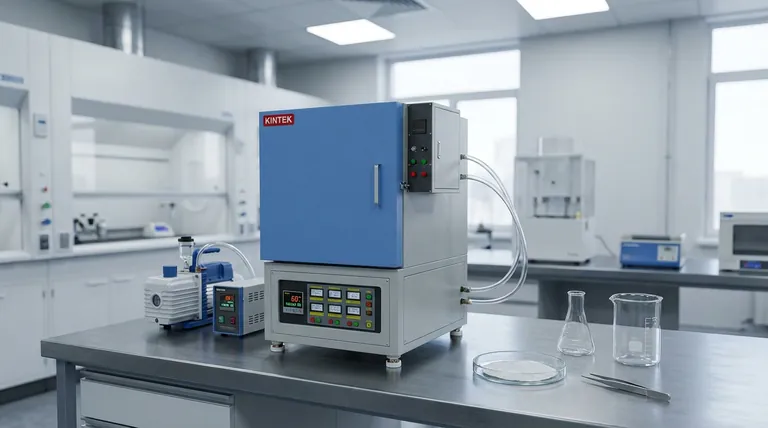
The critical purpose of using a laboratory vacuum drying oven for lignin nanofiber membranes is to accelerate the removal of residual acetic acid solvent at a moderate temperature of approximately 60°C. This process is essential to prevent fiber deformation caused by solvent plasticization and to sufficiently enhance the mechanical strength of the membrane, allowing it to be peeled off the collector without damage.
Core Takeaway Vacuum drying decouples evaporation speed from high temperatures, allowing you to strip aggressive solvents like acetic acid without thermally degrading the organic lignin. This preserves the membrane's delicate nanofibrous architecture while hardening it for practical handling.
Preserving Fiber Integrity
The primary challenge in post-processing lignin nanofibers is removing the solvent without destroying the fiber's morphology.
Preventing Solvent Plasticization
Residual solvents, particularly acetic acid in this context, act as plasticizers. If left in the material, they increase the mobility of the polymer chains, leading to fiber deformation.
By utilizing a vacuum oven, you remove these plasticizing agents rapidly. This "locks in" the fiber structure before the solvent can cause the fibers to merge or warp.
Low-Temperature Operation
Lignin is an organic polymer susceptible to thermal degradation. A standard oven would require higher temperatures to evaporate acetic acid effectively, which would risk burning or degrading the fibers.
The vacuum environment lowers the boiling point of the solvent. This allows for efficient drying at approximately 60°C, a safe range that maintains the chemical stability of the lignin.
Enhancing Mechanical Properties
Beyond merely drying the material, this process is a critical step in mechanical conditioning.
Facilitating Removal from the Collector
Electrospun or cast membranes are often fragile and adhere to their collectors while wet. Attempting to remove them immediately can cause tearing.
Vacuum drying increases the mechanical strength of the membrane. This structural hardening ensures the membrane is robust enough to be peeled off the collector intact for further use or analysis.
Ensuring Structural Uniformity
While not explicitly detailed in the primary text regarding lignin, general vacuum drying principles suggest that removing solvents under vacuum prevents the "violent" shrinkage often seen in air drying. This helps maintain a uniform structure across the membrane surface.
Understanding the Trade-offs
While vacuum drying is superior for this application, it requires precise control to avoid unintended damage.
The Risk of Rapid Evaporation
While the vacuum prevents thermal degradation, lowering the pressure too drastically can cause solvents to boil violently (bumping) rather than evaporate smoothly. This could potentially disrupt the fiber alignment or create surface defects.
Equipment Dependency
Unlike simple air drying, this method relies on maintaining a consistent seal and pump performance. A fluctuation in vacuum pressure during the drying cycle can lead to inconsistent solvent removal, potentially leaving "wet spots" that remain susceptible to plasticization.
Making the Right Choice for Your Goal
When configuring your post-processing workflow for lignin nanofibers, prioritize your parameters based on your specific end-goals:
- If your primary focus is Structural Fidelity: Maintain the temperature strictly around 60°C to prevent thermal degradation of the lignin while relying on the vacuum to handle the evaporation.
- If your primary focus is Sample Recovery: Ensure the drying cycle is complete before attempting to touch the membrane; the increase in mechanical strength is the key indicator that the sample is ready to be removed from the collector.
Summary: The vacuum drying oven is not just a drying tool; it is a stabilization device that balances low thermal impact with high solvent removal efficiency to produce a robust, intact nanofiber membrane.
Summary Table:
| Feature | Impact on Lignin Nanofiber Membranes |
|---|---|
| Temperature (~60°C) | Prevents thermal degradation and burning of organic lignin polymers. |
| Vacuum Environment | Lowers acetic acid boiling point, facilitating rapid solvent evaporation. |
| Solvent Removal | Eliminates plasticization risks to preserve fiber morphology and alignment. |
| Mechanical Strength | Increases structural integrity, allowing damage-free removal from collectors. |
Optimize Your Nanofiber Post-Processing with KINTEK
Precise control over temperature and vacuum levels is vital for preserving the delicate architecture of lignin membranes. KINTEK provides state-of-the-art laboratory vacuum drying ovens designed to eliminate residual solvents without compromising material integrity.
Backed by expert R&D and manufacturing, KINTEK offers Muffle, Tube, Rotary, Vacuum, and CVD systems—all customizable for your unique lab requirements. Whether you are hardening membranes or stabilizing sensitive organic polymers, our equipment ensures uniform results every time.
Ready to enhance your lab’s efficiency? Contact us today to find your custom solution!
References
- Changyu Shen, Jun Li. Investigation on spinnability of low molecular weight alkaline lignin to fabricate biobased carbon fiber. DOI: 10.15251/djnb.2024.191.417
This article is also based on technical information from Kintek Furnace Knowledge Base .
Related Products
- 1200℃ Muffle Oven Furnace for Laboratory
- High Temperature Muffle Oven Furnace for Laboratory Debinding and Pre Sintering
- 1700℃ High Temperature Muffle Oven Furnace for Laboratory
- Laboratory Vacuum Tilt Rotary Tube Furnace Rotating Tube Furnace
- High Pressure Laboratory Vacuum Tube Furnace
People Also Ask
- What is the primary function of a high-temperature laboratory muffle furnace in chemical synthesis? Achieve Precision.
- How does a high-temperature laboratory muffle furnace affect material properties? Transform Anodic Oxide Films Fast
- How is a laboratory muffle furnace used in 3D-printed PP-CF cross-linking? Achieve Thermal Stability at 150 °C
- How is a laboratory high-temperature muffle furnace used to evaluate porous Co-Al materials? Precision Thermal Analysis
- What role does a muffle furnace play in plant bark mineral analysis? Essential for Precise Dry Ashing & Trace Extraction











