
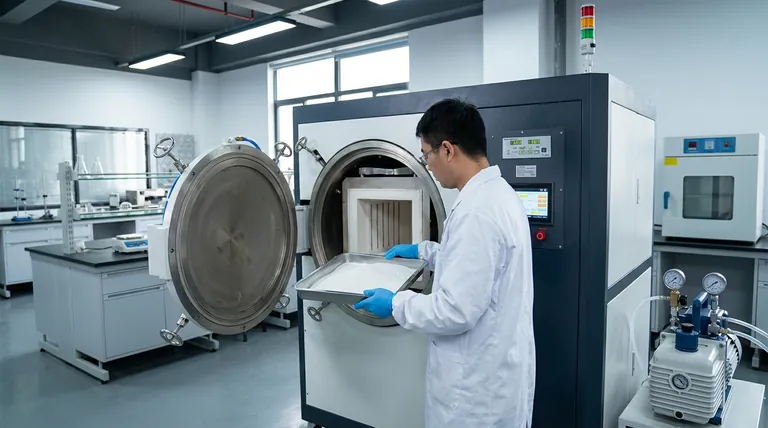
Vacuum drying fundamentally alters the drying mechanism by manipulating pressure rather than relying solely on increased temperature. While standard electric ovens depend on hot air convection which can degrade sensitive materials, vacuum ovens reduce the system pressure to lower the boiling point of solvents, enabling rapid volatilization at significantly lower temperatures.
Core Takeaway By lowering the boiling point of solvents, vacuum drying protects heat-sensitive powders from oxidation and structural collapse while eliminating the physical disruption caused by air currents. This method is superior for maintaining the microscopic integrity, chemical stability, and purity of ultra-fine or porous materials.
The Mechanics of Vacuum vs. Standard Drying
Thermal Protection Through Pressure Reduction
Standard ovens must heat solvents to their atmospheric boiling points (e.g., water at 100°C) to remove them. Vacuum ovens drastically lower this threshold.
By reducing internal pressure, solvents volatilize at much lower temperatures. This is critical for ultra-fine powders and heat-sensitive materials (such as reduced graphene or catalyst precursors), preventing thermal degradation or secondary oxidation that inevitably occurs during prolonged exposure to high heat.
Elimination of Airflow Disturbances
Standard electric ovens rely on air convection (fans) to distribute heat. This airflow creates a high risk for fine powders.
Turbulence in a standard oven can blow lightweight powders away, leading to material loss. Vacuum drying operates in a static environment, eliminating airflow disturbances and ensuring zero loss of valuable precursors.
Prevention of Cross-Contamination
Because the vacuum environment excludes air, it also removes the medium for airborne contaminants.
Standard ovens can circulate dust or foreign particles via convection currents. Vacuum drying isolates the sample, eliminating the risk of cross-contamination and preserving the high purity required for advanced applications like lithium battery anodes or ceramics.
Preservation of Microscopic Structure
Deep Pore Solvent Removal
Standard drying often dries the surface of a particle first, trapping moisture inside. Vacuum drying promotes uniform evaporation.
The pressure differential accelerates the escape of solvents from deep within porous agglomerates. This ensures thorough moisture removal without requiring excessive heat that could damage the outer shell of the particle.
Preventing Component Segregation (The Capillary Effect)
In standard drying, rapid surface evaporation can draw active components outward, leading to uneven distribution.
Vacuum drying prevents this "capillary effect" migration. By enabling low-temperature volatilization, it ensures that metal salts or binders remain uniformly distributed within the precursor or electrode slurry, rather than segregating at the surface.
Avoiding Hard Agglomeration
High-temperature drying often causes particles to fuse together due to liquid bridge forces.
By removing solvents at lower temperatures, vacuum drying minimizes these forces. This prevents the formation of hard agglomerates, preserving the powder's surface activity and specific surface area, which is vital for subsequent processing steps like sintering or densification.
Understanding the Trade-offs
Heat Transfer Mechanisms
While superior for quality, vacuum drying presents a challenge in heat transfer.
Standard ovens use convection (moving air) to heat samples quickly. Vacuum ovens, lacking air, rely on conduction from heated shelves. This means the powder container must have excellent contact with the shelf, and the initial heating phase may be slower than in a forced-air oven.
Batch vs. Continuous Processing
Vacuum drying is inherently a batch process due to the need for a sealed chamber.
If your production line requires continuous, high-throughput drying on a conveyor belt, a vacuum oven creates a bottleneck. It is a tool designed for quality and precision, not necessarily for maximum volume throughput compared to continuous tunnel ovens.
Making the Right Choice for Your Goal
To maximize process efficiency, align the drying method with your specific material requirements:
- If your primary focus is Thermal Sensitivity: Use a vacuum oven to lower solvent boiling points, preventing oxidation and preserving active surface groups on materials like graphene or metallic nanoparticles.
- If your primary focus is Structural Homogeneity: Choose vacuum drying to prevent the "capillary effect," ensuring binders and active components do not migrate to the surface of porous structures or electrode slurries.
- If your primary focus is Material Yield: Rely on vacuum drying to eliminate airflow turbulence, preventing the physical loss of ultra-fine, lightweight powders.
Summary: If your powder requires high purity, structural uniformity, or protection from heat, the vacuum oven is not just an alternative—it is a processing necessity.
Summary Table:
| Feature | Vacuum Drying Oven | Standard Electric Oven |
|---|---|---|
| Drying Mechanism | Low-pressure volatilization | Hot air convection |
| Thermal Protection | High (Low-temp boiling) | Low (Requires high heat) |
| Material Loss | Minimal (No airflow) | High risk (Fan turbulence) |
| Structural Integrity | Prevents "Capillary Effect" | Potential component segregation |
| Agglomeration | Lowers liquid bridge forces | High risk of hard agglomerates |
| Best For | Heat-sensitive/Porous powders | Bulk/Resilient materials |
Elevate Your Powder Processing with KINTEK Precision
Don't compromise the integrity of your heat-sensitive or ultra-fine materials. Backed by expert R&D and manufacturing, KINTEK offers high-performance Vacuum, Muffle, Tube, and CVD systems tailored to your specific lab requirements. Our customizable high-temperature furnaces ensure uniform heating and deep-pore solvent removal without the risk of oxidation or material loss.
Ready to optimize your drying process? Contact our experts today to find the perfect customizable solution for your research and production needs.
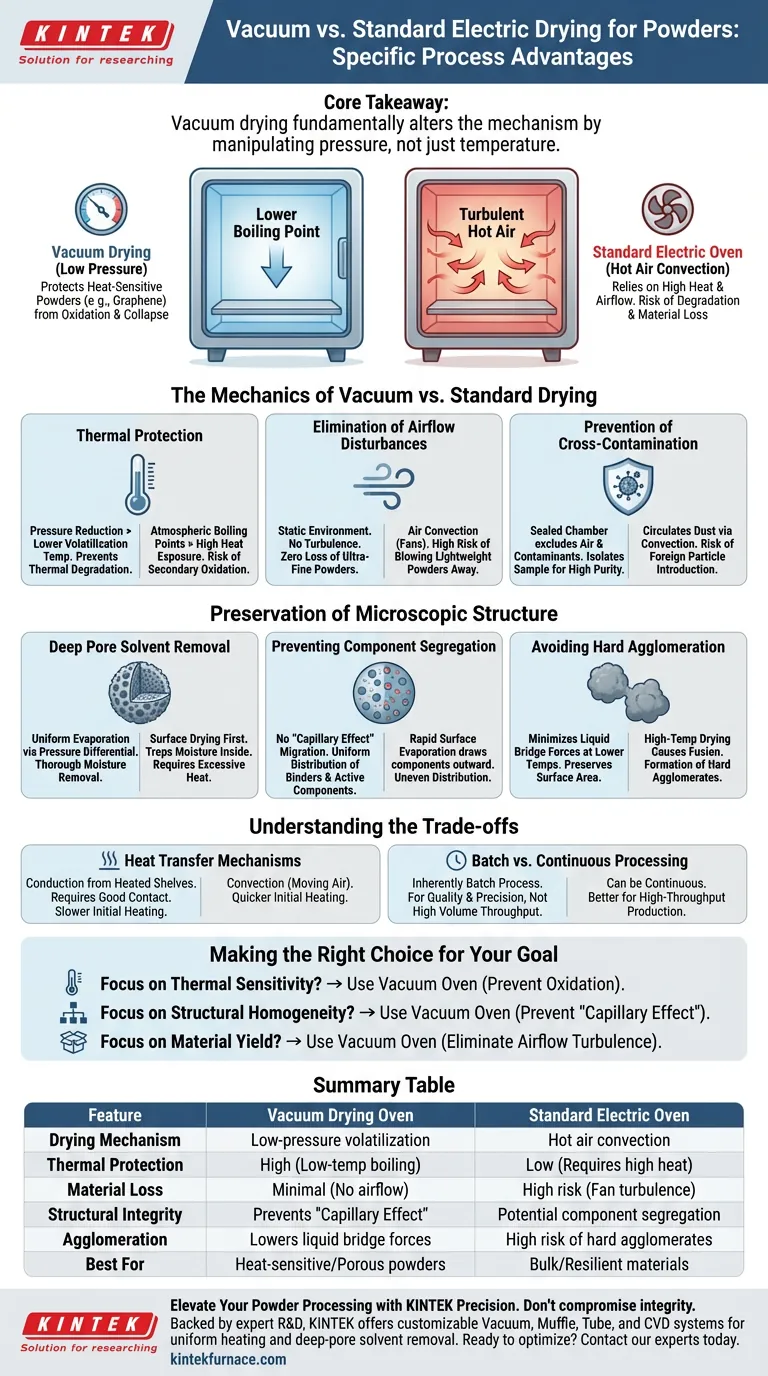
Visual Guide
References
- Akhtar Ali, Hijaz Ahmad. Narrowing of band gap and decrease in dielectric loss in La1-xSrxMnO3 for x = 0.0, 0.1, and 0.2 manganite nanoparticles. DOI: 10.3389/fmats.2024.1369122
This article is also based on technical information from Kintek Furnace Knowledge Base .
Related Products
- Vacuum Heat Treat Sintering and Brazing Furnace
- Vacuum Heat Treat Sintering Furnace Molybdenum Wire Vacuum Sintering Furnace
- Dental Porcelain Zirconia Sintering Ceramic Vacuum Press Furnace
- Molybdenum Vacuum Heat Treat Furnace
- Vacuum Hot Press Furnace Machine Heated Vacuum Press
People Also Ask
- What are the benefits of using vacuum heat treating furnaces for metal alloys? Achieve Superior Metal Properties and Performance
- What is one of the most important uses of vacuum heat treating furnaces in aerospace? Achieve Superior Strength in Aircraft Alloys
- How does vacuum heat treating affect the grain structure of metal alloys? Achieve Precise Microstructure Control
- What is the temperature of a vacuum furnace brazing? Optimize Your Joint Strength and Cleanliness
- What are the steps involved in a typical vacuum brazing treatment? Master the Process for Strong, Clean Joints












