
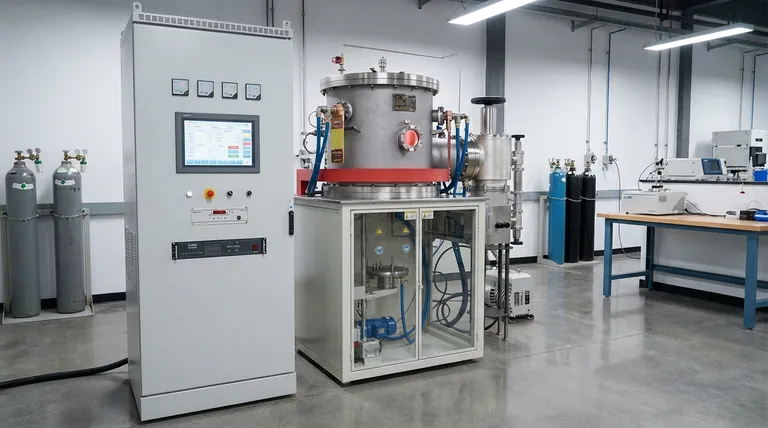
Vacuum sintering and annealing furnaces function as a two-stage thermal processing system to transform loose Neodymium Iron Boron (NdFeB) powder into a solid, high-performance magnet.
The vacuum sintering furnace operates at high temperatures (1000°C–1100°C) to physically compact the material through liquid-phase sintering, achieving near-full density. Following this, the annealing furnace operates at lower temperatures (500°C–700°C) to refine the grain boundary microstructure, ensuring the physical density translates into superior magnetic properties like coercivity.
Core Takeaway While the vacuum sintering furnace is responsible for the physical densification of the material by eliminating voids, the annealing furnace is essential for optimizing the grain boundaries within that dense structure. You cannot achieve high-performance magnets with densification alone; the post-sintering heat treatment is critical for maximizing remanence and coercivity.
The Role of Vacuum Sintering: Achieving Physical Density
The primary mechanism for densification occurs within the high-vacuum sintering furnace.
Liquid-Phase Sintering
The furnace heats the pressed NdFeB powder compacts to a range of 1000°C to 1100°C.
At these temperatures, the neodymium-rich phase within the alloy melts, becoming liquid. This liquid phase acts as a "glue," flowing between the solid grains, filling voids, and pulling the particles together through capillary action.
Elimination of Porosity
As the liquid phase fills the gaps, the material shrinks and porosity is virtually eliminated.
This process transforms a fragile powder compact into a fully dense, solid metallic body. Without reaching this specific temperature range, the material would remain porous and structurally weak.
Prevention of Oxidation
The high-vacuum environment is as critical as the temperature.
Rare earth elements like Neodymium and Dysprosium are highly reactive and prone to oxidation. The vacuum atmosphere prevents oxides from forming on the particle surfaces, which would otherwise inhibit the wetting action of the liquid phase and prevent successful densification.
The Role of Annealing: Optimizing the Densified Structure
Once the magnet is physically dense, it must undergo heat treatment in an annealing furnace to "activate" its potential.
Redistributing Grain Boundary Phases
After sintering, the grain boundaries—the layers separating the magnetic grains—are often irregular or unevenly distributed.
The annealing furnace operates at a moderate temperature of 500°C to 700°C. This thermal treatment smoothes and optimizes the distribution of the Neodymium-rich grain boundary phase.
Isolating Magnetic Grains
For a magnet to resist demagnetization (coercivity), the individual magnetic grains must be magnetically isolated from one another.
Annealing ensures that a continuous, non-magnetic layer surrounds the grains. This decoupling effectively prevents the reversal of magnetization, locking in the magnet's high coercivity without altering the physical density achieved in the previous step.
Understanding the Trade-offs
Achieving the perfect balance between density and magnetic performance requires navigating specific processing risks.
The Risk of Grain Growth
While higher sintering temperatures can speed up densification, exceeding the optimal range (above 1100°C) is detrimental.
Excessive heat causes the actual crystal grains to grow too large. Large grains significantly reduce the magnet's intrinsic coercivity (resistance to demagnetization), rendering the magnet strong but unstable.
Thermal Control vs. Cycle Time
Operators often face a trade-off between throughput and quality in the vacuum sintering phase.
Rapid heating might save time, but it can lead to uneven temperature distribution within the furnace. This results in inconsistent densification, where some magnets in the batch are fully dense while others remain porous or suffer from grain growth.
Making the Right Choice for Your Goal
The interplay between these two furnaces determines the final characteristics of your magnet.
- If your primary focus is Physical Integrity and Remanence: Prioritize the vacuum sintering process; precise control between 1000°C and 1100°C is required to eliminate porosity and maximize the volume of magnetic material.
- If your primary focus is High Coercivity (Resistance to Demagnetization): You must strictly control the annealing process; the 500°C–700°C treatment is the defining factor in isolating grains and stabilizing the magnetic field.
Success in NdFeB manufacturing is not just about squeezing out voids; it is about using heat to architect the microscopic boundaries that define magnetic power.
Summary Table:
| Process Stage | Equipment | Temperature Range | Primary Function |
|---|---|---|---|
| Densification | Vacuum Sintering Furnace | 1000°C – 1100°C | Liquid-phase sintering, eliminates porosity & voids |
| Optimization | Annealing Furnace | 500°C – 700°C | Refines grain boundaries & maximizes magnetic coercivity |
| Environment | High Vacuum | N/A | Prevents oxidation of reactive rare earth elements |
Unlock High-Performance Magnet Production with KINTEK
Precise thermal control is the difference between a weak material and a high-coercivity NdFeB magnet. Backed by expert R&D and manufacturing, KINTEK offers specialized Vacuum Sintering and Annealing systems designed to eliminate porosity and optimize grain boundaries.
Whether you require Muffle, Tube, Rotary, Vacuum, or CVD systems, our laboratory high-temp furnaces are fully customizable to meet your unique materials science needs.
Ready to enhance your magnetic properties? Contact our technical experts today to find the perfect furnace solution.
References
- Finks, Christopher. Technical Analysis: Magnet-to-Magnet Rare Earth Recycling Without Solvent Extraction (M2M-Δ Architecture) - Defense Supply Chain Resilience. DOI: 10.5281/zenodo.17625287
This article is also based on technical information from Kintek Furnace Knowledge Base .
Related Products
- Controlled Inert Nitrogen Hydrogen Atmosphere Furnace
- Vacuum Heat Treat Sintering Furnace with Pressure for Vacuum Sintering
- Vacuum Heat Treat Sintering Furnace Molybdenum Wire Vacuum Sintering Furnace
- Vacuum Heat Treat Sintering and Brazing Furnace
- 2200 ℃ Tungsten Vacuum Heat Treat and Sintering Furnace
People Also Ask
- How does hydrogen furnace annealing assist in preparing mechanically alloyed powders for compaction?
- How does atmospheric annealing in a controlled hydrogen furnace affect the cold compaction behavior of metal powders?
- What are the characteristics and uses of hydrogen atmospheres in furnaces? Unlock Clean Metal Processing
- What are the characteristics and uses of hydrogen atmosphere in furnaces? Achieve Superior Surface Purity and Bonding
- What controlled-atmosphere furnace conditions are required for sintering powder metallurgy copper alloy compacts? Ideal Setup



















