
The introduction of bottom slits profoundly improves thermal efficiency by fundamentally changing how magnetic fields interact with the metal charge. Instead of relying solely on side penetration, these slits allow magnetic flux to enter directly from beneath the crucible, creating a convergence zone of induced currents at the bottom of the charge. This targeted energy minimizes the thickness of the bottom skull layer and significantly increases the superheat degree of the melt pool.
The Core Insight Standard cold crucibles often suffer from lower energy density at the base, leading to thick, inefficient skull layers. Bottom slits bridge this gap by enabling vertical magnetic uniformity, ensuring the melt is heated consistently from the bottom up.
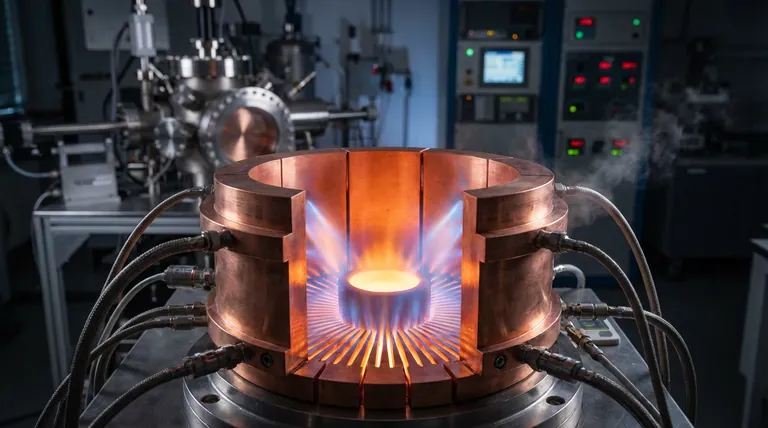
The Mechanism of Enhanced Heating
Breaking the Magnetic Shield
In a standard Induction Skull Melting (ISM) setup, the copper crucible walls naturally shield the charge from the external magnetic field.
Vertical slits in the walls are essential to break this current path, but a solid bottom remains a barrier. By extending slits to the bottom, you effectively remove this final shield, allowing magnetic flux to penetrate the charge from the underside.
Creating a Convergence Zone
When magnetic flux enters from the bottom, it alters the behavior of the induced currents within the metal.
This configuration forces currents to converge at the base of the charge. This concentration of electromagnetic activity generates intense localized heating exactly where it is usually most difficult to achieve.
Achieving Vertical Uniformity
Without bottom slits, induction intensity tends to be strongest at the sides and weaker at the core and base.
Bottom slits facilitate a more uniform vertical distribution of electromagnetic induction intensity. This ensures that the electromagnetic lifting and heating forces are not just lateral, but provide a comprehensive support structure for the melt.
Impact on the Melt Pool
Reducing Bottom Skull Thickness
The "skull" is the solidified crust of metal that separates the molten pool from the water-cooled copper crucible.
While necessary for containment and purity, a skull that is too thick acts as a heat sink, wasting energy. The enhanced induction effect from bottom slits melts the excess material at the base, keeping the bottom skull layer thin and efficient.
Increasing Superheat Degree
Superheat refers to the temperature of the liquid metal above its melting point.
Because the bottom of the charge is being actively heated rather than passively cooled by a thick skull, the overall superheat of the melt increases. This is critical for pouring and casting operations where fluidity is required.
Understanding the Trade-offs
Balancing Skull Integrity
While thinning the skull improves efficiency, it introduces a critical operational balance.
If the skull becomes too thin, you risk direct contact between the molten metal and the copper crucible. This could lead to copper contamination of the melt or damage to the crucible itself.
Structural Complexity
Adding slits to the bottom of a crucible increases the complexity of the manufacturing and cooling design.
Each segment defined by the slits must be individually cooled. Increasing the intricacy of the bottom geometry requires precise engineering to ensure mechanical stability and consistent water flow.
Making the Right Choice for Your Goal
To determine if bottom slits are the right modification for your specific ISM system, consider your primary objectives:
- If your primary focus is increasing energy efficiency: Implement bottom slits to reduce the thermal mass of the bottom skull and direct more energy into the molten pool.
- If your primary focus is high-temperature pouring: Use bottom slits to maximize the superheat degree, ensuring the metal remains fluid longer during the casting process.
- If your primary focus is maximum safety margins: Approach bottom slitting with caution, as you must maintain enough cooling power to prevent the thinner skull from failing.
Optimizing the geometry of the crucible bottom turns the passive support structure into an active participant in the melting process.
Summary Table:
| Feature | Standard Cold Crucible | Bottom-Slit Crucible | Impact on Performance |
|---|---|---|---|
| Magnetic Flux | Side penetration only | Bottom & side penetration | Increased energy density at the base |
| Bottom Skull | Thick, energy-absorbing | Thinner, optimized layer | Higher thermal efficiency & less waste |
| Superheat Degree | Moderate | Significantly higher | Improved fluidity for casting/pouring |
| Heating Pattern | Lateral focus | Vertical uniformity | Consistent melt quality & temperature |
Maximize Your Melting Efficiency with KINTEK
Is your induction system held back by inefficient skull formation and poor thermal uniformity? KINTEK provides industry-leading solutions designed to tackle the most demanding high-temperature challenges.
Backed by expert R&D and manufacturing, KINTEK offers Muffle, Tube, Rotary, Vacuum, CVD systems, and other lab high-temp furnaces, all customizable for unique needs. Whether you are refining Induction Skull Melting (ISM) parameters or developing new alloy processes, our technical team is ready to deliver the precision tools you require.
Ready to optimize your lab's performance? Contact us today to discuss your custom furnace requirements!
References
- Chaojun Zhang, Jianfei Sun. Optimizing energy efficiency in induction skull melting process: investigating the crucial impact of melting system structure. DOI: 10.1038/s41598-024-56966-7
This article is also based on technical information from Kintek Furnace Knowledge Base .
Related Products
- Vacuum Induction Melting Furnace
- 600T Vacuum Induction Hot Press Vacuum Heat Treat and Sintering Furnace
People Also Ask
- What are the core functions of the High Vacuum Induction Melting (VIM) furnace? Optimize DD5 Superalloy Purification
- What are the technical advantages of using a Vacuum Induction Melting furnace in the development of advanced packaging steel?
- What are the advantages of using a VIM furnace to control residual oxygen pressure? Achieve Superior Metal Uniformity
- What role does a Vacuum Induction Melting furnace play in the production of high-aluminum nickel-based superalloys?
- Why is a Vacuum Induction Melting furnace (VIM) used for Cu-Zn-Al-Sn alloys? Achieve Precision Composition Control

