
The k-epsilon turbulence model paired with wall functions serves as a critical computational strategy for efficiently simulating the high-velocity melt flows inside induction furnaces. It allows engineers to accurately model the complex fluid dynamics generated by electromagnetic stirring without the need for prohibitively expensive, high-density meshes near the crucible walls.
The core value of this approach lies in its ability to balance accuracy with computational speed; by mathematically approximating the near-wall physics, it enables the simulation of intense, high Reynolds number flows that would otherwise be resource-intensive to resolve.
Handling High-Energy Turbulence
The Challenge of Induction Flows
Induction melting creates an aggressive fluid dynamic environment. The flows within the furnace typically exhibit Reynolds numbers between $10^4$ and $10^5$, indicating a highly turbulent state.
Managing Bulk Turbulence
To predict the behavior of the melt, the simulation must account for this chaos. The k-epsilon model is utilized specifically to calculate the turbulent energy and dissipation throughout the bulk of the molten metal.
Solving the Boundary Layer Problem
Modeling the Sub-Viscous Layer
A major challenge in CFD (Computational Fluid Dynamics) is the behavior of fluid immediately touching the container wall. Wall functions address this by effectively modeling the flow characteristics of the sub-viscous layer near the crucible without physically resolving it.
Eliminating Fine Mesh Requirements
Without wall functions, accurately capturing near-wall behavior would require an extremely fine physical mesh. This modeling approach removes that necessity, allowing for a coarser mesh at the boundaries while maintaining simulation integrity.
Visualizing the Stirring Effect
Capturing Dual-Vortex Patterns
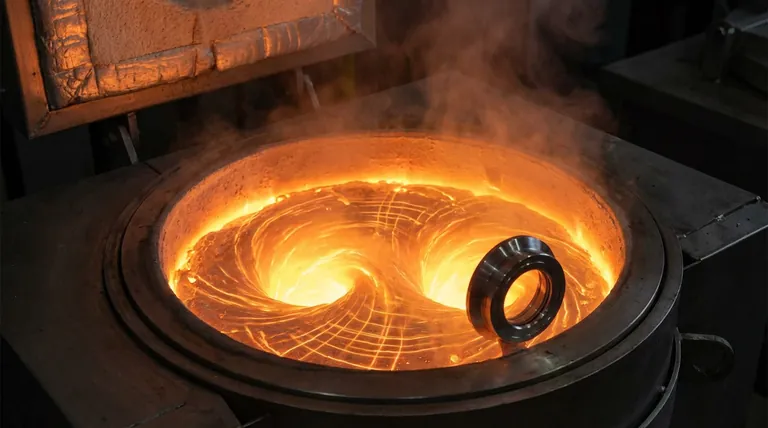
The ultimate goal of using this specific turbulence model is the accurate prediction of flow fields. This method successfully captures the distinct dual-vortex circulating flow fields that result from electromagnetic stirring forces.
Efficiency in Design
By reducing the mesh complexity, engineers can run these simulations faster. This allows for more rapid iteration when designing furnace geometries or adjusting power frequencies to optimize stirring.
Understanding the Trade-offs
Accuracy vs. Resolution
While this approach is highly effective for industrial induction furnaces, it relies on mathematical approximations at the wall. It does not fully resolve the physics of the boundary layer in the same way a Direct Numerical Simulation (DNS) would.
Range of Applicability
This combination is specifically optimized for the high Reynolds numbers mentioned ($10^4$ to $10^5$). It may not be the ideal choice for scenarios involving low-velocity, laminar flows where turbulence models can introduce artificial diffusion.
Making the Right Choice for Your Simulation
To maximize the value of your simulation efforts, align your modeling strategy with your specific engineering goals.
- If your primary focus is computational efficiency: Use wall functions to drastically reduce mesh count and solve time while still capturing global flow patterns.
- If your primary focus is analyzing stirring efficacy: Rely on the k-epsilon model to accurately depict the dual-vortex circulation driven by electromagnetic forces.
This approach provides a robust framework for understanding melt dynamics without getting bogged down by microscopic boundary layer calculations.
Summary Table:
| Feature | k-epsilon with Wall Functions | Impact on Simulation |
|---|---|---|
| Reynolds Number Range | $10^4$ to $10^5$ | Optimized for high-energy, turbulent melt flows |
| Mesh Density | Coarse near-wall mesh | Reduces computational cost and solve time |
| Flow Pattern Capture | Dual-vortex circulating fields | Accurately predicts electromagnetic stirring effects |
| Boundary Layer | Mathematically approximated | Eliminates need to resolve the sub-viscous layer |
| Best Use Case | Industrial furnace design | Enables rapid iteration of geometry and power settings |
Maximize Your Melt Efficiency with KINTEK
Precision in simulation leads to excellence in production. At KINTEK, we understand the complex fluid dynamics required for superior thermal processing. Backed by expert R&D and world-class manufacturing, we provide high-performance Muffle, Tube, Rotary, Vacuum, and CVD systems, all fully customizable to meet your unique laboratory or industrial requirements.
Whether you are optimizing electromagnetic stirring or refining high-temperature cycles, our team is ready to provide the specialized equipment you need for consistent, high-quality results. Contact KINTEK today to discuss your custom furnace needs and see how our advanced heating solutions can drive your research and production forward.
References
- Pablo Garcia-Michelena, Xabier Chamorro. Numerical Simulation of Free Surface Deformation and Melt Stirring in Induction Melting Using ALE and Level Set Methods. DOI: 10.3390/ma18010199
This article is also based on technical information from Kintek Furnace Knowledge Base .
Related Products
- 600T Vacuum Induction Hot Press Vacuum Heat Treat and Sintering Furnace
- Vacuum Induction Melting Furnace
- 1200℃ Controlled Inert Nitrogen Atmosphere Furnace
- 1700℃ Controlled Inert Nitrogen Atmosphere Furnace
- Vacuum Heat Treat Sintering Furnace with Pressure for Vacuum Sintering
People Also Ask
- Why use Vacuum Hot Press (VHP) for ZnS Ceramics? Achieve Superior IR Transparency and Mechanical Strength
- How does a vacuum hot press sintering furnace mitigate copper sintering swelling? Solve Fe-Cu Expansion Issues
- What are the benefits of using a vacuum hot press sintering furnace for the preparation of SiCw/2024 aluminum matrix composites? Achieve High-Performance Aerospace Materials
- How does the vacuum environment in a vacuum hot press sintering furnace protect chromium-containing ceramics? Find out.
- What are the key advantages of vacuum hot press sintering furnaces? Achieve Superior Density and Purity in Materials



















