
The role of a vacuum induction furnace in producing austenitic lightweight steel is to serve as a precise, protective smelting environment.
By melting the steel in a vacuum, the furnace prevents the oxidation of highly reactive lightweight elements like aluminum and manganese, which would otherwise be lost in open-air processing. Simultaneously, the furnace utilizes electromagnetic induction to naturally stir the molten metal, ensuring the chemical composition is perfectly uniform throughout the alloy.
The Bottom Line Success in producing austenitic lightweight steel relies on maintaining precise ratios of volatile elements. The vacuum induction furnace is the only reliable method to "lock in" these active elements while simultaneously degassing the melt to ensure a high-purity, homogeneous internal structure.
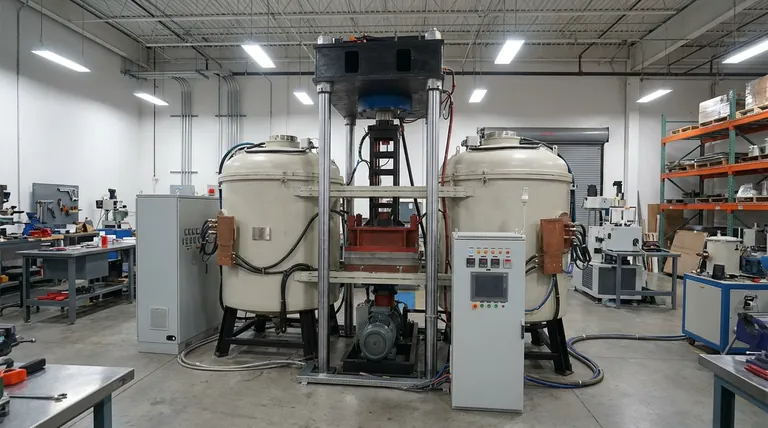
Preserving Chemical Composition
Producing lightweight steel requires the introduction of specific "active" elements that reduce density but are difficult to manage.
Protecting Active Elements
Austenitic lightweight steels rely heavily on elements like aluminum and manganese. These elements are highly prone to oxidation loss when exposed to air at high temperatures. The vacuum environment effectively eliminates this risk, ensuring the final alloy retains the exact chemical balance intended by the design.
Removing Gaseous Impurities
Beyond protecting solid elements, the vacuum environment acts as a purification stage. It actively removes gaseous impurities such as oxygen and nitrogen from the molten steel. This leads to a cleaner microstructure free of gas porosity or unwanted inclusions.
Controlling Trace Impurities
The controlled atmosphere allows for the precise management of detrimental trace elements. Operators can maintain phosphorus and sulfur levels at extremely low concentrations, typically below 0.01 wt%, which is critical for the material's mechanical integrity.
Achieving Structural Uniformity
A correct chemical recipe is useless if the ingredients are not mixed perfectly.
Electromagnetic Stirring
The induction heating mechanism generates a natural electromagnetic stirring effect within the crucible. This non-contact mixing ensures high chemical homogeneity across the entire melt, preventing segregation where heavier or lighter elements might otherwise separate.
Establishing a Research Foundation
Because the furnace guarantees such high consistency, it provides a reliable baseline for metallurgical study. Researchers can be confident that changes in the steel's microstructure are the result of intentional alloying adjustments, not random inconsistencies in the melting process.
Operational Precision and Efficiency
Modern vacuum induction furnaces are designed to offer granular control over the melting process.
Precise Temperature Regulation
These furnaces allow for exacting control of melting temperatures, often reaching 1600°C or higher. This precision is required to fully melt refractory elements without overheating the melt, which could degrade the furnace lining or alter the alloy properties.
Optimized Energy Consumption
Advanced insulation materials and control systems in modern designs minimize heat loss. This focus on thermal efficiency reduces operational costs and lowers the carbon footprint associated with the energy-intensive smelting process.
Understanding the Trade-offs
While vacuum induction melting is superior for quality, it introduces specific operational constraints.
Complexity vs. Volume
The process is inherently batch-oriented and more complex than continuous casting or open-air melting. It is ideal for high-value, high-complexity alloys where composition is non-negotiable, rather than low-cost, high-volume commodity steel production.
The "Cleanliness" Requirement
Because the system is so effective at preserving the melt's state, it also preserves any contaminants introduced via dirty raw materials. While the vacuum removes gases, the "garbage in, garbage out" principle applies strictly to solid contaminants, necessitating high-purity raw inputs like H13 steel or specific rare earth additions.
Making the Right Choice for Your Goal
- If your primary focus is keeping Aluminum and Manganese levels high: Use this furnace to prevent the rapid oxidation loss that occurs with these active elements in standard environments.
- If your primary focus is research and development: Rely on the electromagnetic stirring capability to create the homogeneous baseline necessary for studying microstructural changes.
- If your primary focus is purity: Leverage the vacuum environment to degas the melt and reduce sulfur and phosphorus to trace levels (below 0.01 wt%).
The vacuum induction furnace is not just a melting pot; it is a precision instrument that stabilizes the volatile chemistry required for modern lightweight steels.
Summary Table:
| Feature | Role in Lightweight Steel Production | Benefit to Material Properties |
|---|---|---|
| Vacuum Environment | Prevents oxidation of reactive elements (Al, Mn) | Preserves exact chemical composition and density |
| Degassing | Removes oxygen, nitrogen, and gaseous impurities | Improves microstructure and reduces porosity |
| Electromagnetic Stirring | Ensures non-contact, continuous mixing of the melt | Guarantees chemical homogeneity and consistency |
| Temperature Control | Precise regulation up to and exceeding 1600°C | Enables melting of refractory elements without degradation |
| Impurity Management | Maintains Phosphorus/Sulfur levels below 0.01 wt% | Enhances mechanical integrity and high purity |
Elevate Your Material Science with KINTEK
Precision is non-negotiable when producing high-performance austenitic lightweight steels. KINTEK provides industry-leading vacuum induction furnaces designed to "lock in" volatile elements and eliminate impurities through advanced degassing and electromagnetic stirring.
Backed by expert R&D and world-class manufacturing, we offer a comprehensive range of Muffle, Tube, Rotary, Vacuum, and CVD systems. Whether you are conducting cutting-edge research or specialized production, our lab high-temperature furnaces are fully customizable to meet your unique metallurgical needs.
Ready to achieve superior alloy purity? Contact our experts today to find the perfect thermal solution for your laboratory.
References
- Seong-Hoon Jeong, Changhee Lee. Influence of Chromium Addition on the Microstructure and Mechanical Properties in the Weld of Austenitic Lightweight Steel. DOI: 10.5781/jwj.2025.43.3.2
This article is also based on technical information from Kintek Furnace Knowledge Base .
Related Products
- 600T Vacuum Induction Hot Press Vacuum Heat Treat and Sintering Furnace
- Vacuum Induction Melting Furnace
- Vacuum Hot Press Furnace Machine Heated Vacuum Press Tube Furnace
- Vacuum Heat Treat Sintering and Brazing Furnace
- Vacuum Hot Press Furnace Machine Heated Vacuum Press
People Also Ask
- Why use Vacuum Hot Press (VHP) for ZnS Ceramics? Achieve Superior IR Transparency and Mechanical Strength
- How does a vacuum hot press sintering furnace mitigate copper sintering swelling? Solve Fe-Cu Expansion Issues
- What is the core function of a vacuum hot press sintering furnace in the preparation of high-density RuTi alloys? Achieve Maximum Density and Purity
- What are the key advantages of vacuum hot press sintering furnaces? Achieve Superior Density and Purity in Materials
- How does the vacuum environment in a vacuum hot press sintering furnace protect chromium-containing ceramics? Find out.



















