In research and development, Vacuum Hot Press (VHP) equipment serves as a critical tool for experimenting with and creating advanced materials. R&D teams use this technology to rapidly prototype test samples of materials like composites and ceramics, investigate new fabrication techniques, and fundamentally research methods for enhancing material density, strength, and purity.
The core value of a Vacuum Hot Press in an R&D setting lies in its unique ability to apply simultaneous high temperature and pressure within a controlled vacuum. This process allows researchers to eliminate contamination and porosity, enabling the creation of fully dense, high-purity materials with predictable and superior properties.
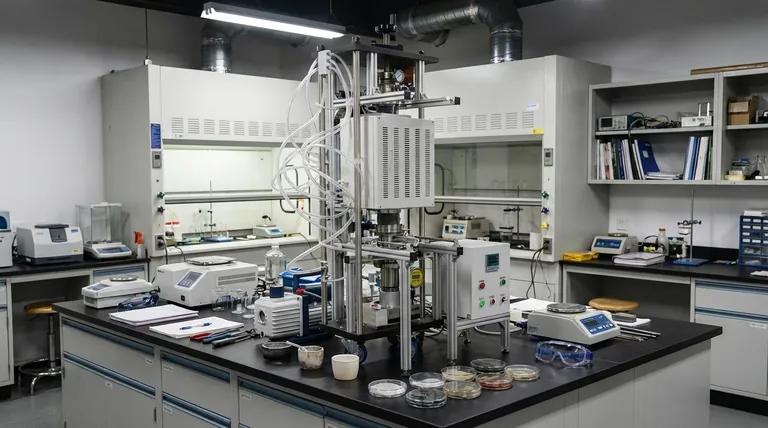
The Core Function: How a VHP Drives Innovation
A Vacuum Hot Press isn't just a heater or a press; its power comes from the precise combination of three environmental factors. Understanding this mechanism is key to grasping its value in research.
Simultaneous Heat and Pressure
The primary function is the application of uniaxial (single-direction) pressure to a material while it is heated to high temperatures. This combination forces powder particles or material layers to consolidate, significantly reducing the space between them.
This process, known as sintering or densification, is the main driver for improving a material's mechanical strength and other physical properties.
The Critical Role of the Vacuum
Performing this process in a vacuum is what separates a VHP from other pressing methods. The vacuum environment prevents oxidation and other chemical reactions that would otherwise occur at high temperatures, ensuring material purity.
It also helps to remove trapped gases from within the material as it densifies, which is essential for eliminating internal voids or porosity.
Achieving Full Densification
The ultimate goal for many advanced materials is to reach near-theoretical density. By combining heat, pressure, and vacuum, a VHP can produce materials with exceptionally low porosity.
This results in finished parts that are stronger, more thermally conductive, and more reliable than those made with conventional atmospheric processes.
Key R&D Applications
In practice, researchers leverage these capabilities to push the boundaries of material science across several high-stakes industries.
Prototyping Advanced Composites
In fields like aerospace, VHPs are essential for developing Ceramic Matrix Composites (CMCs) and Metal Matrix Composites (MMCs). Researchers prototype components like turbine blades, heat shields, and lightweight structural parts.
The VHP allows for the creation of small-scale test coupons with properties that accurately reflect what a full-scale component would exhibit.
Developing High-Purity Ceramics
The electronics industry relies on VHP technology to research and produce high-density ceramic substrates for microchips and to bond semiconductor wafers. The clean vacuum environment is non-negotiable for preventing contamination that would ruin electronic performance.
Researchers also use it to develop novel thermal management materials, such as high-performance heat spreaders and electrical insulators.
Investigating Novel Alloys and Bonding
A VHP is an ideal platform for studying new high-temperature-resistant alloys and for a process called diffusion bonding. This is where heat and pressure are used to join dissimilar materials together in their solid state, without melting.
This technique is fundamental to creating complex, multi-material components and circuits that cannot be fabricated otherwise.
Understanding the Trade-offs
While powerful, the Vacuum Hot Press is a specialized tool with specific limitations that are important to consider in an R&D context.
Slower Cycle Times
Compared to high-volume manufacturing methods, hot pressing is a relatively slow, batch-based process. This makes it ideal for careful experimentation and prototyping but less suitable for mass production.
Geometric Constraints
The uniaxial pressure generally limits the process to simpler geometric shapes, such as discs, cylinders, and rectangular blocks. Complex, three-dimensional shapes are very difficult to produce directly.
High Equipment and Operational Cost
VHP systems are sophisticated and expensive pieces of equipment. The costs associated with the high-purity graphite tooling (dies and punches) and high energy consumption must also be factored into any research budget.
Aligning the VHP with Your Research Goal
To effectively leverage this technology, you must match its capabilities to your specific objective.
- If your primary focus is creating new material compositions: The VHP allows you to test novel formulations and achieve full density for accurate property characterization.
- If your primary focus is improving existing materials: Use the VHP to study the effects of pressure and temperature on porosity reduction and grain structure to enhance mechanical or thermal performance.
- If your primary focus is component prototyping: The VHP is ideal for producing small, high-performance parts like ceramic substrates or composite test coupons for functional evaluation.
Ultimately, mastering the VHP process provides a powerful capability to move from theoretical material design to tangible, high-performance reality.
Summary Table:
| Aspect | Details |
|---|---|
| Core Function | Applies simultaneous heat and pressure in a vacuum for material densification and purity. |
| Key Applications | Prototyping composites (e.g., CMCs, MMCs), developing high-purity ceramics, and investigating novel alloys and bonding. |
| Benefits | Eliminates porosity and contamination, achieves full densification, and enables precise material property control. |
| Limitations | Slower cycle times, geometric constraints, and high equipment and operational costs. |
Ready to advance your R&D with tailored Vacuum Hot Press solutions? At KINTEK, we leverage exceptional R&D and in-house manufacturing to provide diverse laboratories with advanced high-temperature furnace options, including Vacuum & Atmosphere Furnaces and CVD/PECVD Systems. Our strong deep customization capability ensures we precisely meet your unique experimental needs for prototyping composites, ceramics, and alloys. Contact us today to discuss how our expertise can drive your material innovations forward!
Visual Guide

Related Products
- Vacuum Hot Press Furnace Machine for Lamination and Heating
- Vacuum Hot Press Furnace Machine Heated Vacuum Press
- Vacuum Hot Press Furnace Machine Heated Vacuum Press Tube Furnace
- 600T Vacuum Induction Hot Press Vacuum Heat Treat and Sintering Furnace
- Vacuum Heat Treat Sintering Furnace with Pressure for Vacuum Sintering
People Also Ask
- What are the primary components of a vacuum hot press furnace? Master the Core Systems for Precise Material Processing
- What safety features are incorporated in vacuum hot press furnaces? Ensure Operator and Equipment Protection
- What are the benefits of the vacuum environment system in a vacuum hot press furnace? Unlock High-Density Sintering
- What industries benefit from the use of vacuum hot press furnaces? Unlock High-Performance Materials for Your Industry
- Why is a high vacuum environment crucial when preparing copper-carbon nanotube composites in a vacuum hot press furnace? Achieve Superior Composite Integrity