
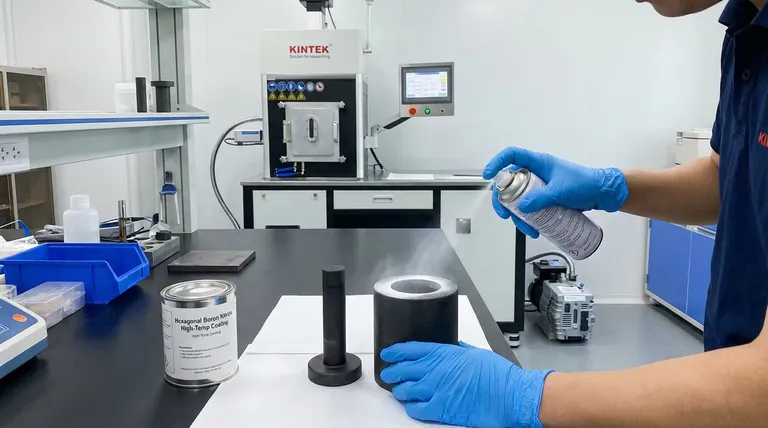
Hexagonal Boron Nitride (h-BN) serves as a critical protective interface for Spark Plasma Sintering (SPS) molds. Its primary function is to act as a high-temperature lubricant and release agent, ensuring that the sintered material does not adhere to the graphite mold walls during the intense heat and pressure of the process.
By creating a chemically inert barrier, h-BN prevents elemental diffusion between the mold and the powder while simultaneously modifying local electrical currents to ensure a controlled sintering environment.
Preserving Mold and Sample Integrity
Facilitating Clean Release
The intense conditions within an SPS setup can cause sintered powders to fuse with the mold walls.
h-BN acts as a high-temperature lubricant.
This coating ensures the final sample can be removed easily without damaging the graphite mold or the sample itself, significantly extending the lifespan of your tooling.
Blocking Chemical Contamination
Direct contact between the graphite mold and the sintering powder can lead to unwanted chemical reactions.
h-BN utilizes its chemical inertness to solve this problem.
It acts as a physical shield, preventing elemental diffusion. This ensures that carbon from the mold does not contaminate the powder, and conversely, that the powder does not react with the mold.
Influencing the Sintering Environment
Managing Electrical Current
SPS relies heavily on the flow of electrical current to generate heat.
The h-BN coating functions as a local electrical insulation layer.
By insulating specific interfaces, the coating helps control the path of the current through the mold and sample. This allows for more precise management of the heating dynamics during the sintering cycle.
Understanding the Operational Dynamics
The Necessity of the Barrier
While the graphite mold provides the structure and conductivity required for SPS, it is not a passive container.
Without the h-BN layer, direct contact is inevitable.
This contact creates a high risk of material degradation. Therefore, the application of h-BN is not merely an enhancement but a fundamental requirement for processing reactive materials or when high purity is required.
Making the Right Choice for Your Goal
To maximize the effectiveness of your SPS process, consider the specific function you need h-BN to prioritize:
- If your primary focus is Sample Purity: Rely on the coating’s chemical inertness to act as a barrier against carbon diffusion from the graphite mold.
- If your primary focus is Mold Longevity: Utilize h-BN primarily as a high-temperature lubricant to prevent sticking and mechanical damage during ejection.
- If your primary focus is Process Control: Leverage the coating’s electrical insulating properties to direct current flow and manage thermal distribution.
Proper application of h-BN transforms the mold from a simple container into a chemically and electrically controlled environment.
Summary Table:
| Key Function | Primary Benefit | Operational Impact |
|---|---|---|
| High-Temp Lubricant | Easy Sample Release | Extends mold lifespan and prevents mechanical damage |
| Chemical Barrier | Prevents Diffusion | Blocks carbon contamination and ensures material purity |
| Electrical Insulator | Current Management | Optimizes heating dynamics and thermal distribution |
| Chemically Inert | Physical Shielding | Eliminates reactions between powders and graphite walls |
Maximize Your Sintering Precision with KINTEK
Don't let mold degradation or chemical contamination compromise your research outcomes. At KINTEK, we understand that high-performance materials require precision environments. Backed by expert R&D and manufacturing, we offer a comprehensive range of Muffle, Tube, Rotary, Vacuum, and CVD systems, alongside lab high-temp furnaces that are fully customizable to your unique sintering needs.
Whether you are processing reactive powders or looking to extend the life of your expensive tooling, our technical team is ready to provide the specialized equipment and expertise you deserve.
Ready to elevate your lab's efficiency? Contact us today to discuss your custom furnace requirements!
References
- Alexander M. Laptev, Olivier Guillon. Tooling in Spark Plasma Sintering Technology: Design, Optimization, and Application. DOI: 10.1002/adem.202301391
This article is also based on technical information from Kintek Furnace Knowledge Base .
Related Products
People Also Ask
- How does the heating mechanism of Spark Plasma Sintering (SPS) function? Enhance TiC/SiC Composite Fabrication
- Why is it necessary to maintain a high vacuum environment during the SPS of SiC? Key to High-Density Ceramics
- What are the technical advantages of using an SPS sintering furnace? Elevate Al2O3-TiC Material Performance
- What are the steps in the discharge plasma sintering process? Master Fast, High-Density Material Consolidation
- What are the advantages of spark plasma sintering (SPS) over traditional forging? Precision Microstructural Control

