
The oscillating furnace is the primary mechanism for ensuring chemical uniformity during the synthesis of quaternary Ge-Se-Tl-Sb alloys. By employing continuous mechanical rocking or rotation at elevated temperatures, the furnace induces high-intensity convective mixing within the melt. This process prevents the separation of elements and ensures the final glass bulk possesses consistent physical and optical properties throughout its structure.
Synthesis of complex quaternary glasses requires an oscillating furnace to overcome gravity-induced segregation. By maintaining a dynamic melt environment, the system forces elements with disparate densities—like Thallium and Antimony—into a stable, homogeneous state.
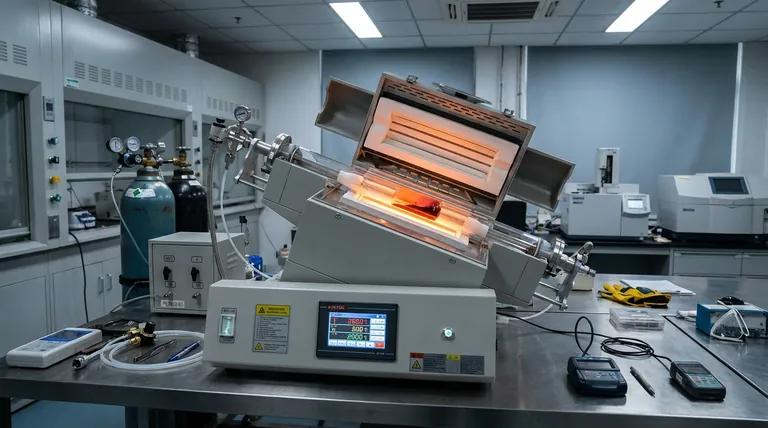
Overcoming Component Segregation in Complex Alloys
The Challenge of Density Gradients
In the Ge-Se-Tl-Sb system, the constituent elements possess significantly different atomic weights and densities. Thallium (Tl) and Antimony (Sb) are particularly prone to settling or "layering" when in a static liquid state at high temperatures.
Without active intervention, gravity causes the heavier components to sink to the bottom of the ampoule. This results in a finished glass that lacks structural integrity and exhibits varying chemical compositions across its volume.
Maintaining Chemical Homogeneity
Chemical homogeneity is the "gold standard" for high-performance chalcogenide glasses. It ensures that the refractive index, thermal expansion, and mechanical strength remain uniform throughout the entire ingot.
The oscillating furnace solves the problem of "component segregation" by preventing the melt from ever reaching a state of static equilibrium. This constant motion is the only reliable way to integrate heavy metals into the lighter Selenium-Germanium matrix.
The Mechanics of Oscillatory Mixing
Convective Flow Generation
The furnace utilizes continuous mechanical rocking or 360-degree rotation to agitate the molten material. This movement creates convective mixing, where internal currents move the liquid elements across different temperature and concentration zones.
This dynamic environment forces the atoms of Germanium, Selenium, Thallium, and Antimony to interact more frequently. This increased collision frequency is vital for the formation of the complex covalent bonds required for a quaternary glass network.
Eliminating Concentration Gradients
Static melting often leads to "dead zones" where certain elements concentrate and others are excluded. Oscillatory motion ensures that concentration gradients are eliminated before the quenching process begins.
By the time the melt is ready to be cooled into a solid glass, the oscillating furnace has produced a chemically homogeneous quaternary alloy bulk. This uniformity is critical for downstream applications, such as infrared lens manufacturing or fiber optics.
Understanding the Trade-offs
Mechanical and Thermal Complexity
While essential for homogeneity, oscillating furnaces introduce mechanical complexity into the lab environment. The constant motion requires robust seals and precise motor control to maintain steady rotation speeds under extreme heat.
Risk of Micro-Bubbles or Inclusions
If the oscillation speed is too aggressive, there is a risk of introducing physical defects. Turbulent mixing can trap residual gases or cause "swirl" patterns that remain visible in the finished glass if the cooling cycle is not perfectly timed.
How to Apply This to Your Synthesis
When synthesizing quaternary glass systems, your equipment strategy should align with your specific material requirements.
- If your primary focus is optical clarity and consistency: You must utilize a high-precision oscillating furnace to ensure a uniform refractive index across the entire glass blank.
- If your primary focus is heavy metal integration (High Tl/Sb content): You should prioritize a furnace with a variable rocking angle to maximize convective mixing and prevent density-driven settling.
- If your primary focus is rapid prototyping of simple binaries: An oscillating furnace may be unnecessary, as simpler systems with similar densities are less prone to the segregation issues found in quaternary alloys.
Achieving a high-quality quaternary glass depends entirely on your ability to master the fluid dynamics of the melt through controlled mechanical oscillation.
Summary Table:
| Feature | Impact on Ge-Se-Tl-Sb Synthesis |
|---|---|
| Mixing Mechanism | Continuous mechanical rocking/360-degree rotation |
| Primary Benefit | Eliminates density-driven segregation of heavy Tl and Sb |
| Material Quality | Ensures uniform refractive index and chemical homogeneity |
| Flow Type | High-intensity convective mixing within the molten alloy |
| Target Outcome | Consistent physical/optical properties across the glass bulk |
Elevate Your Advanced Material Synthesis with KINTEK
Achieving perfect chemical homogeneity in complex quaternary alloys requires more than just heat—it requires precision motion. Backed by expert R&D and world-class manufacturing, KINTEK offers a comprehensive range of Muffle, Tube, Rotary (Oscillating), Vacuum, and CVD systems, all fully customizable to meet your unique lab requirements.
Whether you are integrating heavy metals like Thallium or developing next-generation infrared optics, our high-temperature furnaces provide the stability and dynamic control necessary for superior glass production.
Ready to optimize your alloy uniformity? Contact us today to discuss your custom furnace solution.
References
- A. M. Ismail, E.G. El-Metwally. Insight on the optoelectronic properties of novel quaternary Ge–Se–Tl–Sb non-crystalline glassy alloy films for optical fiber sensing devices. DOI: 10.1140/epjp/s13360-024-05012-6
This article is also based on technical information from Kintek Furnace Knowledge Base .
Related Products
- Electric Rotary Kiln Small Rotary Furnace Biomass Pyrolysis Plant Rotating Furnace
- Laboratory Vacuum Tilt Rotary Tube Furnace Rotating Tube Furnace
- Vacuum Sealed Continuous Working Rotary Tube Furnace Rotating Tube Furnace
- Split Multi Heating Zone Rotary Tube Furnace Rotating Tube Furnace
- Laboratory Muffle Oven Furnace with Bottom Lifting
People Also Ask
- What are the key components of a rotary kiln electric furnace? Unlock Efficient Thermal Processing
- What are the main applications of a rotary kiln electric furnace? Achieve Uniform Heat Treatment for Powders
- What is the significance of the refractory lining in a rotary kiln electric furnace? Unlock Efficiency and Longevity
- What are the key components of a rotary kiln's construction? Discover the Essential Parts for Efficient Industrial Processing
- What role does the rotary kiln serve in coal-based DRI production? Unlock Cost-Effective Ironmaking Efficiency



















