
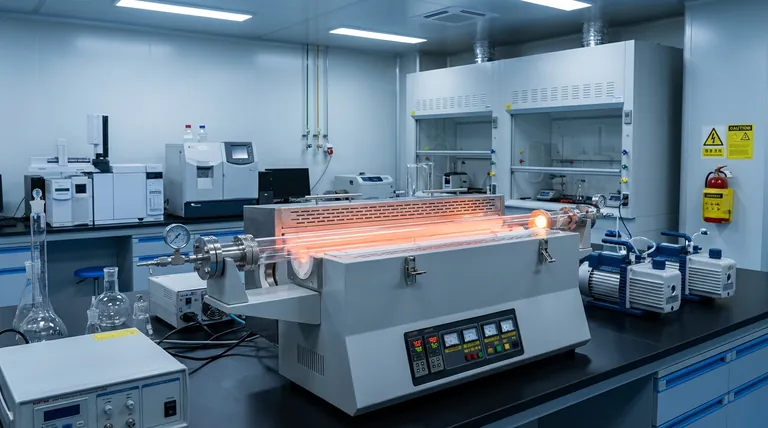
A vacuum-controlled tube furnace acts as the critical vessel for phase transformation in the processing of Ti2AlN thin films. It creates a precise, high-temperature environment—specifically around 750 °C—while utilizing high-purity argon to shield the material from oxygen. This specific setup is required to convert the deposited film from a disordered, amorphous state into a stable, crystalline hexagonal MAX phase without degrading the material.
The furnace serves a dual purpose: it provides the thermal energy necessary for crystallization while simultaneously excluding reactive gases. By maintaining a deep vacuum or an inert argon atmosphere, it ensures the Ti2AlN film achieves its target microstructural properties without succumbing to oxidation.
Orchestrating the Phase Transition
From Amorphous to Crystalline
As deposited, Ti2AlN thin films often exist in an amorphous state, lacking a defined crystal structure. The tube furnace provides the thermal activation energy required to rearrange the atomic structure.
Achieving the Hexagonal MAX Phase
The primary goal of this thermal treatment is the formation of the typical hexagonal MAX phase. The furnace maintains the sample at 750 °C, the specific temperature threshold required to drive this structural evolution.
Uniform Thermal Distribution
Beyond simply reaching a set temperature, the tube furnace ensures a uniform temperature zone. This consistency allows the entire film to crystallize evenly, preventing localized defects or incomplete phase transformations.
Environmental Control and Protection
The Necessity of Inert Atmospheres
Titanium and Aluminum are highly reactive metals that oxidize readily at high temperatures. The furnace mitigates this risk by introducing high-purity argon gas as a protective blanket around the sample.
Deep Vacuum Capabilities
Before introducing argon, the furnace evacuates the chamber to extremely low pressure levels. This step removes ambient air and residual moisture, ensuring the baseline environment is free of contaminants that could compromise the film.
Preventing Oxidation
The combination of vacuum evacuation and argon flow creates a barrier against oxidation. Without this controlled atmosphere, the high annealing temperatures would ruin the film by forming oxides rather than the desired Ti2AlN compound.
Microstructural Enhancement
Relieving Internal Stress
Deposition processes often introduce significant residual stress within thin films. The controlled heating and cooling cycles provided by the furnace allow the lattice to relax, effectively healing these internal stresses.
Densification of the Film
The thermal energy promotes atomic diffusion, which helps eliminate porosity within the material. This results in a denser, more mechanically stable film with improved continuity.
Understanding the Operational Trade-offs
Sensitivity to Gas Purity
The efficacy of the furnace is entirely dependent on the purity of the source gas. Even a minor contamination in the argon supply can be accelerated by the high temperature, leading to rapid oxidation instead of protection.
Balancing Pressure and Volatilization
While vacuum removes contaminants, maintaining a vacuum that is too deep during peak heat can sometimes lead to the volatilization of specific elements. It is often necessary to balance the vacuum with a partial pressure of inert gas to keep the film stoichiometry intact.
Thermal Shock Risks
Precise control over heating and cooling rates is essential. Rapid temperature changes can re-introduce stress or cause the thin film to delaminate from its substrate, negating the benefits of the annealing process.
Making the Right Choice for Your Goal
When configuring your thermal treatment for Ti2AlN, align your furnace parameters with your specific material objectives:
- If your primary focus is Phase Purity: prioritize high-purity argon flow and strict adherence to the 750 °C setpoint to ensure complete conversion to the hexagonal MAX phase.
- If your primary focus is Film Integrity: utilize programmable heating rates to slowly ramp the temperature up and down, minimizing thermal shock and delamination risks.
- If your primary focus is Surface Chemistry: ensure the furnace is capable of reaching high base vacuum levels prior to heating to eliminate all traces of ambient oxygen and moisture.
By mastering the atmosphere and thermal profile within the tube furnace, you convert a raw precursor into a sophisticated, high-performance MAX phase material.
Summary Table:
| Feature | Function in Ti2AlN Treatment | Key Benefit |
|---|---|---|
| Temperature (750°C) | Drives atomic rearrangement | Amorphous to Hexagonal MAX phase conversion |
| Argon Atmosphere | Provides an inert protective blanket | Prevents metal oxidation of Ti and Al |
| High Vacuum | Removes air and residual moisture | Ensures high-purity, contaminant-free environment |
| Thermal Uniformity | Maintains a consistent heat zone | Prevents localized defects and incomplete phase change |
| Controlled Cooling | Relieves internal lattice stress | Minimizes film delamination and thermal shock |
Elevate Your Material Research with KINTEK Precision
Achieving the perfect MAX phase transformation requires absolute control over your thermal environment. Backed by expert R&D and manufacturing, KINTEK offers a comprehensive range of Muffle, Tube, Rotary, Vacuum, and CVD systems, all fully customizable for your unique lab high-temp needs. Whether you are optimizing Ti2AlN thin films or developing new materials, our systems provide the stability and purity your research demands.
Ready to optimize your thin film deposition process? Contact us today to discuss your custom furnace solution.
References
- Semih Duran, İhsan Efeoğlu. Application of honeycomb pattern to Ti2AlN MAX phase films by plasma etching. DOI: 10.1007/s00339-024-07407-9
This article is also based on technical information from Kintek Furnace Knowledge Base .
Related Products
- Vacuum Sealed Continuous Working Rotary Tube Furnace Rotating Tube Furnace
- Vacuum Hot Press Furnace Machine Heated Vacuum Press Tube Furnace
- Laboratory Vacuum Tilt Rotary Tube Furnace Rotating Tube Furnace
- High Pressure Laboratory Vacuum Tube Furnace
- Split Chamber CVD Tube Furnace with Vacuum Station CVD Machine
People Also Ask
- What is the purpose of rotary tube furnaces? Achieve Uniform Heat Treatment for Powders and Granules
- What are the key advantages of using a rotary tube furnace? Achieve Dynamic, Uniform Heating for Powders
- How does the amount of material processed vary between batch and continuous rotary tube furnaces? Scale Your Production Efficiently
- What are the advantages of rotary tube furnaces in fuel compatibility? Boost Efficiency and Cut Costs
- What is the temperature range of some rotary tube furnaces? Achieve Uniform Heating Up to 1200°C



















