
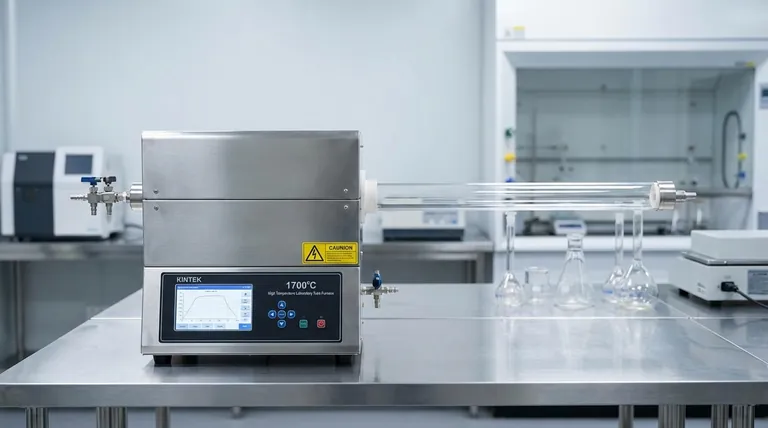
The technical necessity of a tube furnace in synthesizing CoFe@HNCS composite materials lies in its ability to simultaneously provide a strictly controlled inert atmosphere and a precise thermal profile.
This specific environment is required to prevent the oxidation of metallic components while forcing the synchronous carbonization of organic precursors and the reduction of metal species.
By maintaining a high-purity nitrogen flow and a specific heating rate, the tube furnace ensures that nitrogen-doped carbon shells form exactly as the CoFe precursors transform into bimetallic nanoparticles, creating a unified core-shell structure.
The Critical Role of Atmosphere Control
Preventing Metallic Oxidation
The synthesis of CoFe@HNCS involves the formation of metallic Cobalt-Iron (CoFe) nanoparticles. These metals are highly susceptible to oxidation at elevated temperatures.
A tube furnace utilizes a sealed environment with a continuous flow of inert gas, typically nitrogen (N2). This flow displaces oxygen, ensuring the metallic components remain in their reduced, functional state rather than degrading into oxides.
Facilitating Chemical Reduction
Beyond simple protection, the atmosphere within the furnace supports the chemical transformation of the starting materials.
The environment allows for the effective reduction of CoFe Prussian Blue Analogs. This transforms the precursor material from a complex salt structure into the desired bimetallic alloy nanoparticles necessary for the composite's performance.
Precision Thermal Management
Controlled Heating Kinetics
Successful synthesis relies on a specific heating rate, such as 5 °C per minute.
The tube furnace's programmable controller ensures this rate is strictly followed. Deviating from this ramp rate could disrupt the reaction kinetics, leading to incomplete carbonization or uneven particle growth.
Synchronous Reaction Mechanisms
The most complex aspect of this synthesis is the need for two distinct processes to happen at the same time.
The furnace's stable thermal environment ensures that precursors like polydopamine and melamine carbonize to form nitrogen-doped shells at the exact same moment the metal reduction occurs. This synchronicity is vital for creating a cohesive "core-shell" structure where the carbon shell securely encapsulates the metallic core.
Understanding the Trade-offs
Material Limitations of the Tube
While tube furnaces offer precise control, the tube material itself dictates the operational limits.
As noted in broader research, tubes are typically made of quartz or alumina. Researchers must ensure their specific chemical precursors, or the gases evolved during carbonization, do not react adversely with the tube material at high temperatures.
Batch Size Constraints
The geometry of a tube furnace restricts the volume of material that can be processed at once.
While excellent for achieving high uniformity and facilitating gas-solid interactions (like the melt-diffusion seen in other sulfur-based processes), the "hot zone" is physically limited. This makes the tube furnace ideal for high-precision laboratory synthesis but potentially challenging for large-scale mass production without modification.
Making the Right Choice for Your Goal
To maximize the quality of your CoFe@HNCS composites, you must tailor the furnace settings to your specific structural requirements.
- If your primary focus is Core-Shell Uniformity: Prioritize the heating rate accuracy (e.g., 5 °C/min) to ensure the carbonization and reduction processes remain perfectly synchronized.
- If your primary focus is Metallic Phase Purity: Ensure the inert gas flow (N2) is robust and leak-free to completely eliminate oxygen and prevent secondary oxidation of the CoFe alloy.
The tube furnace is not just a heating element; it is the precise reaction vessel that dictates the chemical integrity and structural evolution of your final composite material.
Summary Table:
| Technical Requirement | Tube Furnace Function | Impact on CoFe@HNCS Synthesis |
|---|---|---|
| Atmosphere Control | Continuous Inert Gas Flow (N2) | Prevents metallic oxidation; supports reduction of CoFe precursors. |
| Thermal Precision | Programmable Ramp Rates (e.g., 5°C/min) | Ensures synchronous carbonization of shells and reduction of metal cores. |
| Structural Integrity | Sealed High-Temp Environment | Facilitates uniform nitrogen-doped carbon encapsulation of nanoparticles. |
| Reaction Kinetics | Stable Hot Zone Management | Controls particle growth and ensures phase purity of the bimetallic alloy. |
Elevate Your Nanomaterial Synthesis with KINTEK
Precise control over atmosphere and temperature is non-negotiable for high-performance CoFe@HNCS composites. KINTEK provides industry-leading Tube, Vacuum, and CVD systems designed to meet the rigorous demands of laboratory research and advanced manufacturing.
Backed by expert R&D, our customizable high-temperature furnaces ensure your synthesis achieves perfect core-shell uniformity and metallic purity every time. Ready to optimize your material properties? Contact KINTEK today for a custom solution.
Visual Guide

References
- Ui Young Lee, Dae Ho Yoon. Fine-tunable N-doping in carbon-coated CoFe nano-cubes for efficient hydrogen evolution in AEM water electrolysis. DOI: 10.1007/s42114-025-01237-w
This article is also based on technical information from Kintek Furnace Knowledge Base .
Related Products
- 1200℃ Controlled Inert Nitrogen Atmosphere Furnace
- High Pressure Laboratory Vacuum Tube Furnace
- Multi Zone Laboratory Quartz Tube Furnace Tubular Furnace
- Vertical Laboratory Quartz Tube Furnace Tubular Furnace
- 1400℃ High Temperature Laboratory Tube Furnace with Alumina Tube
People Also Ask
- What controlled-atmosphere furnace conditions are required for sintering powder metallurgy copper alloy compacts? Ideal Setup
- What are the operational advantages of using a controlled atmosphere furnace? Boost Quality and Efficiency in Heat Treatment
- What are the four main types of controlled atmospheres used in these furnaces? Optimize Your Heat Treatment Processes
- What are the key benefits of precise temperature control in a controlled atmosphere furnace? Unlock Superior Quality and Efficiency
- What factors should be considered when choosing a controlled atmosphere furnace? Ensure Optimal Performance for Your Materials



















