
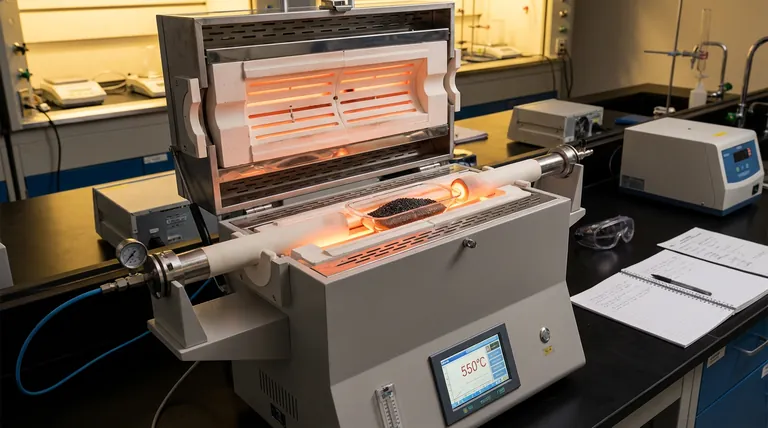
The secondary high-temperature activation is the definitive step that transforms inert metal precursors into functional, catalytic agents. By subjecting the impregnated material to a controlled thermal environment (typically around 550°C), this process converts loaded metal salts into crystalline metal oxides like nickel oxide (NiO) or cobalt oxide (Co3O4). This transformation is essential for anchoring stable active sites within the catalyst's lattice structure.
The primary purpose of this activation is to chemically evolve metal salts into stable crystalline oxides within a controlled thermal field. This ensures the formation of robust active sites necessary for high-performance applications such as plastic thermal cracking.
The Mechanism of Chemical Transformation
Converting Precursors to Active Phases
Impregnation fills the catalyst support with metal salts, but these salts are not yet chemically active.
The high-temperature environment (specifically 550°C for 3.5 hours in your context) forces these precursors to decompose.
This drives the conversion of the salts into crystalline metal oxides, such as NiO or Co3O4, which are the actual engines of catalytic activity.
Lattice Integration and Stability
Mere presence of metal oxides is not enough; they must be stabilized.
The thermal energy helps these oxides integrate into the zeolite lattice.
This formation of stable active sites within the lattice structure significantly enhances the material's durability and effectiveness during demanding reactions.
The Role of the Tubular Furnace
Ensuring a Uniform Thermal Field
The specific use of a tubular furnace is not arbitrary.
It provides a highly controlled thermal environment, ensuring that the temperature is consistent across the entire catalyst bed.
As noted in broader contexts, the uniformity of the furnace temperature directly determines the final activity of the catalyst's acidic sites and physical properties.
Facilitating Solid-State Reactions
High-temperature activation is often a solid-state reaction process.
The furnace maintains the necessary conditions for diffusion reactions to occur.
This allows the metal species to distribute uniformly on particle surfaces or dope effectively into the lattice, preventing the clustering of metals that could reduce efficiency.
Understanding the Trade-offs
The Risk of Thermal Inconsistency
If the thermal field within the furnace is not uniform, the catalyst will suffer from variable performance.
Inconsistent heating can lead to incomplete decomposition of salts in cooler zones or sintering (clumping) of metals in overheated zones.
This directly degrades the magnetic strength and acidic activity of the final product.
Atmosphere Control
The "activation" is often sensitive to the atmosphere (e.g., nitrogen protection vs. oxidation).
While the furnace provides the heat, failing to control the gas flow can lead to the wrong chemical phase (e.g., forming an unwanted oxide type).
You must ensure the specific heating program aligns with the desired chemical reduction or oxidation path.
Making the Right Choice for Your Goal
To maximize the performance of your catalyst, tailor your activation protocol to the specific material requirements:
- If your primary focus is catalytic cracking (Ni/Co): Adhere strictly to the 550°C protocol for 3.5 hours to ensure full conversion to crystalline NiO or Co3O4 within the zeolite lattice.
- If your primary focus is magnetic properties (Fe): Prioritize furnace temperature uniformity and inert gas protection (Nitrogen) to facilitate the specific reductive transformation into Fe3O4.
- If your primary focus is structural doping: Ensure the dwell time is sufficient to allow for diffusion reactions, which stabilize the metal species within the support structure.
Precise thermal activation is the bridge between a simple mixture of chemicals and a high-performance industrial catalyst.
Summary Table:
| Process Phase | Temperature/Time | Key Transformation | Resulting Outcome |
|---|---|---|---|
| Precursor Decomposition | 550°C | Salts to Crystalline Oxides | Active sites like NiO/Co3O4 formed |
| Lattice Integration | 3.5 Hours | Solid-state diffusion | Stabilized active sites in zeolite |
| Thermal Uniformity | Constant Field | Uniform heat distribution | Consistent acidic activity & magnetic strength |
| Atmosphere Control | Variable (N2/Air) | Phase-specific oxidation/reduction | Precise chemical phase (e.g., Fe3O4) |
Maximize Your Catalytic Efficiency with KINTEK
Don't let thermal inconsistency compromise your research. KINTEK provides industry-leading Tube, Muffle, Rotary, and Vacuum systems designed to deliver the precise thermal fields required for sensitive activation processes. Backed by expert R&D and precision manufacturing, our lab high-temperature furnaces are fully customizable to meet your unique chemical transformation needs.
Ready to achieve superior catalyst stability?
→ Contact Our Technical Experts Today
References
- Marco F. Paucar-Sánchez, M.A. Martín‐Lara. Impact of Metal Impregnation of Commercial Zeolites in the Catalytic Pyrolysis of Real Mixture of Post-Consumer Plastic Waste. DOI: 10.3390/catal14030168
This article is also based on technical information from Kintek Furnace Knowledge Base .
Related Products
- Vertical Laboratory Quartz Tube Furnace Tubular Furnace
- Multi Zone Laboratory Quartz Tube Furnace Tubular Furnace
- Laboratory Quartz Tube Furnace RTP Heating Tubular Furnace
- High Pressure Laboratory Vacuum Tube Furnace
- 1700℃ High Temperature Laboratory Tube Furnace with Alumina Tube
People Also Ask
- What are the key differences between single-zone and multi-zone vertical tube furnaces? Choose the Right Furnace for Your Lab
- How are metal support wires selected for sample suspension? Expert Guide to High-Temp Furnace Materials
- What is the purpose of using an industrial-grade vertical tube furnace in phosphorus recovery? High-Fidelity Simulation
- What is a vertical tube furnace and how does it function? Optimize Material Processing with Precision
- What physical conditions does a vertical tube furnace provide for desulfurization experiments? Precision Heat Control



















