
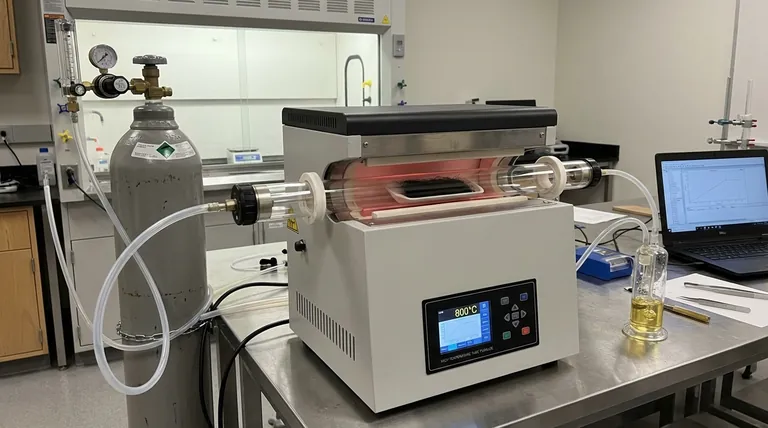
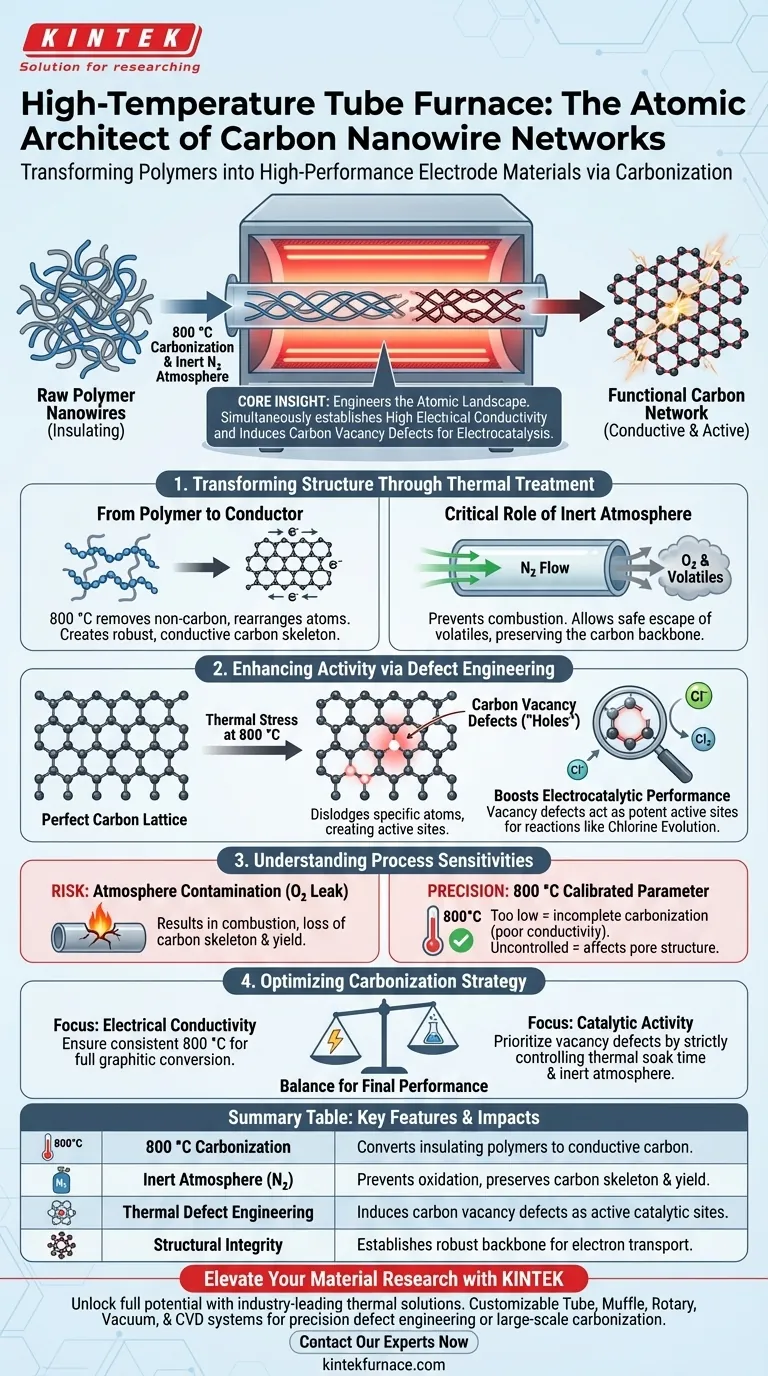
A high-temperature tube furnace serves as the critical transformative tool that converts insulating polymer structures into functional, high-performance electrode materials. By maintaining a stable temperature of 800 °C under a protective nitrogen atmosphere, the furnace carbonizes polypyrrole nanowires, fundamentally altering their atomic structure to create a highly conductive carbon network.
The Core Insight The tube furnace does not simply dry or harden the material; it engineers the atomic landscape. By facilitating carbonization in an inert environment, the process simultaneously establishes high electrical conductivity and induces carbon vacancy defects, which are the essential active sites required for efficient electrocatalytic chlorine evolution.
Transforming Structure Through Thermal Treatment
From Polymer to Conductor
The primary function of the furnace is to drive the carbonization process.
Polypyrrole nanowires are initially polymeric. Subjecting them to 800 °C removes non-carbon elements and rearranges the remaining atoms.
This transformation results in a robust carbon nanowire network that possesses the high electrical conductivity necessary for electron transport during electrochemical reactions.
The Critical Role of the Inert Atmosphere
The furnace must provide a strictly oxygen-free environment, typically using a constant flow of nitrogen.
Without this protective atmosphere, the organic precursors would simply burn (oxidize) rather than carbonize.
The inert gas allows volatile components to escape safely, leaving behind a stable carbon skeleton that serves as the physical backbone of the electrode.
Enhancing Activity via Defect Engineering
Inducing Carbon Vacancy Defects
Beyond simple carbonization, the high thermal energy within the tube furnace performs defect engineering.
At 800 °C, the thermal stress causes specific atoms to dislodge from the carbon lattice, creating "holes" known as carbon vacancy defects.
These are not structural failures; they are intentional features that alter the electronic properties of the material surface.
Boosting Electrocatalytic Performance
The defects created by the furnace significantly increase the material's chemical activity.
Specifically, these vacancy defects act as potent active sites for electrocatalytic chlorine evolution.
By disrupting the perfect carbon structure, the furnace ensures the resulting electrode is not just conductive, but chemically reactive where it matters most.
Understanding Process Sensitivities
The Risk of Atmosphere Contamination
If the tube furnace fails to maintain a strict inert atmosphere (leaking oxygen), the biomass or polymer will undergo combustion.
This results in the loss of the carbon skeleton and a dramatic reduction in the material's structural integrity and yield.
Temperature Precision
The specific temperature of 800 °C is a calibrated parameter, not a random setting.
Temperatures that are too low may result in incomplete carbonization, leading to poor conductivity.
Conversely, uncontrolled heating rates or incorrect temperatures can affect pore structure development, potentially limiting the surface area available for reactions.
Optimizing the Carbonization Strategy
To maximize the performance of carbon nanowire networks, align your thermal treatment with your specific material goals:
- If your primary focus is electrical conductivity: Ensure the furnace maintains a consistent high temperature (800 °C) to fully convert the polymer network into a graphitic-like carbon structure.
- If your primary focus is catalytic activity: Prioritize the creation of vacancy defects by strictly controlling the thermal soaking time and ensuring the atmosphere remains purely inert to protect these active sites.
Ultimately, the tube furnace acts as an atomic architect, balancing the creation of a conductive skeleton with the introduction of catalytic defects to define the material's final performance.
Summary Table:
| Feature | Impact on Carbon Nanowire Networks |
|---|---|
| 800 °C Carbonization | Converts insulating polymers into highly conductive carbon structures. |
| Inert Atmosphere (N2) | Prevents oxidation/combustion, preserving the carbon skeleton and yield. |
| Thermal Defect Engineering | Induces carbon vacancy defects that serve as active catalytic sites. |
| Structural Integrity | Establishes a robust physical backbone for efficient electron transport. |
Elevate Your Material Research with KINTEK
Unlock the full potential of your carbon nanowire networks with KINTEK’s industry-leading thermal solutions. Backed by expert R&D and precision manufacturing, KINTEK offers high-performance Tube, Muffle, Rotary, Vacuum, and CVD systems—all fully customizable to meet your specific research or production needs.
Whether you are focusing on atomic-level defect engineering or large-scale carbonization, our furnaces provide the temperature precision and atmosphere control essential for superior electrocatalytic results. Empower your lab with KINTEK today.
Visual Guide
References
- Cuinan Jiang, Lu Zheng. Carbon‐Based Flexible Electrode for Efficient Electrochemical Generation of Reactive Chlorine Species in Tumor Therapy. DOI: 10.1002/adhm.202500369
This article is also based on technical information from Kintek Furnace Knowledge Base .
Related Products
- 1400℃ High Temperature Laboratory Tube Furnace with Alumina Tube
- 1700℃ High Temperature Laboratory Tube Furnace with Alumina Tube
- 1200℃ Split Tube Furnace Laboratory Quartz Tube Furnace with Quartz Tube
- Vertical Laboratory Quartz Tube Furnace Tubular Furnace
- 1700℃ High Temperature Muffle Oven Furnace for Laboratory
People Also Ask
- How does zone-melting in tube furnaces synthesize bismuth micro-wires? Master Single-Crystal Thermoelectric Growth
- How are high-temp tube furnaces used to measure diffusion coefficients per Fick's law? Master Precision Annealing
- How do high-temperature laboratory tube furnaces ensure environmental stability? Precision Thermal Reduction Tips
- How are high-temperature laboratory tube furnaces applied in long-term vacuum homogenization heat treatments for intermetallic samples?
- How are high-temperature tube furnaces applied in testing ceramic-supported alloy membranes? Insights



















