
At their core, lab tube furnaces are defined by their maximum temperature, the diameter of their process tube, and the number of independent heating zones they possess. Typical specifications include working temperatures from 1200°C to 1700°C, tube outer diameters from Φ25mm to Φ100mm, and configurations with single, double, or three distinct temperature zones.
The choice of a lab tube furnace is a direct trade-off between the material you need to process (which dictates temperature), the size and volume of your sample (which dictates tube diameter), and the thermal precision you require (which dictates the number of heating zones).
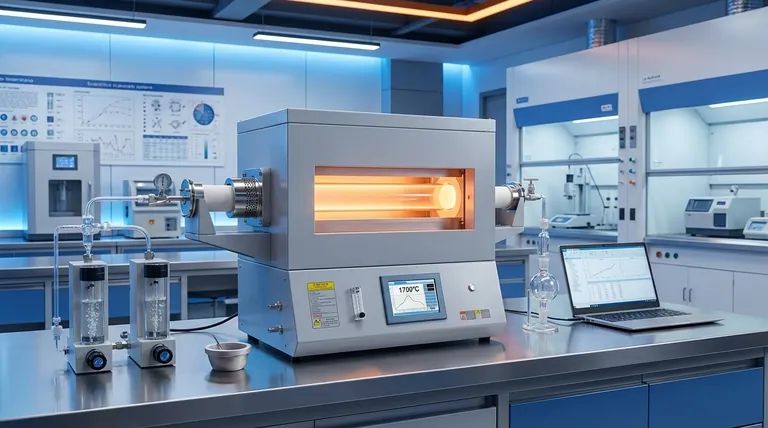
Core Performance Specifications
The performance of a tube furnace is determined by a few critical parameters. Understanding what each one enables is key to selecting the right instrument for your research or production goals.
Maximum Working Temperature
A furnace's peak temperature is its most fundamental specification. Models are commonly categorized by their maximum continuous working temperature, typically 1200°C, 1500°C, or 1700°C. This capability directly relates to the types of materials and processes you can perform, from basic drying and annealing to advanced material synthesis and sintering.
Furnace Tube Diameter
The tube diameter dictates the maximum size and volume of the sample you can process. Standard outer diameters range from a small Φ25mm for targeted experiments up to Φ100mm for larger samples or higher throughput applications.
Heating Zone Configuration
This is perhaps the most important specification for process control.
- Single-Zone: Provides a single, uniform hot zone. This is ideal for processes like annealing or calcination where the entire sample needs to be held at one consistent temperature.
- Multi-Zone (Double or Three): These furnaces have independently controlled heating sections. This allows for the creation of precise temperature gradients along the tube, which is essential for advanced applications like chemical vapor deposition (CVD) and crystal growth.
Heating Zone Length
The length of the heated section, which typically ranges from 150mm to 440mm, defines the physical space where your sample will experience the target temperature. A longer zone allows for processing larger samples or ensuring a more stable and uniform temperature profile in the center.
Key Physical and Design Specifications
Beyond raw performance, the physical design determines how the furnace integrates into your lab and what specific processes it is best suited for.
Furnace Orientation
Tube furnaces are commonly available in two primary orientations.
- Horizontal: This is the most common configuration, suitable for a wide range of general-purpose applications.
- Vertical: This design is ideal for processes involving melting, where gravity is beneficial, or for experiments where the sample should not touch the tube walls.
Specialized Furnace Types
While horizontal and vertical models cover many uses, highly specialized versions exist for specific applications. These include rotary furnaces for continuous mixing, high-pressure furnaces, and integrated systems for CVD or PECVD processes.
Materials and Safety Features
Modern furnaces are constructed from high-quality, heat-resistant materials to ensure stability and long-term reliability at extreme temperatures. Crucially, they incorporate integrated safety functions like over-temperature and over-pressure protection, which automatically shut down the system to prevent equipment failure and ensure user safety.
Understanding the Trade-offs
Selecting a furnace involves balancing capability, complexity, and cost. There is no single "best" model, only the one best suited for a specific task.
Single-Zone vs. Multi-Zone
The primary trade-off is simplicity versus control. A single-zone furnace is simpler, more affordable, and perfectly adequate for uniform heating. A multi-zone furnace provides unparalleled control over the thermal profile but is more complex to operate and represents a greater initial investment.
Temperature Capability vs. Cost
Higher maximum temperatures require more advanced (and expensive) heating elements and insulation materials. A 1700°C furnace is a significantly larger investment than a 1200°C model, so it's critical to choose a temperature range that matches your actual processing needs.
Tube Diameter vs. Thermal Uniformity
While a larger tube allows for bigger samples, achieving perfect temperature uniformity across a wider diameter can be more challenging. For applications demanding the highest precision, a smaller diameter tube often provides a more homogenous thermal environment.
Making the Right Choice for Your Application
Your ultimate goal should guide your selection of specifications.
- If your primary focus is uniform sample heating (e.g., annealing, calcination, sintering): A single-zone furnace with the appropriate temperature rating and tube diameter is the most direct and cost-effective solution.
- If your primary focus is creating precise thermal gradients (e.g., crystal growth, CVD): A multi-zone furnace is non-negotiable, as it provides the necessary control over the temperature profile.
- If your primary focus is processing large samples or maximizing throughput: Prioritize a larger furnace tube diameter (e.g., Φ100mm) and a longer heating zone.
- If your primary focus is melting materials or avoiding sample contact with the tube: A vertical furnace orientation is the ideal choice.
By matching the furnace's core specifications to your specific scientific or industrial goal, you ensure you are investing in the right tool for the job.
Summary Table:
| Specification | Typical Range | Key Impact |
|---|---|---|
| Max Working Temperature | 1200°C to 1700°C | Dictates material processing capabilities (e.g., annealing vs. sintering) |
| Tube Diameter (Outer) | Φ25mm to Φ100mm | Determines maximum sample size and volume |
| Heating Zones | Single, Double, or Three Zones | Controls thermal uniformity and gradient precision |
| Heating Zone Length | 150mm to 440mm | Defines sample processing space and temperature stability |
| Orientation | Horizontal or Vertical | Suits different applications (e.g., general use vs. melting) |
Need a lab tube furnace tailored to your exact requirements? At KINTEK, we understand that your research demands precision. Our expert team will help you select or customize a furnace—whether it's a Muffle, Tube, Rotary, Vacuum, or CVD system—to match your specific temperature, tube size, and heating zone needs. Backed by expert R&D and manufacturing, we ensure optimal performance for your unique applications. Contact us today for a personalized solution!
Visual Guide

Related Products
- 1400℃ High Temperature Laboratory Tube Furnace with Alumina Tube
- Laboratory Quartz Tube Furnace RTP Heating Tubular Furnace
- Laboratory Vacuum Tilt Rotary Tube Furnace Rotating Tube Furnace
- 1700℃ High Temperature Laboratory Tube Furnace with Alumina Tube
- 1200℃ Split Tube Furnace Laboratory Quartz Tube Furnace with Quartz Tube
People Also Ask
- How do high-temperature laboratory tube furnaces ensure environmental stability? Precision Thermal Reduction Tips
- How are high-temperature laboratory tube furnaces applied in long-term vacuum homogenization heat treatments for intermetallic samples?
- How are high-temperature tube furnaces applied in testing ceramic-supported alloy membranes? Insights
- How does a laboratory high-temperature tube furnace contribute to the conversion of electrospun fibers? Expert Insights
- What is the mechanism of a high-temperature furnace in Bi-2223 sintering? Achieve Precision Phase Transformation



















