
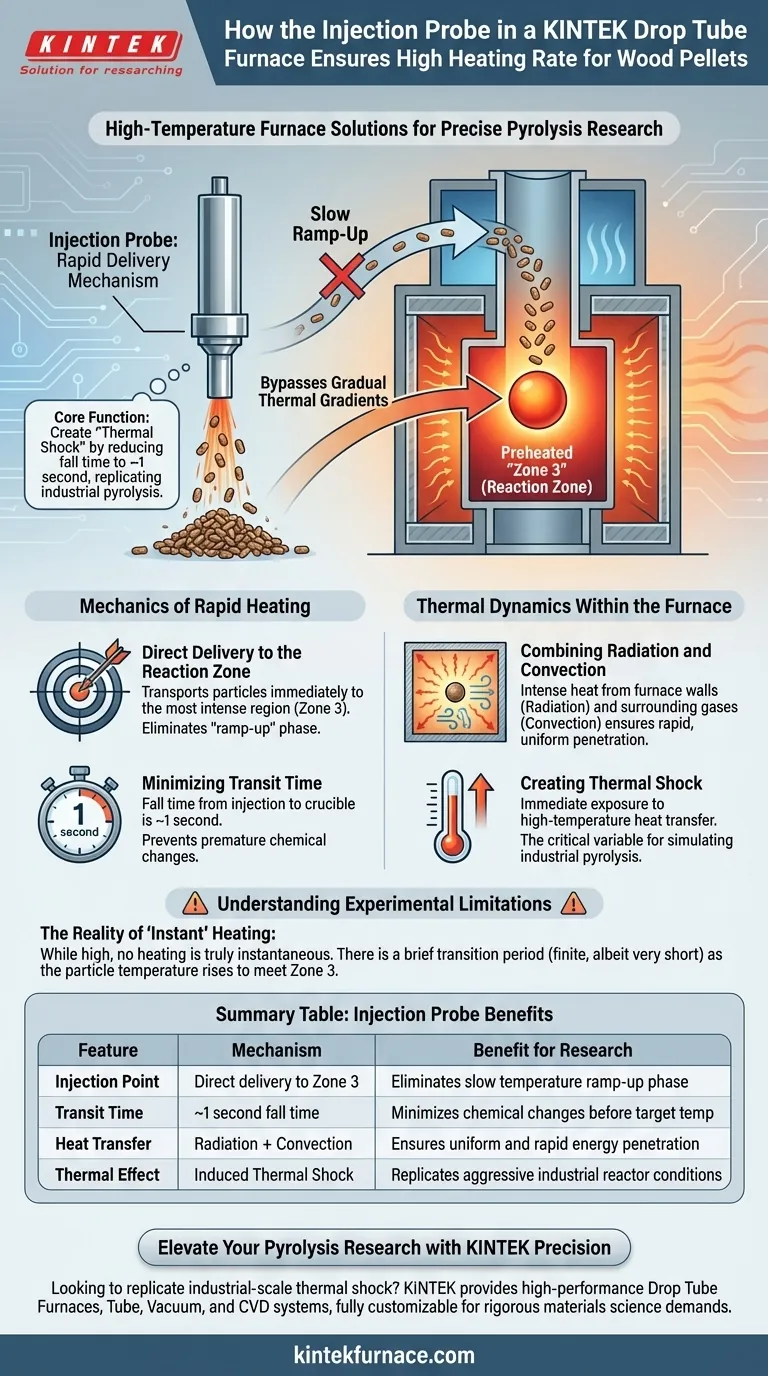
The injection probe functions as a rapid delivery mechanism that bypasses the gradual thermal gradients typically found in static furnace setups. By introducing wood pellets directly from the top of the furnace into a preheated "Zone 3," the probe ensures the material is exposed to peak temperatures almost instantly, rather than warming up slowly as it enters the unit.
The core function of the injection probe is to create "thermal shock" by reducing the particle's fall time to approximately one second. This replicates the aggressive heating conditions of industrial pyrolysis, which cannot be simulated by slowly introducing fuel into a hot zone.
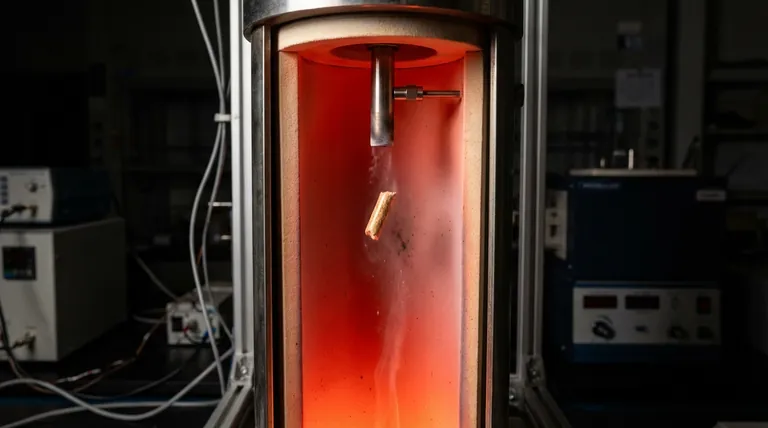
The Mechanics of Rapid Heating
Direct Delivery to the Reaction Zone
The injection probe is designed to transport particles immediately to the most intense region of the furnace.
Rather than allowing the wood pellets to travel through cooler entry zones, the probe delivers them directly into Zone 3, the preheated high-temperature reaction zone. This precise positioning eliminates the "ramp-up" phase that often skews experimental data in standard reactors.
Minimizing Transit Time
To achieve a high heating rate, the duration of the particle's exposure to intermediate temperatures must be negligible.
The design facilitates a fall time from the injection point to the crucible of approximately 1 second. This extremely short transit window prevents the pellet from undergoing significant chemical changes before it reaches the target reaction temperature.
Thermal Dynamics Within the Furnace
Combining Radiation and Convection
Once the probe releases the pellet into the reaction zone, the furnace utilizes two heat transfer modes simultaneously.
The particles are subjected to intense radiation from the furnace walls and convection from the surrounding gases. This dual-action heating ensures the thermal energy penetrates the wood pellet rapidly and uniformly.
Creating Thermal Shock
The combination of rapid positioning and immediate exposure to high-temperature heat transfer results in thermal shock.
This is the critical variable for valid experimentation. It effectively simulates the actual pyrolysis environment found in large-scale industrial furnaces, where fuel is injected directly into massive fireballs or fluidized beds.
Understanding Experimental Limitations
The Reality of "Instant" Heating
While the injection probe creates a high heating rate, it is important to recognize that no heating is truly instantaneous.
Even with a 1-second fall time, there is a brief transition period. Researchers must acknowledge that while this setup closely mimics industrial shock, there is still a finite (albeit very short) period where the particle temperature rises to meet the ambient temperature of Zone 3.
Making the Right Choice for Your Research
When evaluating if a Drop Tube Furnace with an injection probe is suitable for your work, consider your specific experimental goals.
- If your primary focus is simulating industrial pyrolysis: The injection probe is essential because it replicates the thermal shock and rapid decomposition found in commercial reactors.
- If your primary focus is slow combustion or torrefaction: This setup may be too aggressive, as the high heating rate bypasses the gradual drying and warming phases relevant to those processes.
The injection probe effectively acts as a kinetic switch, allowing you to bypass thermal inertia and capture the physics of high-energy reactions.
Summary Table:
| Feature | Mechanism | Benefit for Research |
|---|---|---|
| Injection Point | Direct delivery to Zone 3 | Eliminates the slow temperature ramp-up phase |
| Transit Time | ~1 second fall time | Minimizes chemical changes before target temp |
| Heat Transfer | Radiation + Convection | Ensures uniform and rapid energy penetration |
| Thermal Effect | Induced Thermal Shock | Replicates aggressive industrial reactor conditions |
Elevate Your Pyrolysis Research with KINTEK Precision
Are you looking to replicate industrial-scale thermal shock in a laboratory environment? KINTEK provides high-performance Drop Tube Furnaces, Tube, Vacuum, and CVD systems designed to meet the rigorous demands of modern material science.
Backed by expert R&D and manufacturing, our high-temperature furnaces are fully customizable to your unique research needs, ensuring your wood pellet or fuel analysis is precise and scalable. Contact KINTEK today to discuss how our specialized injection probes and customizable furnace solutions can accelerate your experimental breakthroughs.
Visual Guide
References
- Guillaume Gerandi, Valérie Tschamber. Particulate and gaseous emissions during combustion of wood pellets under low and high heating rates in a drop tube furnace. DOI: 10.2139/ssrn.5600417
This article is also based on technical information from Kintek Furnace Knowledge Base .
Related Products
- Vacuum Sealed Continuous Working Rotary Tube Furnace Rotating Tube Furnace
- Slide PECVD Tube Furnace with Liquid Gasifier PECVD Machine
- Custom Made Versatile CVD Tube Furnace Chemical Vapor Deposition CVD Equipment Machine
- 1200℃ Split Tube Furnace Laboratory Quartz Tube Furnace with Quartz Tube
- Laboratory Vacuum Tilt Rotary Tube Furnace Rotating Tube Furnace
People Also Ask
- What is the purpose of rotary tube furnaces? Achieve Uniform Heat Treatment for Powders and Granules
- What are the key advantages of using a rotary tube furnace? Achieve Dynamic, Uniform Heating for Powders
- How does the amount of material processed vary between batch and continuous rotary tube furnaces? Scale Your Production Efficiently
- What are the advantages of rotary tube furnaces in fuel compatibility? Boost Efficiency and Cut Costs
- What is the temperature range of some rotary tube furnaces? Achieve Uniform Heating Up to 1200°C



















