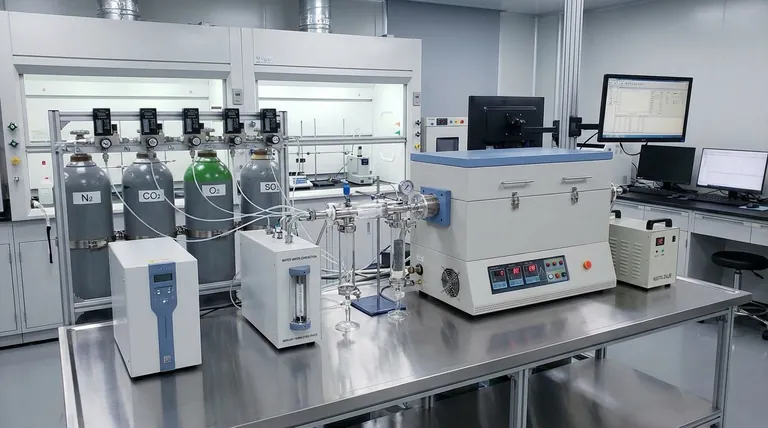
A fixed-bed reactor system reproduces the complex chemistry of flue gas by integrating precision flow controllers to mix carrier gases like N2, CO2, and O2 with reactive contaminants such as SO2 and water vapor. It simultaneously introduces elemental mercury via permeation tubes and maintains specific temperatures, such as 80 °C, to create a realistic testing ground for verifying the practical efficacy of adsorbent materials.
While simple lab tests might measure mercury capture in isolation, this system mimics the "crowded" chemical environment of real coal combustion. It determines if an adsorbent can maintain its efficiency when forced to compete with acidic gases for the same pore structures.
Replicating the Chemical Environment
To accurately evaluate performance, the system must move beyond simple air mixtures and recreate the specific gas matrix found in industrial outputs.
Precision Gas Mixing
The foundation of the simulation is the precise blending of bulk gases.
Mass flow controllers regulate the introduction of Nitrogen (N2), Carbon Dioxide (CO2), and Oxygen (O2). This creates the volumetric baseline of the flue gas stream.
Introducing Reactive Contaminants
Real-world complexity comes from impurities that interfere with adsorption.
The system injects Sulfur Dioxide (SO2) and water vapor (H2O) into the stream. These components are critical because they compete chemically with mercury for binding sites on the adsorbent.
Mercury Generation
To simulate the pollutant target, the system utilizes mercury permeation tubes.
These devices release a controlled, constant rate of elemental mercury into the gas stream, ensuring the concentration levels match those typically found in coal combustion emissions.
Evaluating Performance Mechanisms
The physical conditions of the reactor are just as critical as the chemical composition for gathering actionable data.
Thermal Regulation
The reactor operates at controlled temperatures, specifically targeting 80 °C in standard configurations.
This temperature replicates the thermal conditions found in specific downstream sections of a power plant, ensuring the adsorbent is tested under realistic thermal stress.
Competitive Adsorption Analysis
The core purpose of this setup is to verify competitive adsorption mechanisms.
The system tests whether the pore structure of the carbon material will be blocked by acidic gases (like SO2) or if it can successfully select and trap mercury despite the interference.
Understanding the Trade-offs
While a fixed-bed reactor is a powerful tool for simulation, it is essential to understand the limitations of this testing method.
Static vs. Dynamic Evaluation
A fixed-bed system holds the adsorbent stationary while gas passes through it.
This is excellent for studying chemical kinetics and pore utilization, but it does not simulate the physical attrition or movement an adsorbent might face in a fluid-bed system or injection process.
Idealized Mixing
The gas mixture, while complex, is perfectly controlled.
Real-world flue gas may contain unexpected spikes in concentration or particulate matter (fly ash) that this clean simulation does not account for, potentially overestimating adsorbent lifespan.
Making the Right Choice for Your Goal
When reviewing data from a fixed-bed reactor system, tailor your interpretation to your specific engineering needs.
- If your primary focus is material selection: Prioritize data showing high mercury uptake in the presence of high SO2 concentrations to ensure the material resists acidic interference.
- If your primary focus is process optimization: Examine the performance data at 80 °C to verify the material remains active at the specific thermal window of your facility.
The value of this system lies in its ability to predict not just if a material captures mercury, but how it handles the chemical competition of a real industrial environment.
Summary Table:
| Feature | Component/Parameter | Function in Simulation |
|---|---|---|
| Gas Matrix | N2, CO2, O2 | Creates the volumetric baseline of flue gas. |
| Contaminants | SO2, Water Vapor (H2O) | Simulates chemical competition for adsorbent pores. |
| Pollutant Target | Mercury Permeation Tubes | Provides controlled, constant release of elemental mercury. |
| Temperature | Controlled (e.g., 80 °C) | Replicates realistic thermal stress of power plant environments. |
| Analysis Focus | Pore Structure Efficiency | Evaluates resistance to acidic gas interference. |
Maximize Your Research Precision with KINTEK
Don't settle for simplified testing—achieve realistic results with laboratory systems designed for industrial complexity. Backed by expert R&D and world-class manufacturing, KINTEK provides high-performance solutions including Muffle, Tube, Rotary, Vacuum, and CVD systems, as well as specialized high-temp furnaces for environmental simulation.
Whether you are evaluating material selection or optimizing chemical kinetics, our systems are fully customizable to meet your unique mercury adsorption or thermal processing needs.
Ready to elevate your lab’s capabilities?
Contact our experts today to find the perfect reactor system for your application.
Visual Guide

References
- M. Antonia López-Antón, Ana Arenillas. Mercury Removal by Carbon Materials with Emphasis on the SO <sub>2</sub> –Porosity Relationship. DOI: 10.1002/open.202500190
This article is also based on technical information from Kintek Furnace Knowledge Base .
Related Products
- MPCVD Machine System Reactor Bell-jar Resonator for Lab and Diamond Growth
- Custom Made Versatile CVD Tube Furnace Chemical Vapor Deposition CVD Equipment Machine
- 915MHz MPCVD Diamond Machine Microwave Plasma Chemical Vapor Deposition System Reactor
- Slide PECVD Tube Furnace with Liquid Gasifier PECVD Machine
- Cylindrical Resonator MPCVD Machine System for Lab Diamond Growth
People Also Ask
- What are the essential components of an MPCVD reactor system? Build a Pristine Environment for High-Purity Materials
- How does pressure affect the MPCVD growth process? Master Plasma Control for Superior Film Quality
- How do carbon-containing groups contribute to diamond growth in the MPCVD method? Unlock High-Quality Diamond Synthesis
- Why is temperature control important in the MPCVD growth process? Ensure High-Quality, Reliable Diamond Film Deposition
- What are the key components of an MPCVD system? Unlock High-Purity Crystal Growth