
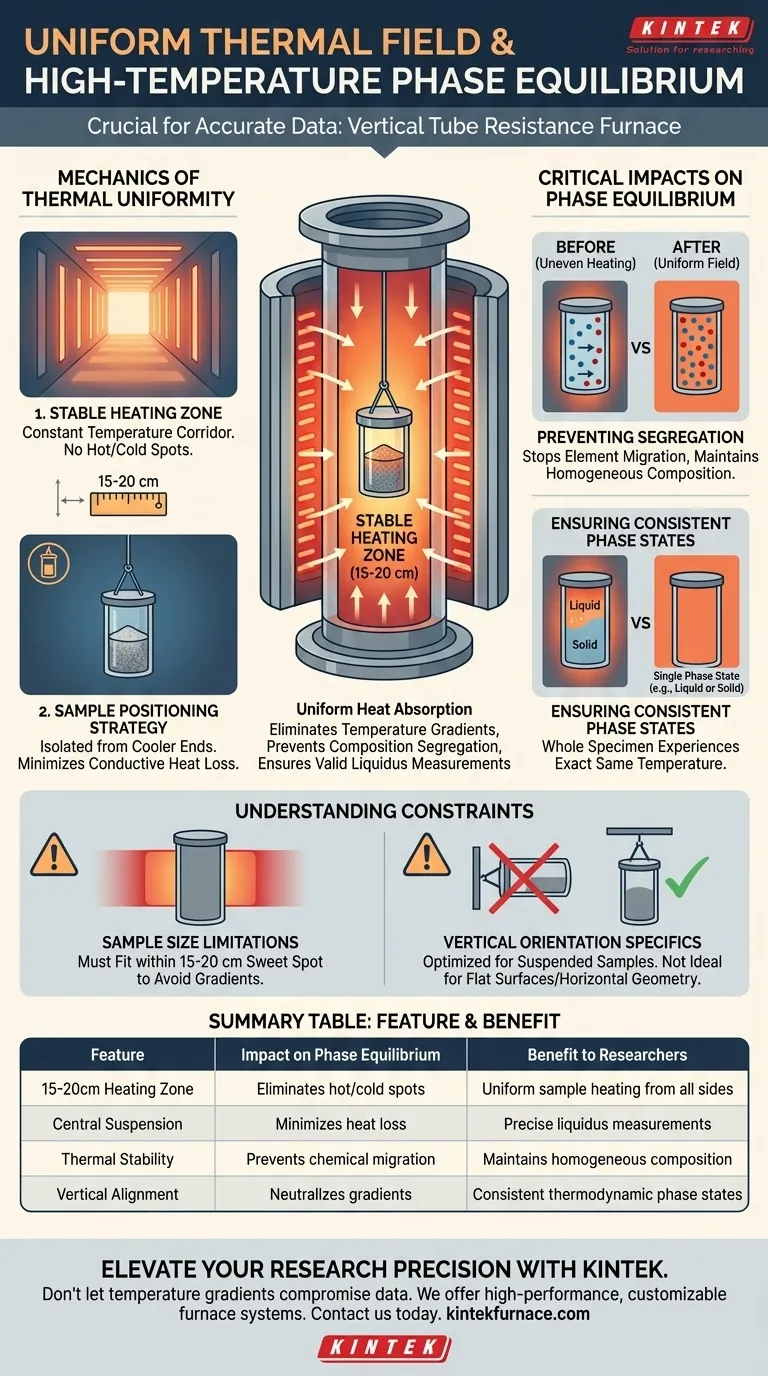
The uniform thermal field provided by a vertical tube resistance furnace creates a consistent temperature environment crucial for accurate phase equilibrium data. By utilizing a stable heating zone of 15 to 20 centimeters, this apparatus ensures that samples suspended in the center are heated evenly from all sides. This uniformity eliminates temperature gradients that would otherwise distort experimental results.
In high-temperature experiments, temperature gradients are the enemy of precision. A vertical tube furnace neutralizes this threat by maintaining a uniform thermal field, preventing composition segregation and ensuring valid liquidus temperature measurements.
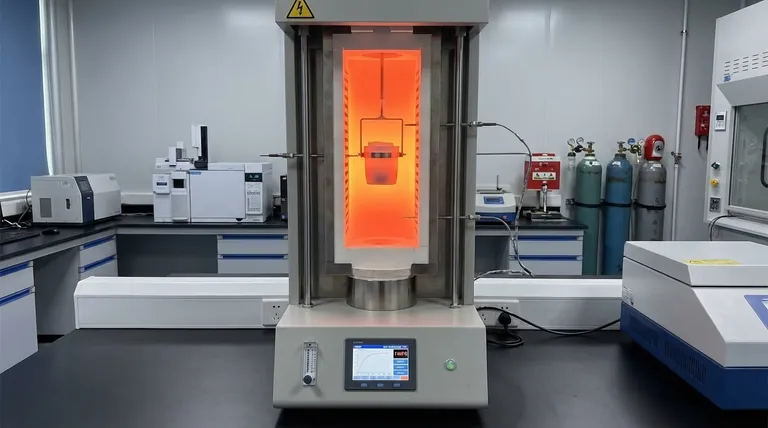
The Mechanics of Thermal Uniformity
The Role of the Heating Zone
To achieve precise data, the furnace generates a specific region of stability. This heating zone typically spans 15 to 20 centimeters in length.
Within this vertical corridor, often powered by lanthanum chromite heating elements, the temperature remains constant. This eliminates the "hot spots" or "cold spots" frequently found in less specialized equipment.
Sample Positioning Strategy
The physical placement of the sample is just as critical as the heat generation.
By suspending the specimen in the exact center of this stable zone, the experimenter isolates it from the cooler ends of the tube. This ensures the sample absorbs thermal energy uniformly, rather than conductively losing heat to a mounting stage.
Critical Impacts on Phase Equilibrium
Preventing Composition Segregation
One of the primary risks in high-temperature equilibrium experiments is the migration of chemical components.
If a sample is heated unevenly, thermal gradients can drive mass transport, causing elements to segregate. A uniform thermal field prevents this migration, ensuring the chemical composition remains homogeneous throughout the experiment.
Ensuring Consistent Phase States
For phase equilibrium, the entire sample must exist in the same thermodynamic state at the same time.
Without a uniform field, one end of a sample could be liquid while the other remains solid. This vertical tube setup guarantees that the whole specimen experiences the exact same temperature, preventing inconsistent phase states.
Understanding the Constraints
Sample Size Limitations
While the 15 to 20-centimeter zone is highly stable, it imposes a strict limit on sample dimensions.
If a sample is too large or elongated, its edges may extend outside this "sweet spot." This would reintroduce the very temperature gradients the furnace is designed to eliminate.
Vertical Orientation Specifics
The vertical design is optimized for suspended samples, which is ideal for equilibrium studies.
However, this orientation may not be suitable for experiments requiring flat liquid surfaces or specific substrate interactions that rely on horizontal geometry.
Making the Right Choice for Your Goal
To maximize the reliability of your high-temperature data, apply these principles:
- If your primary focus is determining liquidus temperatures: Rely on the central suspension method to eliminate thermal gradients that artificially shift melting points.
- If your primary focus is preventing chemical variance: Ensure your sample fits entirely within the 15-20 cm uniform zone to stop composition segregation before it starts.
Precision in phase equilibrium is not just about reaching high temperatures; it is about controlling them completely.
Summary Table:
| Feature | Impact on Phase Equilibrium | Benefit to Researchers |
|---|---|---|
| 15-20cm Heating Zone | Eliminates hot/cold spots within the stable corridor | Ensures uniform sample heating from all sides |
| Central Suspension | Minimizes conductive heat loss to mounting stages | Isolates sample for precise liquidus measurements |
| Thermal Stability | Prevents mass transport and chemical migration | Maintains homogeneous composition throughout |
| Vertical Alignment | Neutralizes temperature gradients along the tube axis | Guarantees consistent thermodynamic phase states |
Elevate Your Research Precision with KINTEK
Don't let temperature gradients compromise your high-temperature phase equilibrium data. At KINTEK, we understand that precision is non-negotiable. Backed by expert R&D and manufacturing, we offer high-performance Tube, Muffle, Rotary, Vacuum, and CVD systems—all customizable to provide the uniform thermal fields your unique lab needs require.
Ready to eliminate thermal inconsistency? Contact us today to discover how our high-temperature furnaces can ensure the integrity of your experimental results.
Visual Guide
References
- Hamed Abdeyazdan, Evgueni Jak. Phase equilibria in the CuO <sub>0.5</sub> –SbO <sub>1.5</sub> –SiO <sub>2</sub> system. DOI: 10.1111/jace.70123
This article is also based on technical information from Kintek Furnace Knowledge Base .
Related Products
- Vertical Laboratory Quartz Tube Furnace Tubular Furnace
- Custom Made Versatile CVD Tube Furnace Chemical Vapor Deposition CVD Equipment Machine
- Slide PECVD Tube Furnace with Liquid Gasifier PECVD Machine
- High Pressure Laboratory Vacuum Tube Furnace
- Vacuum Sealed Continuous Working Rotary Tube Furnace Rotating Tube Furnace
People Also Ask
- What are the key differences between single-zone and multi-zone vertical tube furnaces? Choose the Right Furnace for Your Lab
- How are metal support wires selected for sample suspension? Expert Guide to High-Temp Furnace Materials
- What is a vertical tube furnace and how does it function? Optimize Material Processing with Precision
- How does a vertical single-temperature zone tube furnace facilitate the growth of high-quality PdSe2 single crystals?
- How are wafers loaded and unloaded in a vertical tube furnace? Achieve Precision and Purity in Wafer Processing


















