
The primary function of the vacuum tube furnace in this specific context is to serve as a controlled pyrolysis chamber. By maintaining a precise temperature of 500 °C within a vacuum or inert atmosphere, the furnace strictly regulates oxygen exposure during the final synthesis stage. This environment is critical for solidifying iron elements onto the activated carbon surface without destroying the carbon substrate or altering the desired iron phase.
The vacuum tube furnace acts as a protective barrier against uncontrolled oxidation, ensuring the successful formation of the magnetic Fe3O4 phase while preventing the combustion of the activated carbon support. This dual protection is essential for creating a composite that is both catalytically active and magnetically recoverable.
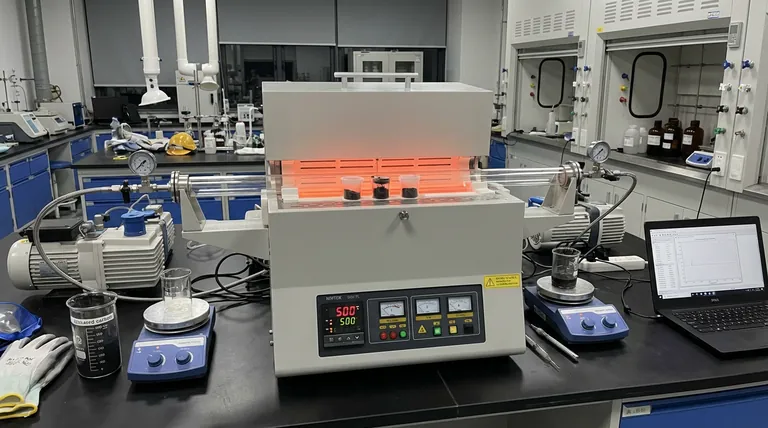
Controlling the Chemical Environment
Preventing Substrate Combustion
The core material of the catalyst is Coconut Shell Activated Carbon (CSAC). At the required treatment temperature of 500 °C, carbon is highly reactive with oxygen.
Without the vacuum or inert atmosphere provided by the tube furnace, the activated carbon would combust (burn away), leaving behind only ash. The furnace ensures the carbon support remains intact to host the catalytic sites.
Stabilizing the Magnetic Phase
The specific goal of this synthesis is to produce Fe3O4 (magnetite). This phase is crucial because it allows the catalyst to be easily recovered from solutions using a magnet.
If oxygen levels were uncontrolled, the iron oxides could further oxidize into Fe2O3 (hematite) or other non-magnetic phases. The vacuum environment halts oxidation at the precise Fe3O4 stage, locking in the material's magnetic recovery performance.
The Mechanics of Solidification
Precise Thermal Pyrolysis
The furnace provides a stable thermal environment at exactly 500 °C. This temperature is the activation energy threshold required for the final pyrolysis step.
At this temperature, the precursors on the carbon surface undergo chemical changes that fix the iron oxides permanently to the substrate.
Ensuring Component Integration
The process is not just about heating; it is about solidification. The furnace ensures that the iron elements physically and chemically bond with the activated carbon surface.
This integration results in a durable composite material where the magnetic particles do not detach during catalytic reactions.
Understanding the Trade-offs
Vacuum Integrity vs. Inert Gas Flow
While the primary reference highlights the vacuum capability, these furnaces often support inert gas flow (like Nitrogen or Argon). A pure vacuum offers the lowest oxygen contamination but removes convective heat transfer.
Using an inert gas can improve temperature uniformity across the tube but introduces a risk of trace oxygen impurities if the gas source is not high-purity.
Temperature Sensitivity
The 500 °C setpoint is a critical parameter, not a suggestion.
If the temperature is too low, the iron oxides may not fully solidify or crystallize into the Fe3O4 phase, leading to leaching during use. If the temperature is too high, even in a vacuum, there is a risk of sintering the nanoparticles, which reduces surface area and lowers catalytic activity.
Optimizing the Synthesis Protocol
To achieve the best results with Fe3O4@CSAC catalysts, consider the following operational priorities:
- If your primary focus is Magnetic Recovery: Prioritize the integrity of the vacuum seal to rigorously exclude oxygen and prevent the formation of non-magnetic hematite.
- If your primary focus is Catalytic Activity: Focus on the precision of the heating ramp and the stability of the 500 °C dwell time to ensure uniform active site distribution.
The vacuum tube furnace ultimately serves as the "gatekeeper" of the synthesis, determining whether the final product is a high-performance catalyst or merely a mixture of burnt carbon and rust.
Summary Table:
| Process Parameter | Role in Catalyst Synthesis | Impact on Final Product |
|---|---|---|
| Vacuum/Inert Atmos. | Prevents oxidation of Fe3O4 & CSAC | Ensures magnetic recovery & substrate integrity |
| 500 °C Setpoint | Activation energy for pyrolysis | Fixes iron oxides to carbon without sintering |
| Controlled Heating | Solidification of iron elements | Durable bonding to prevent leaching during use |
| Thermal Stability | Regulates chemical environment | Maintains high surface area and catalytic activity |
Elevate Your Catalyst Synthesis with KINTEK Precision
Maximize the performance of your Fe3O4@CSAC composites with high-purity thermal environments. Backed by expert R&D and world-class manufacturing, KINTEK offers specialized Muffle, Tube, Rotary, Vacuum, and CVD systems tailored for critical pyrolysis and solidification stages. Whether you require rigorous oxygen exclusion or precise ramp-rate control, our lab high-temp furnaces are fully customizable to meet your unique research needs.
Ready to optimize your magnetic catalyst production? Contact KINTEK today to discuss your custom furnace solution!
References
- Ke Zhang, Yuntao Yan. Preparation of Fe<sub>3</sub>O<sub>4</sub>@CSAC catalyst and its degradation performance and heat release mechanisms in sewage degradation. DOI: 10.1039/d4ra00080c
This article is also based on technical information from Kintek Furnace Knowledge Base .
Related Products
- Vacuum Hot Press Furnace Machine Heated Vacuum Press Tube Furnace
- High Pressure Laboratory Vacuum Tube Furnace
- Vacuum Sealed Continuous Working Rotary Tube Furnace Rotating Tube Furnace
- Laboratory Vacuum Tilt Rotary Tube Furnace Rotating Tube Furnace
- Magnesium Extraction and Purification Condensing Tube Furnace
People Also Ask
- Why use Vacuum Hot Press (VHP) for ZnS Ceramics? Achieve Superior IR Transparency and Mechanical Strength
- What are the benefits of the vacuum environment system in a vacuum hot press furnace? Unlock High-Density Sintering
- What safety features are incorporated in vacuum hot press furnaces? Ensure Operator and Equipment Protection
- What control features does a vacuum hot press furnace offer? Precision Control for Advanced Materials Processing
- How have vacuum hot press furnaces transformed material processing? Achieve Superior Density and Purity



















