
High-temperature tube furnaces are critical for converting lignin into carbon fiber because they provide a strictly controlled environment that prevents combustion while forcing structural evolution. A pure nitrogen atmosphere protects the fibers from oxidizing (burning) at temperatures ranging from 500°C to over 1000°C, while precise temperature ramp rates—specifically around 3°C/min—ensure that non-carbon elements volatilize slowly, resulting in a dense, highly graphitized, and thermally stable structure.
Core Takeaway: The quality of carbonized lignin fibers depends on a delicate balance: the nitrogen atmosphere acts as a protective shield to prevent the material from turning to ash, while the heating profile acts as a controlled stressor that drives the atomic rearrangement necessary for high conductivity and mechanical strength.
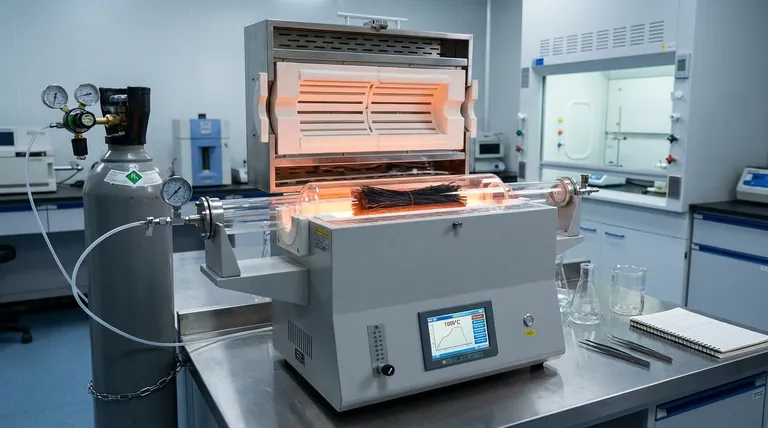
The Critical Role of the Nitrogen Atmosphere
Preventing Oxidative Combustion
At temperatures as low as 500°C, lignin fibers are highly susceptible to oxidation. Without a protective barrier, the high heat required for carbonization would simply burn the fibers.
Creating an Inert Reaction Zone
A continuous flow of pure nitrogen displaces oxygen within the tube. This creates an inert environment where the fibers can endure temperatures up to 1000°C (and potentially higher) without degrading.
Enabling Elemental Elimination
By preventing reaction with external oxygen, the nitrogen atmosphere forces the material to look "inward." This allows the fiber to shed non-carbon atoms—specifically nitrogen, oxygen, and hydrogen—that are naturally present in the lignin precursor.
Impact of Temperature Control and Heating Rates
The Importance of Slow Heating
The heating rate is a decisive factor in fiber quality. A controlled rate of approximately 3°C/min is recommended.
Avoiding Structural Damage
Rapid heating can cause non-carbon elements to gasify and expand too quickly within the fiber. This internal pressure can crack or shatter the fiber structure. A slow ramp allows these volatiles to escape gradually, preserving the fiber's integrity.
The Function of Dwell Time
Holding the temperature steady (dwell time) for 30 to 90 minutes is essential. This duration provides the necessary thermal energy for carbon atoms to rearrange themselves.
Driving Graphitization
During this dwell period, the remaining carbon atoms align into an ordered structure. This process, known as graphitization, transforms the disordered lignin into a turbostratic graphite structure, significantly increasing density and thermal stability.
Understanding the Trade-offs and Pitfalls
Thermal Field Uniformity
It is not enough to simply reach a high temperature; the heat must be evenly distributed. Thermal field uniformity ensures that every inch of the fiber experiences the same conditions, preventing weak spots or inconsistencies in the final mechanical integrity.
The Risk of Skipping Stabilization
While the user question focuses on the nitrogen/carbonization phase, strictly applying high heat and nitrogen to raw lignin can cause melting. Fibers must often undergo a thermal stabilization phase in air first to become thermoset, preventing them from fusing together during the nitrogen carbonization stage.
Balancing Conductivity vs. Brittleness
Higher temperatures (up to 1800°C) and longer dwell times generally yield higher conductivity and purer carbon content. However, pushing these parameters too far without precise control can lead to excessive brittleness in the final fiber.
Making the Right Choice for Your Goal
To optimize your lignin carbonization process, align your furnace settings with your desired outcome:
- If your primary focus is Structural Integrity: Prioritize a slower heating rate (e.g., 3°C/min) and ensure your furnace has exceptional thermal uniformity to prevent micro-cracking.
- If your primary focus is Electrical Conductivity: Aim for higher carbonization temperatures (1000°C+) and longer dwell times to maximize graphitization and the removal of non-carbon elements.
- If your primary focus is Process Yield: Ensure strictly controlled nitrogen flow to prevent even trace amounts of oxygen from entering the chamber and reducing your fiber mass to ash.
Success lies in the precision of the heating curve—treating the furnace not just as an oven, but as an instrument for atomic realignment.
Summary Table:
| Parameter | Role in Lignin Carbonization | Impact on Fiber Quality |
|---|---|---|
| Nitrogen Atmosphere | Prevents oxidative combustion & removes non-carbon atoms | High carbon purity and dense, stable structure |
| Heating Rate (3°C/min) | Controls volatilization of internal gases | Prevents structural cracking; ensures fiber integrity |
| Dwell Time (30-90 min) | Provides energy for atomic rearrangement | Enhances graphitization, density, and stability |
| Temperature (1000°C+) | Drives the graphitization process | Maximizes electrical conductivity and thermal resistance |
Elevate Your Advanced Material Research with KINTEK
Precise control over thermal profiles and atmospheric purity is the difference between brittle ash and high-performance carbon fiber. Backed by expert R&D and manufacturing, KINTEK offers high-precision Tube, Muffle, Rotary, Vacuum, and CVD systems designed to meet the rigorous demands of lignin carbonization.
Whether you require exceptional thermal field uniformity for structural integrity or high-temperature capabilities for maximum conductivity, our lab furnaces are fully customizable for your unique research needs.
Ready to optimize your carbonization process? Contact our technical specialists today to find the perfect heating solution for your lab.
References
- Changyu Shen, Jun Li. Investigation on spinnability of low molecular weight alkaline lignin to fabricate biobased carbon fiber. DOI: 10.15251/djnb.2024.191.417
This article is also based on technical information from Kintek Furnace Knowledge Base .
Related Products
- 1400℃ High Temperature Laboratory Tube Furnace with Alumina Tube
- 1700℃ High Temperature Laboratory Tube Furnace with Alumina Tube
- 1200℃ Split Tube Furnace Laboratory Quartz Tube Furnace with Quartz Tube
- High Temperature Muffle Oven Furnace for Laboratory Debinding and Pre Sintering
- Vertical Laboratory Quartz Tube Furnace Tubular Furnace
People Also Ask
- How does zone-melting in tube furnaces synthesize bismuth micro-wires? Master Single-Crystal Thermoelectric Growth
- How are high-temperature laboratory tube furnaces applied in long-term vacuum homogenization heat treatments for intermetallic samples?
- How are high-temp tube furnaces used to measure diffusion coefficients per Fick's law? Master Precision Annealing
- How do high-temperature laboratory tube furnaces ensure environmental stability? Precision Thermal Reduction Tips
- How are high-temperature tube furnaces applied in testing ceramic-supported alloy membranes? Insights



















