
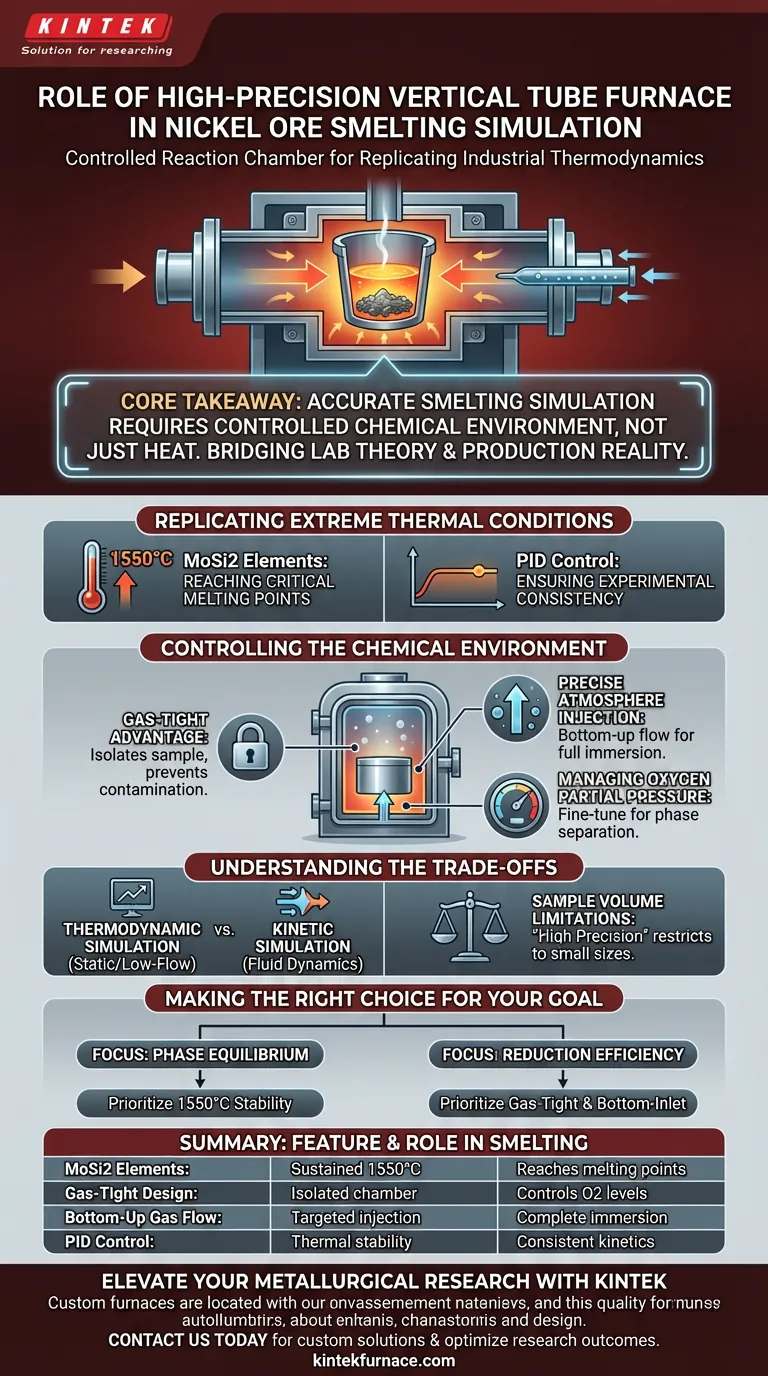
The primary role of a high-precision vertical tube furnace in nickel ore smelting is to act as a strictly controlled reaction chamber that replicates industrial thermodynamics. By utilizing specialized Molybdenum Disilicide (MoSi2) heating elements, this equipment provides the extreme thermal stability required to melt ore samples while simultaneously managing the complex gas atmospheres needed for chemical reduction.
Core Takeaway To simulate industrial smelting accurately, heat alone is insufficient; you must control the chemical environment. This furnace bridges the gap between laboratory theory and production reality by maintaining temperatures up to 1550°C and enabling precise regulation of oxygen partial pressure and reducing atmospheres.
Replicating Extreme Thermal Conditions
To understand the value of this equipment, one must look beyond simple heating. The success of a smelting simulation depends on the stability and intensity of the thermal environment.
Reaching Critical Melting Points
Nickel ore smelting requires temperatures that exceed the capabilities of standard laboratory ovens. The vertical tube furnace uses Molybdenum Disilicide (MoSi2) heating elements to achieve and sustain a high-temperature range of 1550°C.
Ensuring Experimental Consistency
In reliable simulations, temperature fluctuations can ruin data regarding reaction kinetics. This furnace is designed to stably maintain high heat, ensuring that the ore remains in the correct molten phase for the duration of the experiment.
Controlling the Chemical Environment
The most distinct advantage of a high-precision vertical tube furnace is its ability to manipulate the atmosphere surrounding the sample. Smelting is not just melting; it is a chemical reduction process.
The Gas-Tight Advantage
Industrial smelting relies on specific gas mixtures to reduce oxides into metal. This furnace features a gas-tight design that isolates the sample from the ambient lab environment, preventing contamination.
Precise Atmosphere Injection
To simulate the reducing conditions of a blast or electric furnace, gases are introduced through the bottom of the tube. This bottom-up flow ensures the sample is fully immersed in the required gas mixture.
Managing Oxygen Partial Pressure
The separation of nickel from slag is heavily dependent on oxygen partial pressure. This equipment allows researchers to fine-tune this variable, recreating the exact thermodynamic conditions found in large-scale processing.
Understanding the Trade-offs
While this equipment is essential for thermodynamic simulation, it is important to recognize its limitations compared to industrial operations.
Thermodynamic vs. Kinetic Simulation
This furnace excels at simulating thermodynamics (temperature and chemical equilibrium). However, because it is a static or low-flow environment, it may not perfectly replicate the physical fluid dynamics and mass transfer rates of a churning industrial furnace.
Sample Volume Limitations
The "high precision" nature of the equipment generally restricts it to small sample sizes. While this allows for exact control, it means the results must be carefully extrapolated when applying them to bulk processing scenarios.
Making the Right Choice for Your Goal
When designing your experiment, consider which variables are most critical to your data set.
- If your primary focus is Phase Equilibrium: Prioritize the furnace's ability to hold a steady 1550°C, as temperature stability is the deciding factor in phase separation.
- If your primary focus is Reduction Efficiency: Focus on the gas-tight capabilities and bottom-gas inlet systems to strictly control oxygen partial pressure.
By leveraging the high-temperature stability and atmospheric precision of this furnace, you transform a basic heating test into a rigorous simulation of industrial metallurgy.
Summary Table:
| Feature | Role in Smelting Simulation | Benefit |
|---|---|---|
| MoSi2 Elements | Sustained heat up to 1550°C | Reaches critical melting points for nickel ore |
| Gas-Tight Design | Isolated reaction chamber | Prevents contamination and controls oxygen levels |
| Bottom-Up Gas Flow | Targeted atmosphere injection | Ensures complete sample immersion in reducing gases |
| PID Control | Thermal stability and precision | Guarantees consistent reaction kinetics and data |
Elevate Your Metallurgical Research with KINTEK
Precise smelting simulations require more than just heat; they demand absolute control over the thermal and chemical environment. Backed by expert R&D and manufacturing, KINTEK offers high-performance Muffle, Tube, Rotary, Vacuum, and CVD systems, as well as other lab high-temperature furnaces, all fully customizable for your unique mineral processing needs.
Whether you are refining nickel ore or developing new alloys, our equipment provides the 1550°C stability and gas-tight precision necessary to bridge the gap between lab theory and industrial production. Contact us today to discuss your custom furnace requirements and optimize your research outcomes!
Visual Guide
References
- Erdenebold Urtnasan, Jei‐Pil Wang. Artificial Slags with Modulated Properties for Controlled Nickel Dissolution in Smelting Process. DOI: 10.1007/s12666-024-03304-0
This article is also based on technical information from Kintek Furnace Knowledge Base .
Related Products
- Vertical Laboratory Quartz Tube Furnace Tubular Furnace
- High Pressure Laboratory Vacuum Tube Furnace
- Custom Made Versatile CVD Tube Furnace Chemical Vapor Deposition CVD Equipment Machine
- 1700℃ High Temperature Laboratory Tube Furnace with Alumina Tube
- 1400℃ High Temperature Laboratory Tube Furnace with Alumina Tube
People Also Ask
- What are the key differences between single-zone and multi-zone vertical tube furnaces? Choose the Right Furnace for Your Lab
- How does a vertical tube furnace achieve precise temperature control? Unlock Superior Thermal Stability for Your Lab
- How are wafers loaded and unloaded in a vertical tube furnace? Achieve Precision and Purity in Wafer Processing
- How does a vertical single-temperature zone tube furnace facilitate the growth of high-quality PdSe2 single crystals?
- What are the main characteristics of vertical tube furnaces? Optimize Your Lab with Space-Saving, Uniform Heating



















