
A high-temperature tube reactor system serves as a precision simulator for industrial operating conditions by integrating high-precision mass flow controllers with dedicated water pumps. This hardware combination synthesizes complex tail gas environments—specifically mixtures of oxygen, water vapor, and nitrous oxide (N2O)—to replicate the harsh realities of industrial processing within a controlled laboratory setting.
The core value of this system lies in its ability to decouple variables; it provides a stable thermal field alongside precise chemical inputs to rigorously test catalyst longevity and resistance to poisoning before full-scale deployment.
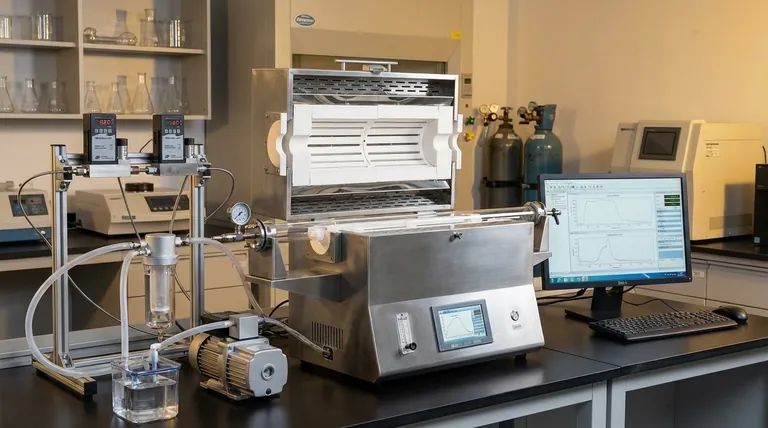
Recreating the Chemical Environment
To evaluate an egg-shell catalyst effectively, you must move beyond simple air-flow tests and replicate the "dirty" air of a factory.
Precision Gas Formulation
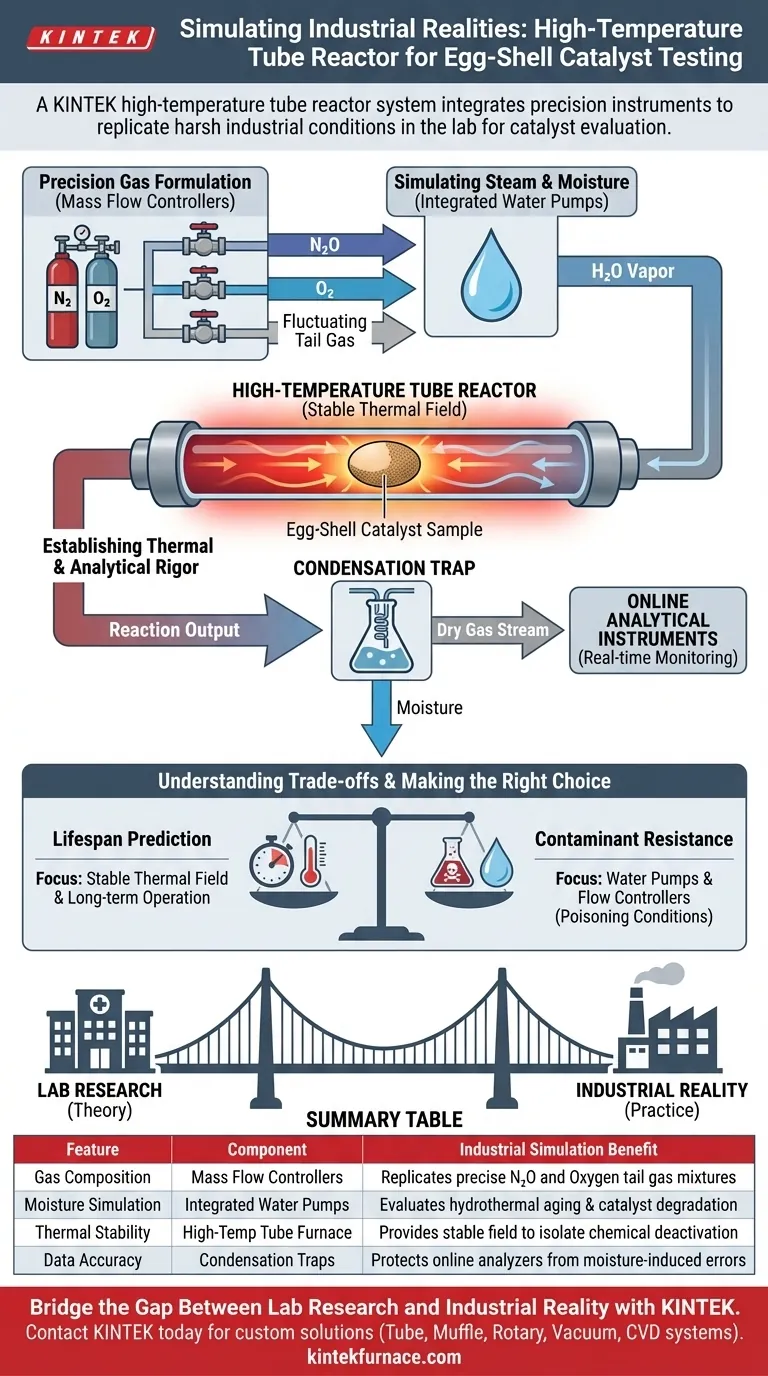
The system utilizes high-precision mass flow controllers to dictate the exact composition of the gas stream.
This allows researchers to introduce specific concentrations of N2O and oxygen, mimicking the fluctuating tail gas found in industrial output.
Simulating Steam and Moisture
Industrial environments rarely consist of dry gas; they often contain significant water vapor which can accelerate catalyst degradation.
Integrated water pumps inject precise amounts of moisture into the system, ensuring the test environment accounts for the hydrothermal aging effects common in real-world operations.
Establishing Thermal and Analytical Rigor
Simulating the gas mixture is only half the battle; the physical conditions of the reactor must also remain constant to yield usable data.
The Stable Thermal Field
The tube reactor is designed to maintain a stable thermal field throughout the testing duration.
This stability is critical for distinguishing between thermal degradation of the catalyst and chemical deactivation caused by the gas mixture.
Protecting Analytical Integrity
To measure performance, the system employs online analytical instruments that monitor reaction outputs in real-time.
However, because the simulation uses water vapor, condensation traps are essential to remove moisture before the gas reaches the analyzers, ensuring the data remains accurate and the equipment undamaged.
Understanding the Trade-offs
While this system provides a high-fidelity simulation, it is important to recognize the inherent challenges in high-temperature testing.
Complexity of "Wet" Simulations
Introducing water vapor via pumps adds a layer of complexity compared to dry testing.
You must rely on the condensation traps functioning perfectly; if they fail, moisture can enter the online analyzers, leading to erratic data or equipment failure.
The Scope of Simulation
The system excels at simulating chemical composition and temperature, specifically for tail gas environments containing N2O.
However, it is a specialized tool; its accuracy is defined by the precision of the flow controllers and the stability of the heating element. Any drift in these components directly impacts the validity of the "industrial" simulation.
Making the Right Choice for Your Goal
When designing your evaluation protocol, consider which variable matters most to your specific industrial application.
- If your primary focus is Lifespan Prediction: Rely on the stable thermal field and long-term operation capabilities to identify thermal degradation over extended periods.
- If your primary focus is Contaminant Resistance: Utilize the water pumps and flow controllers to create "poisoning conditions," stressing the catalyst with high moisture and N2O loads.
Ultimately, this system bridges the gap between theory and practice by subjecting catalysts to the exact thermal and chemical stresses they will face in the field.
Summary Table:
| Feature | Component | Industrial Simulation Benefit |
|---|---|---|
| Gas Composition | Mass Flow Controllers | Replicates precise N2O and Oxygen tail gas mixtures |
| Moisture Simulation | Integrated Water Pumps | Evaluates hydrothermal aging and catalyst degradation |
| Thermal Stability | High-Temp Tube Furnace | Provides a stable field to isolate chemical deactivation |
| Data Accuracy | Condensation Traps | Protects online analyzers from moisture-induced errors |
Bridge the Gap Between Lab Research and Industrial Reality
Don't let unpredictable industrial variables compromise your research. At KINTEK, we understand that evaluating catalyst longevity requires a perfect balance of thermal stability and precise chemical control. Backed by expert R&D and manufacturing, KINTEK offers Tube, Muffle, Rotary, Vacuum, and CVD systems, all fully customizable to simulate the exact thermal and chemical stresses of your field environment.
Whether you are predicting catalyst lifespan or testing contaminant resistance, our high-temperature laboratory furnaces provide the precision you need. Contact KINTEK today to discuss your custom reactor needs and ensure your materials are ready for full-scale deployment.
Visual Guide
References
- Eun-Han Lee, Shin‐Kun Ryi. Quick drying process: a promising strategy for preparing an egg-shell-type Cu/γ-Al <sub>2</sub> O <sub>3</sub> catalyst for direct N <sub>2</sub> O decomposition. DOI: 10.1039/d4ta07764d
This article is also based on technical information from Kintek Furnace Knowledge Base .
Related Products
- 1400℃ High Temperature Laboratory Tube Furnace with Alumina Tube
- 1700℃ High Temperature Laboratory Tube Furnace with Alumina Tube
- 1200℃ Split Tube Furnace Laboratory Quartz Tube Furnace with Quartz Tube
- Vertical Laboratory Quartz Tube Furnace Tubular Furnace
- Custom Made Versatile CVD Tube Furnace Chemical Vapor Deposition CVD Equipment Machine
People Also Ask
- How does zone-melting in tube furnaces synthesize bismuth micro-wires? Master Single-Crystal Thermoelectric Growth
- How do high-temperature laboratory tube furnaces ensure environmental stability? Precision Thermal Reduction Tips
- How are high-temp tube furnaces used to measure diffusion coefficients per Fick's law? Master Precision Annealing
- How are high-temperature laboratory tube furnaces applied in long-term vacuum homogenization heat treatments for intermetallic samples?
- How are high-temperature tube furnaces applied in testing ceramic-supported alloy membranes? Insights



















