
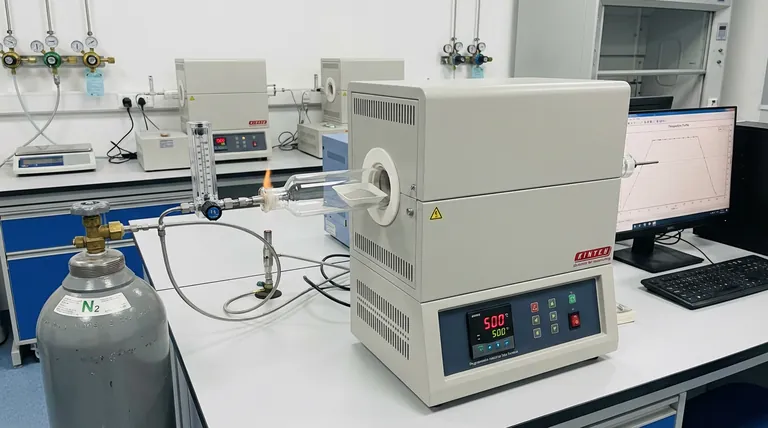
The use of an industrial-grade programmable tube furnace with nitrogen control is essential to precisely manage the thermal decomposition of precursors while protecting the catalyst's chemical integrity. This equipment setup maintains a constant nitrogen flow to actively purge volatile waste gases generated during pyrolysis, while the programmable heating profile ensures the nickel (NiO) and tungsten (WOx) oxides stabilize into the specific crystalline phases required for effective catalysis.
Success in synthesizing Ni-WOx/SAPO-11 catalysts relies on strictly separating precursor decomposition from uncontrolled oxidation. The nitrogen atmosphere creates a protective barrier that removes volatile byproducts, while the furnace's precise thermal regulation establishes the stable crystalline foundation necessary for subsequent reduction steps.
The Critical Role of Nitrogen Atmosphere
Efficient Removal of Pyrolysis Waste
During the calcination process at 500 °C, the catalyst precursors undergo pyrolysis, breaking down chemically. A constant, controlled flow of nitrogen is required to efficiently sweep away the waste gases resulting from this decomposition. Without this flow, volatile byproducts could linger near the catalyst surface, potentially re-depositing or interfering with the formation of clean active sites.
Preventing Unwanted Phase Transitions
The chemical environment during calcination defines the final state of the metal oxides. The nitrogen atmosphere excludes oxygen and other reactive gases, preventing unwanted phase transitions in the metal oxides. This ensures that the nickel oxide (NiO) and tungsten oxides (WOx) form correctly, rather than oxidizing further or interacting unpredictably with atmospheric contaminants.
The Necessity of Industrial-Grade Programmable Control
Establishing a Stable Crystalline Foundation
The primary goal of this calcination step is not just to dry the material, but to establish a stable crystalline phase foundation. The industrial-grade nature of the furnace ensures uniform heat distribution, guaranteeing that the NiO and WOx structures are consistent throughout the entire batch. This structural uniformity is a prerequisite for the subsequent reduction steps to be effective.
Enabling Downstream Reduction
The calcination phase dictates the success of the following reduction stage. By using a programmable furnace to lock in the correct oxide phases at 500 °C, you prepare the tungsten species for the precise valence adjustment (creating W5+ and W6+ sites) that occurs later. If the initial oxide foundation is flawed due to poor thermal control, the downstream generation of Bronsted acid sites—critical for breaking bonds—will be compromised.
Understanding the Trade-offs
The Risk of Thermal Overshoot
While high temperatures are necessary for calcination, a lack of programmable control introduces significant risk. If the furnace temperature fluctuates or rises uncontrollably (e.g., toward 700 °C), the tungsten species may suffer from excessive reduction or phase segregation. This alters the distribution of acid centers, fundamentally changing the catalytic activity and rendering the catalyst ineffective for its intended chemical processes.
Atmosphere Sensitivity
Reliance on a nitrogen atmosphere creates a dependency on gas purity and flow consistency. If the nitrogen flow is interrupted or contains impurities, the inert environment is breached. As seen in similar processes with carbon-based supports, the presence of oxygen at high temperatures can lead to oxidative side reactions or burnout, destroying the catalyst structure before it is even fully formed.
Making the Right Choice for Your Goal
To ensure the Ni-WOx/SAPO-11 catalyst performs optimally, align your equipment settings with your specific processing objectives:
- If your primary focus is Phase Purity: Ensure the nitrogen flow rate is calibrated to completely evacuate pyrolysis gases without creating turbulence that disrupts the powder bed.
- If your primary focus is Catalytic Activity: Prioritize the precision of the temperature ramp and hold times to 500 °C to guarantee the correct crystalline foundation for the eventual creation of Bronsted acid sites.
Precision in the calcination stage is the single most important factor in defining the potential activity of the final catalyst.
Summary Table:
| Feature | Requirement | Impact on Catalyst Performance |
|---|---|---|
| Atmosphere | Controlled Nitrogen Flow | Purges pyrolysis waste and prevents unwanted oxidation |
| Temperature | Stable 500 °C (Programmable) | Establishes critical NiO/WOx crystalline foundation |
| Heating Ramp | Precise & Uniform | Prevents phase segregation and thermal overshoot |
| Goal | Phase Stability | Ensures successful downstream reduction and Brønsted acidity |
Maximize Your Catalytic Yield with KINTEK Precision
Don't let thermal fluctuations or atmospheric impurities compromise your research. Backed by expert R&D and manufacturing, KINTEK offers high-performance Muffle, Tube, Rotary, Vacuum, and CVD systems, all customizable to meet your specific Ni-WOx/SAPO-11 synthesis requirements. Our industrial-grade programmable furnaces provide the precise thermal regulation and atmosphere control needed to secure stable crystalline phases and optimal Brønsted acid sites.
Ready to elevate your lab's high-temperature processing? Contact KINTEK Today to Customize Your Solution
References
- Tong Su, Longlong Ma. Directed hydrogenolysis of “cellulose-to-ethylene glycol” using a Ni–WO<sub><i>x</i></sub> based catalyst. DOI: 10.1039/d5ra01528f
This article is also based on technical information from Kintek Furnace Knowledge Base .
Related Products
- 1200℃ Controlled Inert Nitrogen Atmosphere Furnace
- 1400℃ Controlled Inert Nitrogen Atmosphere Furnace
- 1700℃ Controlled Inert Nitrogen Atmosphere Furnace
- Controlled Inert Nitrogen Hydrogen Atmosphere Furnace
- Mesh Belt Controlled Atmosphere Furnace Inert Nitrogen Atmosphere Furnace
People Also Ask
- What controlled-atmosphere furnace conditions are required for sintering powder metallurgy copper alloy compacts? Ideal Setup
- What are the operational advantages of using a controlled atmosphere furnace? Boost Quality and Efficiency in Heat Treatment
- Why is a controlled atmosphere furnace required for 316L debinding? Ensure Structural Integrity & Zero Cracks
- Why is uniform atmosphere flow important in a controlled atmosphere furnace? Ensure Consistent Results and Avoid Costly Failures
- What causes discrepancies between theoretical and experimental grain boundary mobility during ceramic sintering? Explained



















