
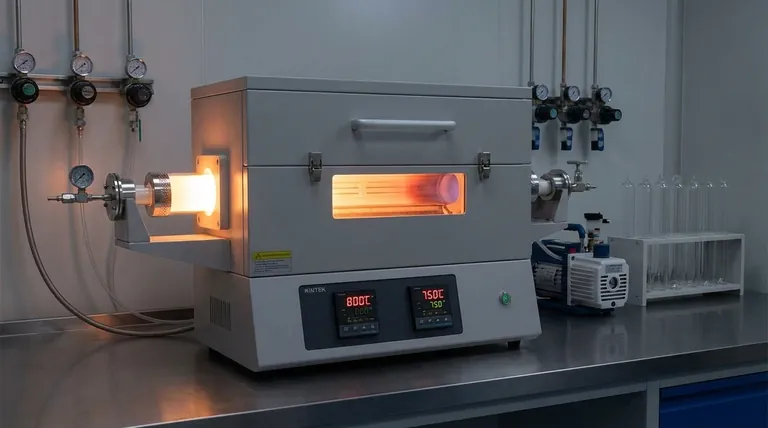
The primary function of a gradient temperature horizontal furnace is to create the specific thermodynamic environment required to grow Fe4GeTe2 single crystals via the Chemical Vapor Transport (CVT) method. By establishing a precise temperature difference—typically 800°C at the source end and 750°C at the growth end—the furnace acts as the kinetic engine that drives material transport within a sealed quartz tube.
The furnace does not merely heat the materials; it establishes a critical temperature gradient that forces gas-phase precursors to migrate from a hot source zone to a cooler growth zone. This thermal difference is the fundamental driving force for crystallization, directly dictating the quality and size of the final product.
The Mechanics of Chemical Vapor Transport (CVT)
Establishing the Driving Force
The furnace is designed to maintain two distinct thermal zones across the length of a sealed quartz tube.
The "source end" is heated to a higher temperature, such as 800°C.
Simultaneously, the "growth end" is maintained at a lower temperature, typically around 750°C.
Facilitating Gas-Phase Migration
This specific temperature difference creates a kinetic driving force inside the tube.
At the hot source end, the solid raw materials react to form gas-phase precursors.
Driven by the thermal gradient, these gases naturally migrate toward the cooler end of the tube.
Supersaturation and Crystallization
Once the gas-phase precursors reach the cooler growth end, the drop in temperature causes a state of supersaturation.
This forces the materials to transition back from gas to solid.
The result is the slow, organized deposition of material, leading to the formation of Fe4GeTe2 single crystals.
The Critical Role of Precision
Determining Crystal Quality
The capability of the furnace to hold a stable temperature is not a minor detail; it is the deciding factor in the experiment's success.
High-precision temperature control ensures that the rate of crystallization remains steady.
This directly influences the final dimensions and structural integrity of the crystal.
Regulating Growth Speed
The process relies on slow crystallization to produce high-quality samples.
If the furnace creates a stable gradient, the crystal lattice can form with fewer defects.
Fluctuations in furnace temperature can disrupt this growth, leading to smaller or lower-quality crystals.
Understanding the Trade-offs
Kinetics vs. Quality
While the temperature gradient drives the process, a larger gradient does not always equal better results.
Increasing the temperature difference might speed up transport, but it can compromise the "slow crystallization" required for high quality.
The trade-off is often between the speed of production and the structural perfection of the single crystal.
Optimizing the Growth Environment
To achieve the best results in Fe4GeTe2 preparation, you must align the furnace settings with your specific quality requirements.
- If your primary focus is maximizing crystal size: Prioritize a furnace with exceptional thermal stability to maintain a slow, uninterrupted growth rate over a long duration.
- If your primary focus is establishing transport: Ensure the gradient is strictly maintained at the recommended 50°C difference (800°C to 750°C) to provide sufficient kinetic energy for the precursors.
Ultimately, the gradient temperature furnace provides the precise thermodynamic landscape necessary to transform raw components into structured, high-quality materials.
Summary Table:
| Feature | Specification/Role in Fe4GeTe2 Growth |
|---|---|
| Methodology | Chemical Vapor Transport (CVT) |
| Source Zone Temp | Approximately 800°C (Volatilization) |
| Growth Zone Temp | Approximately 750°C (Crystallization) |
| Thermal Gradient | ∆T ≈ 50°C (Kinetic Driving Force) |
| Key Outcome | Controlled supersaturation for high-purity crystals |
| Success Factor | Precise temperature stability for defect-free lattices |
Elevate Your Materials Synthesis with KINTEK
Precise thermal gradients are the heartbeat of high-quality crystal growth. Backed by expert R&D and world-class manufacturing, KINTEK offers high-performance Muffle, Tube, Rotary, Vacuum, and CVD systems tailored for complex processes like Chemical Vapor Transport.
Whether you need standard horizontal furnaces or fully customizable high-temp systems for unique laboratory requirements, our technology ensures the stability and precision your research demands.
Ready to optimize your Fe4GeTe2 production? Contact us today to find your perfect furnace solution!
References
- Riju Pal, Atindra Nath Pal. Spin-reorientation driven emergent phases and unconventional magnetotransport in quasi-2D vdW ferromagnet Fe4GeTe2. DOI: 10.1038/s41699-024-00463-y
This article is also based on technical information from Kintek Furnace Knowledge Base .
Related Products
- 1700℃ High Temperature Laboratory Tube Furnace with Alumina Tube
- 2200 ℃ Graphite Vacuum Heat Treat Furnace
- 1700℃ Controlled Inert Nitrogen Atmosphere Furnace
- 1700℃ High Temperature Muffle Oven Furnace for Laboratory
- 1400℃ High Temperature Laboratory Tube Furnace with Alumina Tube
People Also Ask
- How does zone-melting in tube furnaces synthesize bismuth micro-wires? Master Single-Crystal Thermoelectric Growth
- How are high-temperature laboratory tube furnaces applied in long-term vacuum homogenization heat treatments for intermetallic samples?
- How do high-temperature laboratory tube furnaces ensure environmental stability? Precision Thermal Reduction Tips
- How are high-temp tube furnaces used to measure diffusion coefficients per Fick's law? Master Precision Annealing
- How are high-temperature tube furnaces applied in testing ceramic-supported alloy membranes? Insights














