
A high-temperature tube furnace provides a critical dual-controlled environment consisting of precise thermal regulation and strict inert atmosphere protection. Specifically, it maintains a continuous nitrogen flow while executing a controlled heating ramp of 10 °C/min up to a target temperature of 265 °C. These conditions are mandatory to induce solid-state cross-linking in CPOF-4 and CPOF-5 without damaging the organic framework.
The success of this process hinges on balancing reaction activation with material preservation. The tube furnace facilitates crystal-to-crystal transformation by protecting the sample from oxidation while delivering the exact energy required to polymerize ethynyl groups within a restricted lattice.
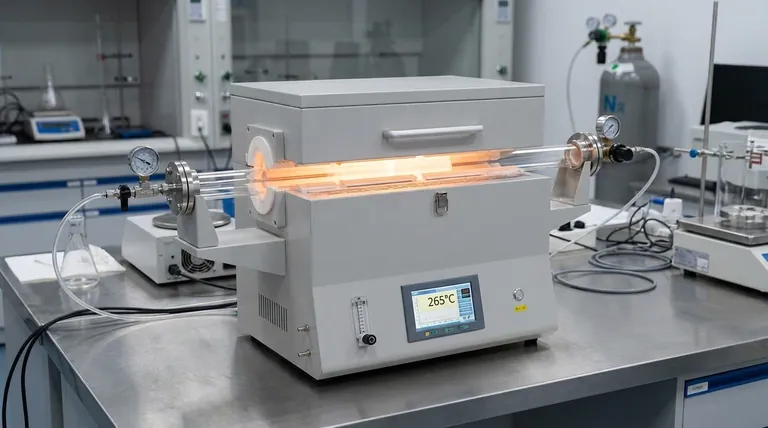
The Necessity of Inert Atmosphere Protection
Prevention of Oxidative Degradation
At the elevated temperatures required for cross-linking, organic frameworks are highly susceptible to burning or degrading if exposed to oxygen.
The tube furnace mitigates this risk by maintaining a constant flow of nitrogen.
Ensuring Chemical Purity
By displacing air with an inert gas, the furnace ensures that the thermal energy drives only the intended cross-linking reaction.
This protection allows the material to withstand 265 °C for several hours without undergoing unwanted chemical decomposition.
Precision Thermal Regulation
The Importance of the Heating Rate
The process utilizes a specific heating rate of 10 °C/min.
This controlled ramp prevents thermal shock to the crystals as they approach the reaction temperature.
Achieving the Activation Threshold
The furnace targets a precise temperature of 265 °C.
This specific thermal environment provides the necessary activation energy to trigger the polymerization of the ethynyl groups.
Sustaining the Reaction Window
The temperature must be maintained for several hours to allow the reaction to reach completion.
Stability at this high temperature is crucial for ensuring the entire bulk of the material undergoes the transformation.
Mechanism of Crystal-to-Crystal Transformation
Reaction within Restricted Spaces
The tube furnace environment enables chemistry to occur within the restricted lattice space of the COFs.
Because the material remains in a solid state, the framework itself acts as a scaffold for the reaction.
Polymerization of Ethynyl Groups
The heat induces the ethynyl groups on the framework to cross-link.
Because the lattice restricts movement, these groups are forced to polymerize in a specific, ordered manner, resulting in a robust crystal-to-crystal transformation.
Operational Risks and Trade-offs
Sensitivity to Atmospheric Integrity
The most critical failure point in this process is a breach in the inert atmosphere.
Even minor oxygen leaks at 265 °C can lead to rapid oxidative degradation, destroying the crystalline structure rather than strengthening it.
Adherence to Thermal Parameters
Deviating from the prescribed 10 °C/min ramp or the 265 °C target introduces significant risk.
Inaccurate temperature control can result in incomplete cross-linking (if too low) or thermal decomposition of the organic linkers (if too high).
Ensuring Successful Cross-Linking
To replicate the successful transformation of CPOF-4 and CPOF-5, you must strictly adhere to the established environmental parameters.
- If your primary focus is preserving structural integrity: Prioritize the continuity and purity of the nitrogen flow to prevent any oxidative damage during the heating cycle.
- If your primary focus is maximizing reaction conversion: Ensure your equipment can maintain the precise 265 °C target for the full duration required to polymerize the ethynyl groups.
Precision in both atmosphere and temperature is not optional; it is the physical requirement for solid-state polymerization in these materials.
Summary Table:
| Parameter | Requirement | Purpose |
|---|---|---|
| Atmosphere | Continuous Nitrogen Flow | Prevents oxidative degradation & ensures chemical purity |
| Heating Rate | 10 °C/min | Prevents thermal shock to crystals during ramp-up |
| Target Temp | 265 °C | Provides activation energy for ethynyl polymerization |
| Process State | Solid-state | Enables crystal-to-crystal transformation in restricted lattice |
| Hold Time | Several Hours | Ensures complete bulk material transformation |
Elevate Your Materials Research with KINTEK Precision
Achieving the delicate balance required for crystal-to-crystal transformations in CPOF materials demands uncompromising environmental control. At KINTEK, we specialize in providing high-performance laboratory solutions tailored for advanced chemical synthesis.
Why choose KINTEK for your high-temperature processes?
- Expert R&D & Manufacturing: Our systems are engineered for stability, offering the precise heating ramps and airtight inert atmosphere seals critical for organic framework integrity.
- Versatile Solutions: Whether you require Tube, Muffle, Rotary, Vacuum, or CVD systems, our furnaces provide the exact thermal environment your research requires.
- Fully Customizable: We tailor our equipment to meet your unique temperature and atmospheric specifications, ensuring your materials never face oxidative risk.
Ready to optimize your solid-state cross-linking yields? Contact our experts today to find the perfect furnace for your lab!
References
- Dan Wen, Teng Ben. Catalyst-free solid-state cross-linking of covalent organic frameworks in confined space. DOI: 10.20517/cs.2023.45
This article is also based on technical information from Kintek Furnace Knowledge Base .
Related Products
- 1400℃ High Temperature Laboratory Tube Furnace with Alumina Tube
- 1700℃ High Temperature Laboratory Tube Furnace with Alumina Tube
- 1200℃ Split Tube Furnace Laboratory Quartz Tube Furnace with Quartz Tube
- Vertical Laboratory Quartz Tube Furnace Tubular Furnace
- 1700℃ High Temperature Muffle Oven Furnace for Laboratory
People Also Ask
- How does zone-melting in tube furnaces synthesize bismuth micro-wires? Master Single-Crystal Thermoelectric Growth
- How are high-temp tube furnaces used to measure diffusion coefficients per Fick's law? Master Precision Annealing
- How do high-temperature laboratory tube furnaces ensure environmental stability? Precision Thermal Reduction Tips
- How are high-temperature laboratory tube furnaces applied in long-term vacuum homogenization heat treatments for intermetallic samples?
- How are high-temperature tube furnaces applied in testing ceramic-supported alloy membranes? Insights



















