
A vacuum tube furnace creates a strictly controlled, oxygen-free high-vacuum environment. During the preparation of C@TiC nanoparticles, this apparatus maintains high vacuum levels while reaching temperatures as high as 1500 °C to facilitate the pyrolysis of titanium-based metal-organic framework (Ti-MOF) precursors.
Core Takeaway: The vacuum tube furnace functions as a protective exclusion chamber. By eliminating oxygen during high-temperature pyrolysis, it prevents the chemical degradation of reactive titanium and carbon, ensuring the formation of a precise core/shell nanoparticle structure rather than unwanted oxides.
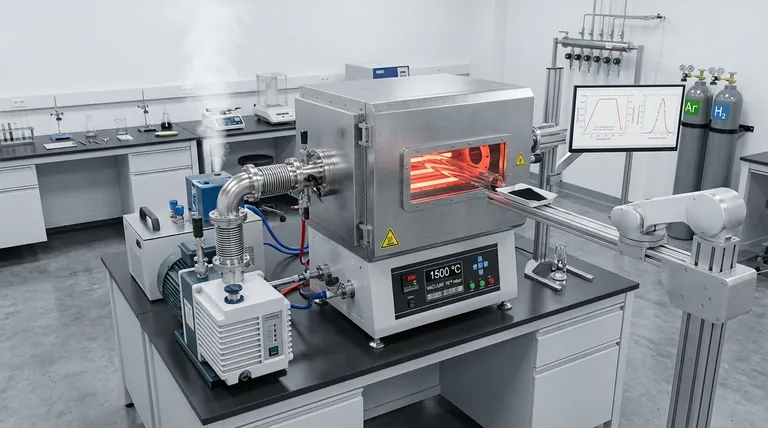
The Critical Role of the Vacuum Environment
Preventing Unintended Oxidation
The primary function of the vacuum environment is chemical isolation. At the elevated temperatures required for synthesis (up to 1500 °C), both titanium and carbon are highly reactive with oxygen.
Without a high vacuum, the titanium would rapidly oxidize into titanium dioxide, and the carbon shell would burn off as carbon dioxide. The vacuum ensures that the precursors remain chemically pure, allowing the metallic core and carbon shell to form correctly.
Facilitating MOF Pyrolysis
The synthesis relies on the thermal decomposition (pyrolysis) of Ti-MOF precursors. This process requires intense heat to break down the organic framework and reorganize the atoms into the desired C@TiC structure.
The vacuum environment allows this thermal breakdown to occur in a reductive atmosphere purely driven by heat, rather than a combustion reaction driven by air.
Thermal Precision and Structural Integrity
Achieving High-Temperature Stability
To synthesize C@TiC nanoparticles, the system must maintain extreme temperatures stably. The tube furnace provides a consistent thermal zone capable of reaching 1500 °C.
This high thermal ceiling is necessary to fully graphitize the carbon shell and crystallize the titanium carbide core.
Controlling Particle Formation
While the vacuum protects the chemistry, the furnace's thermal regulation dictates the physical structure. The furnace layout allows for the precise management of temperature gradients.
By regulating these gradients, researchers can influence the size and yield of the resulting nanoparticles, ensuring the core/shell morphology is uniform throughout the batch.
Common Pitfalls to Avoid
Vacuum Integrity Failures
The most significant risk in this synthesis is a compromise in the vacuum seal. Even a microscopic leak introducing trace amounts of oxygen can ruin the entire batch by inducing surface oxidation on the nanoparticles.
Thermal Gradient Mismanagement
While high heat is necessary, improper heat distribution can lead to inconsistent particle sizes. If the temperature gradient within the tube is not precisely regulated, the evaporation and condensation rates may fluctuate, resulting in low yields or irregular shapes.
Optimizing Your Synthesis Strategy
To ensure the successful preparation of C@TiC nanoparticles, focus your attention on the specific parameters related to your output goals.
- If your primary focus is Chemical Purity: Prioritize the maintenance of high vacuum levels throughout the entire heating and cooling cycle to absolutely prevent oxidation of the titanium core.
- If your primary focus is Particle Uniformity: Focus on the internal layout and thermal gradients of the furnace to ensure consistent heat distribution across the precursor material.
The vacuum tube furnace is the defining tool that transforms a volatile chemical reaction into a controlled manufacturing process.
Summary Table:
| Feature | Requirement for C@TiC Synthesis | Impact on Final Product |
|---|---|---|
| Atmosphere | High Vacuum / Oxygen-Free | Prevents TiO2 formation and carbon shell combustion |
| Temperature | Up to 1500 °C | Facilitates MOF pyrolysis and core crystallization |
| Process | Controlled Pyrolysis | Ensures precise core/shell nanoparticle morphology |
| Thermal Stability | High Gradient Control | Dictates uniform particle size and overall batch yield |
Elevate Your Nanomaterial Synthesis with KINTEK
Precision is non-negotiable when dealing with reactive titanium-based precursors. KINTEK provides industry-leading vacuum tube furnaces designed to maintain strict chemical isolation and high-temperature stability up to 1500 °C.
Backed by expert R&D and manufacturing, we offer customizable Tube, Muffle, Rotary, and CVD systems tailored to your specific lab requirements. Whether you are perfecting C@TiC nanoparticles or developing advanced ceramics, our systems ensure the thermal precision and vacuum integrity you need to prevent oxidation and guarantee purity.
Ready to optimize your high-temperature research? Contact our technical experts today to discuss your custom furnace solution.
References
- Yan Wang, Junyang Jin. Influence of Absorber Contents and Temperatures on the Dielectric Properties and Microwave Absorbing Performances of C@TiC/SiO2 Composites. DOI: 10.3390/nano14242033
This article is also based on technical information from Kintek Furnace Knowledge Base .
Related Products
- Vacuum Hot Press Furnace Machine Heated Vacuum Press Tube Furnace
- Vacuum Sealed Continuous Working Rotary Tube Furnace Rotating Tube Furnace
- High Pressure Laboratory Vacuum Tube Furnace
- Laboratory Vacuum Tilt Rotary Tube Furnace Rotating Tube Furnace
- Magnesium Extraction and Purification Condensing Tube Furnace
People Also Ask
- Why use Vacuum Hot Press (VHP) for ZnS Ceramics? Achieve Superior IR Transparency and Mechanical Strength
- What are the benefits of the vacuum environment system in a vacuum hot press furnace? Unlock High-Density Sintering
- What safety features are incorporated in vacuum hot press furnaces? Ensure Operator and Equipment Protection
- How have vacuum hot press furnaces transformed material processing? Achieve Superior Density and Purity
- What control features does a vacuum hot press furnace offer? Precision Control for Advanced Materials Processing



















