
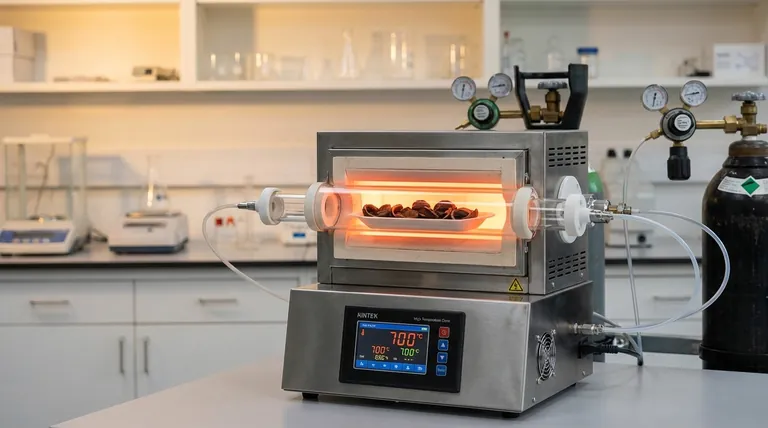
The primary requirement for a high-temperature tubular furnace is its ability to maintain a strictly controlled thermal environment necessary for the chemical reaction between walnut shell carbon and Potassium Hydroxide (KOH). This equipment ensures the material can withstand sustained heating at 700°C for extended periods, allowing the activating agent to effectively etch the carbon framework and generate a vast network of pores.
The furnace acts as a precision reactor rather than a simple oven, facilitating a 600-minute chemical process that transforms low-grade carbon into a highly porous material with a specific surface area as high as 2927 m²/g.
The Mechanics of Chemical Activation
Driving the KOH Reaction
The core purpose of the furnace is to facilitate a deep chemical interaction between the activated carbon powder and KOH.
At 700°C, KOH does not just sit on the surface; it chemically attacks the carbon matrix.
This reaction creates new voids and widens existing pathways within the walnut shell structure.
Maximizing Surface Area
The ultimate goal of this thermal treatment is a drastic increase in porosity.
By maintaining the reaction temperature for 600 minutes, the furnace allows the KOH to fully penetrate the material.
This extended dwell time is directly responsible for achieving exceptional specific surface area values, transforming the material into a high-grade adsorbent.
Why the "Tubular" Design Matters
Atmosphere Control
A tubular furnace is specifically designed to be gas-tight, which is critical for chemical activation.
This design allows for the introduction of inert gases, such as Argon, to create a controlled atmosphere.
By excluding unwanted oxygen from the environment, the furnace prevents the carbon from burning away (oxidizing) uncontrollably before the internal pore structure can form.
Uniform Heat Distribution
Achieving a specific surface area of 2927 m²/g requires thermal consistency across the entire sample.
Tubular furnaces minimize temperature gradients, ensuring that the carbon powder in the center of the boat receives the same thermal energy as the powder on the edges.
This uniformity ensures that the physical and chemical properties of the final product are consistent throughout the batch.
Critical Process Parameters
Sustained Process Duration
The activation of walnut shells is not instantaneous; it requires a "soak time" of up to 600 minutes.
The furnace must provide unwavering stability during this long duration to drive the reaction to completion.
Controlled Heating Rates
Precise control over how fast the temperature rises (e.g., 10°C per minute) is vital.
Gradual heating allows the carbon matrix to undergo physical and chemical changes slowly.
This prevents structural collapse or "thermal shock," which would destroy the delicate micropores created during activation.
Understanding the Trade-offs
Energy Intensity vs. Quality
The primary trade-off in this process is the significant energy cost required to maintain 700°C for 600 minutes.
While this duration maximizes surface area (up to 2927 m²/g), it reduces the throughput speed of production.
Operators must balance the need for ultra-high porosity against the energy expenditure and processing time.
Complexity of Scale-up
While a tubular furnace offers the highest precision for atmosphere and temperature, it is inherently a batch or semi-continuous process.
Scaling this precise environment to industrial quantities is more complex than simple combustion processes.
The strict requirement for gas-tightness means that any leak in the tube can ruin the activation atmosphere, leading to inconsistent product quality or ash formation.
Making the Right Choice for Your Goal
To optimize the activation of walnut shell carbon, align your furnace parameters with your specific end-goal requirements:
- If your primary focus is Maximum Adsorption Capacity: Prioritize the full 600-minute dwell time to push the specific surface area toward the 2927 m²/g theoretical maximum.
- If your primary focus is Structural Integrity: Utilize slower heating ramps (e.g., 10°C/min) to prevent the carbon framework from collapsing during the volatilization phases.
Precise thermal management is the difference between simple charred biomass and high-performance activated carbon.
Summary Table:
| Feature | Requirement for Activation | Benefit for Walnut Shell Carbon |
|---|---|---|
| Temperature Stability | Constant 700°C for 600 min | Ensures complete KOH etching for maximum porosity |
| Atmosphere Control | Gas-tight (Argon/Inert) | Prevents carbon oxidation and material loss |
| Thermal Uniformity | Even heat across the tube | Consistent surface area (up to 2927 m²/g) throughout the batch |
| Ramp Rate Control | Precise 10°C/min heating | Prevents structural collapse or thermal shock of the carbon matrix |
| Design Type | Tubular Furnace | High precision for specialized chemical activation reactions |
Maximize Your Material Performance with KINTEK Precision
Achieving an exceptional surface area of 2927 m²/g requires more than just heat—it requires the absolute thermal and atmospheric control found in KINTEK’s high-temperature systems.
Backed by expert R&D and manufacturing, KINTEK offers Muffle, Tube, Rotary, Vacuum, and CVD systems, all fully customizable to meet your unique activation protocols. Whether you are scaling up walnut shell carbon production or refining lab-scale chemical activation, our furnaces provide the stability and gas-tight integrity your research demands.
Ready to optimize your carbon activation process?
Contact KINTEK today for a customized solution
Visual Guide

References
- Daniel Arenas Esteban, David Ávila‐Brande. Enhancing Electrochemical Properties of Walnut Shell Activated Carbon with Embedded MnO Clusters for Supercapacitor Applications. DOI: 10.1002/batt.202400101
This article is also based on technical information from Kintek Furnace Knowledge Base .
Related Products
- 1700℃ High Temperature Laboratory Tube Furnace with Alumina Tube
- Vertical Laboratory Quartz Tube Furnace Tubular Furnace
- 1400℃ High Temperature Laboratory Tube Furnace with Alumina Tube
- High Temperature Muffle Oven Furnace for Laboratory Debinding and Pre Sintering
- 1700℃ High Temperature Muffle Oven Furnace for Laboratory
People Also Ask
- How does zone-melting in tube furnaces synthesize bismuth micro-wires? Master Single-Crystal Thermoelectric Growth
- How do high-temperature laboratory tube furnaces ensure environmental stability? Precision Thermal Reduction Tips
- How are high-temperature laboratory tube furnaces applied in long-term vacuum homogenization heat treatments for intermetallic samples?
- How are high-temp tube furnaces used to measure diffusion coefficients per Fick's law? Master Precision Annealing
- How are high-temperature tube furnaces applied in testing ceramic-supported alloy membranes? Insights



















