
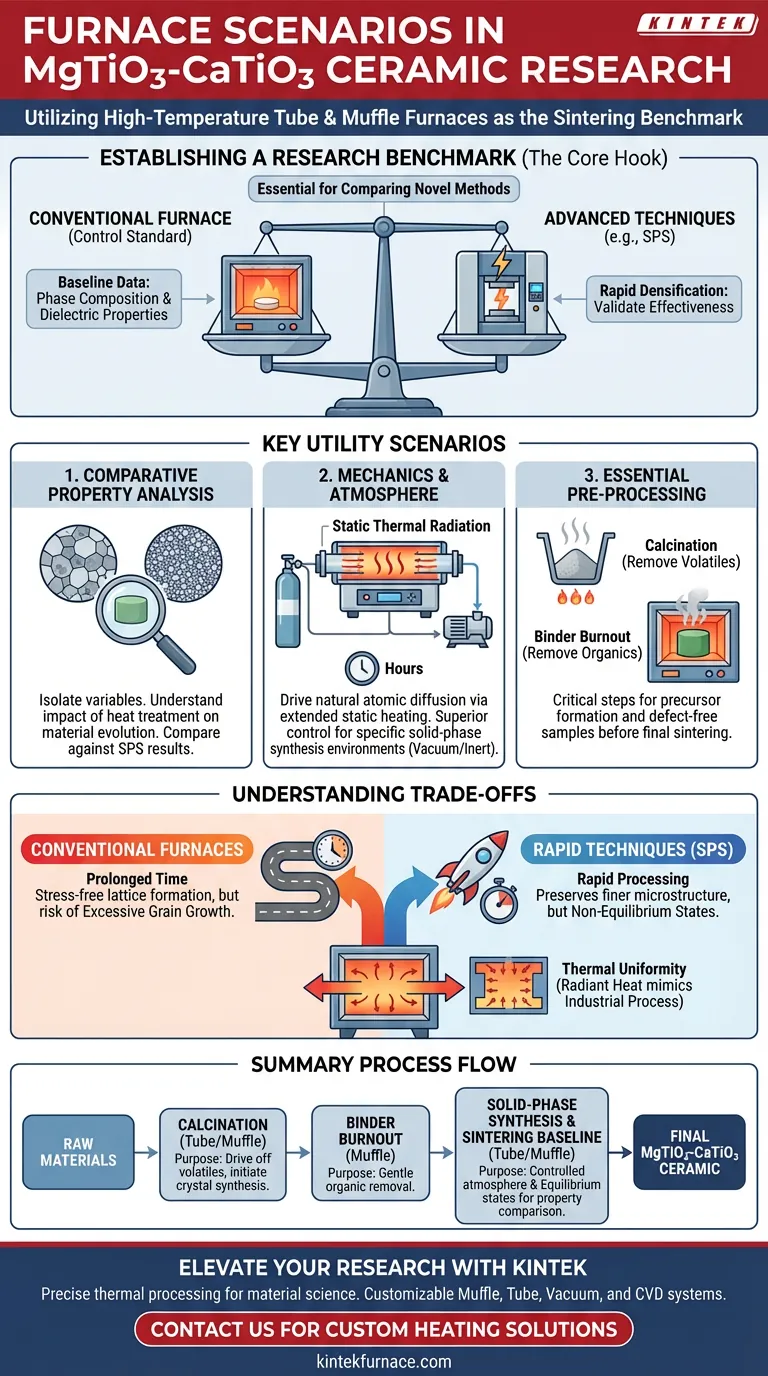
Laboratory high-temperature tube and muffle furnaces are deployed primarily to establish a baseline for conventional sintering in the study of MgTiO3-CaTiO3 ceramics. These units provide a controlled environment utilizing static thermal radiation over extended periods, allowing researchers to study standard atomic diffusion and compare results against advanced manufacturing methods.
Core Takeaway While modern techniques like Spark Plasma Sintering (SPS) offer rapid processing, conventional furnaces remain essential for creating a "control" standard. They facilitate the analysis of crystal structure, phase composition, and dielectric properties under traditional thermodynamic conditions, serving as the benchmark for validating the effectiveness of newer heat treatment paths.
Establishing a Research Benchmark
Comparison with Advanced Techniques
In the research of MgTiO3-CaTiO3 ceramics, the primary utility of these furnaces is to act as a comparative benchmark.
Researchers often employ advanced methods like Spark Plasma Sintering (SPS) to achieve rapid densification. However, to understand the true impact of these rapid techniques, they must compare the resulting material properties against those achieved through conventional heating.
Analyzing Property Evolution
By using standard tube or muffle furnaces, scientists can isolate specific variables in the heating process.
This allows for a precise analysis of how different heat treatment paths influence phase composition and the evolution of dielectric properties. Without this baseline, it is difficult to determine if property improvements are due to the material composition or the sintering speed.
The Mechanics of Conventional Sintering
Driving Atomic Diffusion
Unlike rapid techniques that may use pressure or pulsed current, conventional furnaces rely on static thermal radiation.
This process typically spans several hours. The extended duration is necessary to drive atomic diffusion naturally, ensuring the material reaches a state of equilibrium that differs from the non-equilibrium states often produced by rapid sintering.
Controlled Atmospheric Synthesis
Tube furnaces, in particular, are utilized when specific atmospheric conditions are required during the solid-phase synthesis of MgTiO3-CaTiO3.
These units offer superior management of the environment, including vacuum or inert gas protection. This ensures that chemical reactions occur under precise thermodynamic conditions, preventing oxidation or unwanted side reactions that could alter the physicochemical properties of the ceramic.
Essential Pre-processing Scenarios
Calcination and Solid-Phase Synthesis
Before final sintering, raw materials often require calcination.
High-temperature furnaces are used to heat the initial powders to drive off volatile components and initiate the formation of the desired crystal phases. This step is critical for synthesizing the precursor powders that will later be pressed and sintered.
Binder Burnout
In the preparation of ceramic samples, organic binders are often added to help shape the "green" (unfired) body.
Muffle furnaces are extensively used for binder burnout. This process involves heating the sample at lower temperatures to gently remove organic matter before the high-temperature sintering phase begins, ensuring the final ceramic is free of carbon defects.
Understanding the Trade-offs
Processing Time vs. Microstructure
The primary trade-off when using conventional furnaces is time. The process requires hours of heating, holding, and cooling.
While this allows for stress-free lattice formation, the prolonged exposure to high heat can lead to excessive grain growth. In contrast, rapid techniques like SPS often preserve finer grain structures. Therefore, these furnaces are less suitable for research specifically aiming to produce nanostructured ceramics, but remain the standard for bulk ceramic studies.
Thermal Uniformity
While muffle furnaces generally use baffles to distribute heat, they rely on radiant transfer.
This can sometimes create slight thermal gradients compared to the direct heating of SPS. However, for most conventional sintering research, this mimics the standard industrial manufacturing process, making the data highly relevant for mass-production scalability.
Making the Right Choice for Your Goal
To maximize the value of your research into MgTiO3-CaTiO3 ceramics, align your equipment choice with your specific analytical needs:
- If your primary focus is establishing a baseline: Use a tube or muffle furnace to generate standard data on phase composition and dielectric properties driven by natural atomic diffusion.
- If your primary focus is material synthesis and preparation: Utilize these furnaces for critical pre-processing steps like calcination and binder burnout to ensure sample purity.
- If your primary focus is comparing novel techniques: Use the conventional sintered samples as the "control group" to rigorously validate the benefits of rapid methods like SPS.
By using high-temperature furnaces as a rigorous standard, you ensure your advanced research is grounded in fundamental material science principles.
Summary Table:
| Process Scenario | Equipment Used | Primary Purpose |
|---|---|---|
| Sintering Baseline | Muffle/Tube Furnace | Establish a control standard for dielectric property comparison. |
| Solid-Phase Synthesis | Tube Furnace | Controlled atmosphere (vacuum/inert) for pure phase formation. |
| Calcination | Muffle/Tube Furnace | Driving off volatiles and initiating crystal phase synthesis. |
| Binder Burnout | Muffle Furnace | Gentle removal of organic matter before high-temp sintering. |
| Atomic Diffusion | Muffle Furnace | Analyzing equilibrium states via static thermal radiation. |
Elevate Your Ceramic Research with KINTEK
Precise thermal processing is the backbone of material science. Backed by expert R&D and manufacturing, KINTEK offers high-performance Muffle, Tube, Rotary, Vacuum, and CVD systems—all fully customizable to meet the rigorous demands of MgTiO3-CaTiO3 synthesis and sintering.
Whether you need to establish a research benchmark or scale your production, our lab high-temperature furnaces deliver the thermal uniformity and atmospheric control your project requires. Contact us today to find your custom heating solution!
Visual Guide
References
- Wega Trisunaryanti, Satriyo Dibyo Sumbogo. Characteristic and Performance of Ni, Pt, and Pd Monometal and Ni-Pd Bimetal onto KOH Activated Carbon for Hydrotreatment of Castor Oil. DOI: 10.22146/ijc.84640
This article is also based on technical information from Kintek Furnace Knowledge Base .
Related Products
- 1400℃ High Temperature Laboratory Tube Furnace with Alumina Tube
- 1700℃ High Temperature Laboratory Tube Furnace with Alumina Tube
- 1200℃ Split Tube Furnace Laboratory Quartz Tube Furnace with Quartz Tube
- Vertical Laboratory Quartz Tube Furnace Tubular Furnace
- 1800℃ High Temperature Muffle Oven Furnace for Laboratory
People Also Ask
- How does zone-melting in tube furnaces synthesize bismuth micro-wires? Master Single-Crystal Thermoelectric Growth
- How do high-temperature laboratory tube furnaces ensure environmental stability? Precision Thermal Reduction Tips
- How are high-temp tube furnaces used to measure diffusion coefficients per Fick's law? Master Precision Annealing
- How are high-temperature laboratory tube furnaces applied in long-term vacuum homogenization heat treatments for intermetallic samples?
- How are high-temperature tube furnaces applied in testing ceramic-supported alloy membranes? Insights



















