
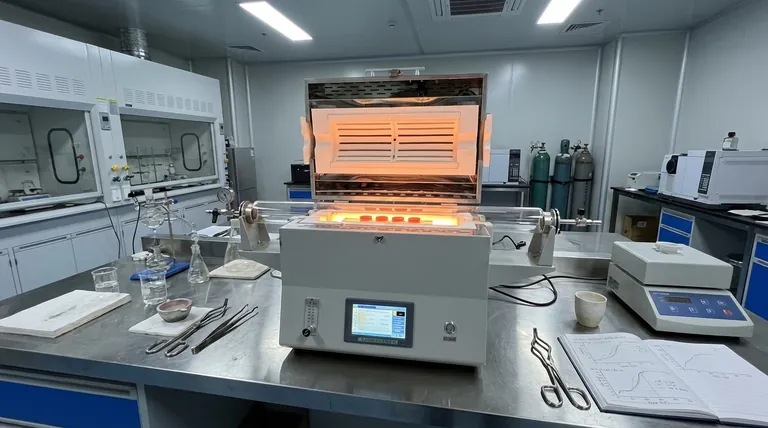
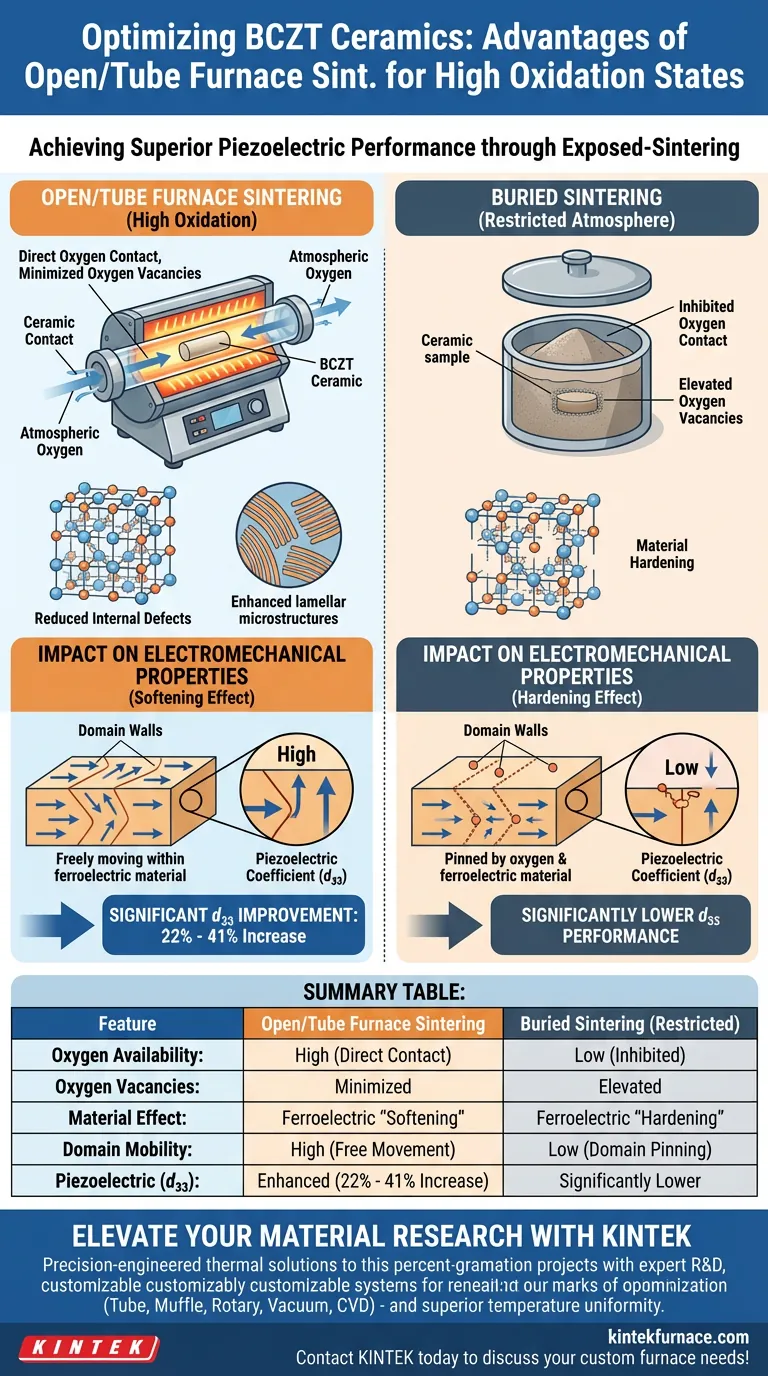
Utilizing a laboratory tube furnace or an open sintering furnace offers the distinct advantage of maintaining full, direct contact between the (Ba0.85Ca0.15)(Zr0.1Ti0.9)O3 (BCZT) ceramic and atmospheric oxygen. This "exposed-sintering" environment is critical for minimizing oxygen vacancies, which directly correlates to a significant enhancement in piezoelectric performance.
Core Takeaway Achieving a high oxidation state in BCZT ceramics prevents the formation of oxygen vacancies that "pin" domain walls. This results in a ferroelectric "softening" effect, increasing domain mobility and boosting the piezoelectric coefficient ($d_{33}$) by 22% to 41% compared to samples sintered in restricted environments.
The Mechanism of Oxidation and Performance
Maximizing Oxygen Contact
The primary benefit of an open or tube furnace is the unrestricted availability of oxygen. Unlike buried-sintering methods, where samples are embedded in powder, open sintering allows the ceramic surface to interact freely with the atmosphere.
Reduction of Internal Defects
This direct exposure facilitates a thorough oxidation process. By ensuring sufficient oxygen is available during the high-temperature phase (typically 1300–1500°C), the concentration of internal oxygen vacancies is significantly reduced.
Enhancement of Lamellar Structures
This oxidation is particularly beneficial for ceramics exhibiting lamellar structures. The open-air environment ensures that these complex microstructures do not suffer from oxygen deficiencies that would otherwise degrade their electrical properties.
Impact on Electromechanical Properties
The "Softening" Effect
Reducing oxygen vacancies leads to a phenomenon known as material "softening." In ferroelectrics, oxygen vacancies often act as pinning sites that restrict the movement of domain walls.
Increased Domain Mobility
When these pinning sites are removed through high oxidation, the domain walls within the BCZT structure can move more freely. This mobility is the fundamental driver of high piezoelectric response in these materials.
Significant $d_{33}$ Improvement
The practical result of this enhanced mobility is a measurable increase in the piezoelectric coefficient ($d_{33}$). Open-sintered BCZT ceramics can exhibit $d_{33}$ values 22% to 41% higher than their dense, oxygen-deficient counterparts.
Understanding the Trade-offs: Open vs. Buried
The Risks of Buried Sintering
It is important to understand what you avoid by using an open furnace. The alternative "buried-sintering" method limits air contact, inhibiting the oxidation process.
Material Hardening
When oxidation is inhibited, oxygen vacancy concentrations rise. This leads to ferroelectric "hardening," characterized by reduced polarization intensity and a significant drop in piezoelectric performance.
Temperature Uniformity Considerations
While open furnaces excel at oxidation, the sintering process also requires precise kinetic conditions for grain growth and densification. Ensure your furnace maintains superior temperature uniformity, as this dictates the final grain size distribution and density.
Making the Right Choice for Your Goal
-
If your primary focus is maximizing piezoelectric sensitivity ($d_{33}$): Choose an open or tube furnace to ensure full oxidation, reduce vacancy pinning, and achieve the "softest" material response possible.
-
If your primary focus is densification and grain control: Ensure your open furnace setup offers excellent temperature uniformity (1300–1500°C range), as this controls pore elimination and grain growth regardless of the atmosphere.
By prioritizing an oxygen-rich sintering environment, you effectively unlock the full potential of domain mobility within the BCZT lattice.
Summary Table:
| Feature | Open/Tube Furnace Sintering | Buried Sintering (Restricted) |
|---|---|---|
| Oxygen Availability | High (Direct Contact) | Low (Inhibited) |
| Oxygen Vacancies | Minimized | Elevated |
| Material Effect | Ferroelectric "Softening" | Ferroelectric "Hardening" |
| Domain Mobility | High (Free Movement) | Low (Domain Pinning) |
| Piezoelectric ($d_{33}$) | Enhanced (22% - 41% Increase) | Significantly Lower |
Elevate Your Material Research with KINTEK
Maximize the piezoelectric performance of your BCZT ceramics with precision-engineered thermal solutions. Backed by expert R&D and manufacturing, KINTEK offers high-performance Tube, Muffle, Rotary, Vacuum, and CVD systems—all customizable to meet your specific oxidation and sintering requirements. Our furnaces provide the superior temperature uniformity and atmospheric control necessary to eliminate oxygen vacancies and unlock superior domain mobility.
Ready to optimize your high-temperature processes? Contact KINTEK today to discuss your custom furnace needs!
Visual Guide
References
- Zihe Li, Chris Bowen. Porous Structure Enhances the Longitudinal Piezoelectric Coefficient and Electromechanical Coupling Coefficient of Lead‐Free (Ba<sub>0.85</sub>Ca<sub>0.15</sub>)(Zr<sub>0.1</sub>Ti<sub>0.9</sub>)O<sub>3</sub>. DOI: 10.1002/advs.202406255
This article is also based on technical information from Kintek Furnace Knowledge Base .
Related Products
- Vacuum Dental Porcelain Sintering Furnace for Dental Laboratories
- Chairside Dental Porcelain Zirconia Sintering Furnace with Transformer for Ceramic Restorations
- Vertical Laboratory Quartz Tube Furnace Tubular Furnace
- Dental Porcelain Zirconia Sintering Ceramic Vacuum Press Furnace
- High Temperature Muffle Oven Furnace for Laboratory Debinding and Pre Sintering
People Also Ask
- What is the purpose of dental sintering furnaces? Transform Zirconia into Durable, High-Quality Dental Restorations
- How does a dental vacuum porcelain furnace maintain restoration quality? Precision Sintering for Superior Esthetics
- What is the role of dental sintering furnaces in dental restorations? Transform Zirconia into Durable, Aesthetic Teeth
- What is a dental sintering furnace and what is its purpose? Achieve High-Strength Dental Restorations
- What general precautions should be followed when using the Fast Slow Dental Sintering Furnace? Ensure Safe, High-Quality Dental Restorations



















