
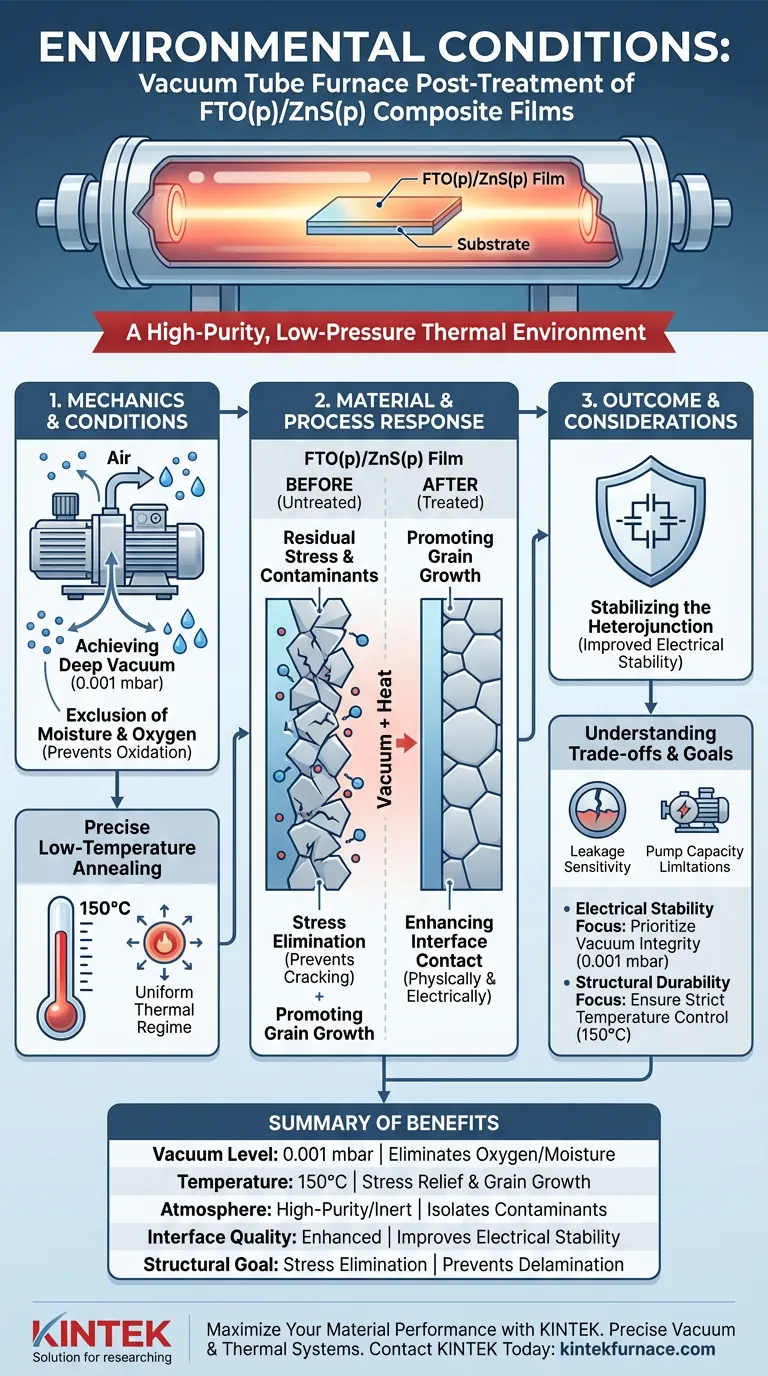
A vacuum tube furnace establishes a high-purity, low-pressure thermal environment designed to strictly isolate composite films from atmospheric contaminants. For FTO(p)/ZnS(p) composite films specifically, this equipment utilizes a mechanical pump to achieve a vacuum level of 0.001 mbar while maintaining a stable annealing temperature of 150°C. This setup is critical for excluding oxidizing agents like oxygen and moisture that would otherwise degrade the material properties.
By maintaining a consistent vacuum of 0.001 mbar during the 150°C annealing process, the furnace serves as a protective barrier against oxidation. This controlled environment is the defining factor in relieving internal film stresses and securing the structural integrity of the heterojunction.
The Mechanics of the Controlled Environment
To understand why this specific environment is necessary for FTO(p)/ZnS(p) films, we must look at the interplay between pressure, temperature, and material chemistry.
Achieving Deep Vacuum
The primary function of the furnace in this context is pressure reduction. By using a mechanical pump to reach 0.001 mbar, the system creates a near-void environment.
This drastic reduction in pressure removes the vast majority of air molecules from the chamber. It ensures that the film is treated in isolation, rather than reacting with the surrounding atmosphere.
Exclusion of Moisture and Oxygen
The vacuum environment specifically targets the removal of oxygen and moisture. These are the two most detrimental elements to the stability of FTO and ZnS composites during thermal treatment.
By stripping these elements away, the furnace prevents unwanted chemical reactions, such as oxidation, which could compromise the purity of the film surfaces.
Thermal Treatment and Material Response
The environment is not just about what is removed; it is about how the heat is applied within that void.
Precise Low-Temperature Annealing
The process involves heating the films to 150°C.
While many ceramics require extremely high temperatures, this specific composite requires a moderate thermal regime. The tube furnace maintains this temperature uniformly, ensuring the entire film surface is treated equally.
Stress Elimination
One of the most critical roles of this environment is the elimination of internal stresses.
Films often harbor residual stress from the deposition process. Annealing in this vacuum eliminates these stresses, preventing future cracking or delamination.
Promoting Grain Growth
The thermal energy provided at 150°C encourages the grains within the film to grow and coalesce.
Larger, more uniform grains generally lead to better material properties. The vacuum ensures this growth happens without the interference of grain-boundary oxidation.
Interface Optimization
For composite films like FTO(p)/ZnS(p), the performance is dictated by the quality of the junction between the materials.
Enhancing Interface Contact
The combination of vacuum pressure and thermal energy optimizes the contact at the interface between the FTO and ZnS layers.
Poor contact leads to high electrical resistance. This process ensures the layers adhere physically and electrically.
Stabilizing the Heterojunction
Ultimately, the goal of this environment is to improve the electrical stability of the heterojunction.
By removing contaminants and relieving stress, the vacuum tube furnace ensures the junction performs reliably over time.
Understanding the Trade-offs
While a vacuum tube furnace is highly effective, it is essential to recognize the operational constraints and potential pitfalls of this method.
Leakage Sensitivity
The system relies entirely on the integrity of the vacuum seals. Even a microscopic leak can introduce enough oxygen to ruin the annealing process at 0.001 mbar.
Regular maintenance of O-rings and flanges is non-negotiable to maintain the protective environment.
Pump Capacity Limitations
Achieving 0.001 mbar requires a robust mechanical pump.
If the pump is underpowered or poorly maintained, it may stabilize at a higher pressure (e.g., 0.1 mbar). This insufficient vacuum can lead to partial oxidation, resulting in a film that is structurally sound but electrically compromised.
Making the Right Choice for Your Goal
When configuring your post-treatment process for FTO(p)/ZnS(p) films, align your furnace settings with your specific material objectives.
- If your primary focus is Electrical Stability: Prioritize the integrity of the vacuum (0.001 mbar) to ensure the interface between FTO and ZnS is free of oxides.
- If your primary focus is Structural Durability: Ensure the temperature is held strictly at 150°C to maximize stress relief without inducing thermal degradation.
The vacuum tube furnace is not just a heater; it is a precision tool that creates the specific exclusion zone required to turn a raw composite film into a stable, high-performance heterojunction.
Summary Table:
| Feature | Specification/Impact | Benefit for FTO(p)/ZnS(p) |
|---|---|---|
| Vacuum Level | 0.001 mbar | Eliminates oxygen and moisture to prevent oxidation |
| Temperature | 150°C (Annealing) | Facilitates stress relief and promotes grain growth |
| Atmosphere | High-Purity/Inert | Isolates films from environmental contaminants |
| Interface Quality | Enhanced Contact | Improves electrical stability of the heterojunction |
| Structural Goal | Stress Elimination | Prevents cracking and delamination of composite layers |
Maximize Your Material Performance with KINTEK
Precision matters when treating sensitive FTO(p)/ZnS(p) composite films. Backed by expert R&D and world-class manufacturing, KINTEK offers high-performance Muffle, Tube, Rotary, Vacuum, and CVD systems designed to meet your most rigorous laboratory requirements.
Our furnaces provide the stable, high-vacuum environments and uniform thermal control necessary to ensure your heterojunctions are free from oxidation and internal stress. Whether you need a standard setup or a fully customizable system for unique research needs, our team is ready to support your success.
Ready to elevate your lab’s capabilities? Contact KINTEK Today to Find Your Solution
Visual Guide
References
- Ahmad Aljader. Fabrication of FTO(P)/ZNS(P)/SI(N) Heterojunction and Study of Its Structural, Optical and Electrical Properties. DOI: 10.52783/pst.953
This article is also based on technical information from Kintek Furnace Knowledge Base .
Related Products
- Vacuum Hot Press Furnace Machine Heated Vacuum Press Tube Furnace
- Vacuum Sealed Continuous Working Rotary Tube Furnace Rotating Tube Furnace
- High Pressure Laboratory Vacuum Tube Furnace
- Laboratory Vacuum Tilt Rotary Tube Furnace Rotating Tube Furnace
- Magnesium Extraction and Purification Condensing Tube Furnace
People Also Ask
- Why use Vacuum Hot Press (VHP) for ZnS Ceramics? Achieve Superior IR Transparency and Mechanical Strength
- What are the benefits of the vacuum environment system in a vacuum hot press furnace? Unlock High-Density Sintering
- What safety features are incorporated in vacuum hot press furnaces? Ensure Operator and Equipment Protection
- What control features does a vacuum hot press furnace offer? Precision Control for Advanced Materials Processing
- How does the uniaxial pressure applied by a vacuum hot press furnace affect the microstructure of ZrC-SiC materials?



















