
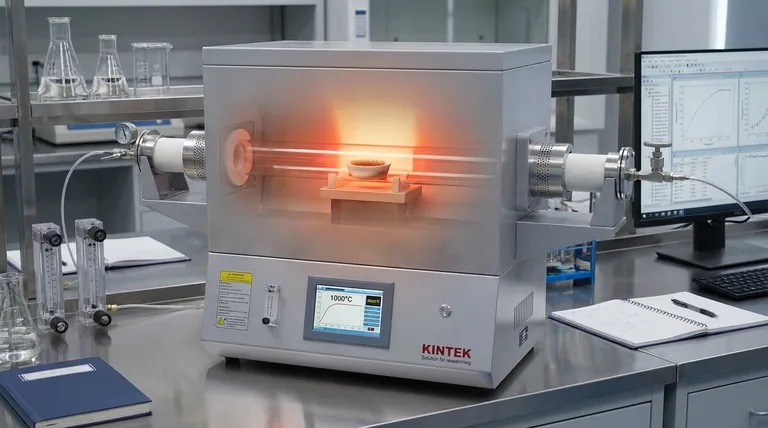
A high-temperature tube furnace primarily provides a stable thermal field at exactly 1000°C to facilitate the growth of Gold-Nickel-Titanium Dioxide (Au-Ni-TiO2) nanowire heterostructures. This specific thermal condition is required to induce a phase change in the catalyst, allowing the synthesis process to proceed via the Vapor-Liquid-Solid (VLS) mechanism.
The furnace acts as a precision instrument for thermodynamic control, not just a heat source. By maintaining a constant 1000°C environment, it liquefies the Au-Ni catalyst, enabling it to absorb vapor-phase materials and guide the directional crystallization of Titanium Dioxide.
Creating the Thermodynamic Environment
Activation of the Catalyst
The primary function of the furnace is to reach and maintain 1000°C. At this specific temperature, the Gold-Nickel (Au-Ni) alloy catalyst transitions into a liquid or quasi-liquid state.
This phase change is the trigger for the entire reaction. Without reaching this specific thermal threshold, the catalyst remains solid and inactive, preventing the necessary interactions with the growth materials.
Facilitating the VLS Mechanism
Once the catalyst is in a liquid state, the Vapor-Liquid-Solid (VLS) mechanism takes over. The furnace's thermal energy allows the liquefied catalyst to absorb and dissolve growth materials from the surrounding vapor.
As the catalyst becomes supersaturated, it precipitates the material, guiding the directional growth of the nanowires. The furnace ensures this cycle continues uninterrupted until the desired structures are formed.
Controlling Morphology and Quality
The Importance of Thermal Stability
The tube furnace provides a constant temperature zone. This stability is crucial for ensuring uniform growth rates across the sample.
Fluctuations in temperature can disrupt the VLS mechanism. A stable field ensures that the catalyst remains in its active liquid state throughout the growth duration.
Managing Thermal Gradients
Beyond absolute temperature, the thermal gradients within the tube play a decisive role in the final product. These gradients influence how the material crystallizes.
Specifically, the profile of these gradients determines the aspect ratio (length-to-width) and the crystalline quality of the resulting nanowires.
Understanding Process Sensitivities
The Risk of Thermal Deviation
While the target is 1000°C, the process is highly sensitive to the precision of this thermal field.
If the temperature drops below the threshold, the Au-Ni catalyst may solidify prematurely. This arrests the VLS process, leading to incomplete growth or structural defects.
Gradient Mismanagement
If the thermal gradients are not controlled or are too steep, the crystallization may become erratic.
This often results in nanowires with poor crystalline quality or undesirable aspect ratios, rendering the heterostructures unsuitable for their intended application.
Optimizing Your Synthesis Strategy
To achieve the best results in preparing Au-Ni-TiO2 nanowires, you must align your furnace settings with your specific material goals:
- If your primary focus is high aspect ratios: Pay close attention to the thermal gradients within the furnace, as these dictate the directional elongation of the wire.
- If your primary focus is crystalline purity: Prioritize the stability of the constant temperature zone to ensure the catalyst remains perfectly liquid throughout the VLS process.
Precise thermal control is the defining factor that separates a random aggregate from a high-performance nanowire heterostructure.
Summary Table:
| Process Parameter | Requirement | Role in Synthesis |
|---|---|---|
| Core Temperature | 1000°C | Liquefies Au-Ni catalyst to trigger reaction |
| Mechanism | Vapor-Liquid-Solid (VLS) | Facilitates absorption and directional crystallization |
| Thermal Stability | High Precision | Ensures uniform growth rates and structural integrity |
| Thermal Gradient | Controlled Profile | Determines nanowire aspect ratio and crystalline quality |
Elevate Your Nanomaterial Synthesis with KINTEK
Precision at 1000°C is non-negotiable for high-performance Au-Ni-TiO2 nanowire heterostructures. Backed by expert R&D and world-class manufacturing, KINTEK offers high-stability Tube, Muffle, Rotary, Vacuum, and CVD systems designed to maintain the exact thermal gradients your research demands. Whether you require standard configurations or fully customizable high-temperature furnaces for unique laboratory needs, our technology ensures your VLS processes are flawless.
Ready to achieve superior crystalline purity? Contact our technical experts today for a tailored thermal solution.
Visual Guide

References
- Zhina Razaghi, Guo‐zhen Zhu. Ni‐Assisted Endotaxial Growth of Au Nanoparticles Within TiO<sub>2</sub> Nanowires. DOI: 10.1002/admi.202500490
This article is also based on technical information from Kintek Furnace Knowledge Base .
Related Products
- 1400℃ High Temperature Laboratory Tube Furnace with Alumina Tube
- 1700℃ High Temperature Laboratory Tube Furnace with Alumina Tube
- 1200℃ Split Tube Furnace Laboratory Quartz Tube Furnace with Quartz Tube
- Vertical Laboratory Quartz Tube Furnace Tubular Furnace
- 1700℃ High Temperature Muffle Oven Furnace for Laboratory
People Also Ask
- How does zone-melting in tube furnaces synthesize bismuth micro-wires? Master Single-Crystal Thermoelectric Growth
- How are high-temperature laboratory tube furnaces applied in long-term vacuum homogenization heat treatments for intermetallic samples?
- How are high-temp tube furnaces used to measure diffusion coefficients per Fick's law? Master Precision Annealing
- How do high-temperature laboratory tube furnaces ensure environmental stability? Precision Thermal Reduction Tips
- How are high-temperature tube furnaces applied in testing ceramic-supported alloy membranes? Insights



















