
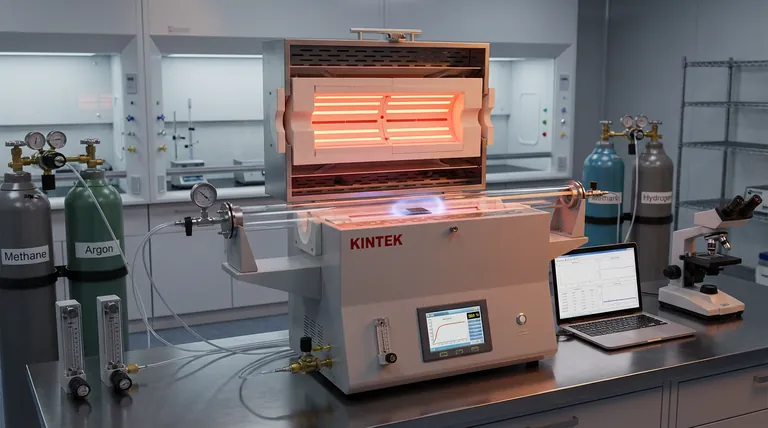
The Tube Furnace functions as the critical thermal reactor in the Chemical Vapor Deposition (CVD) process for carbon nanotubes (CNTs). Its primary role is to provide a strictly controlled high-temperature environment—typically around 850 °C—that facilitates the thermal decomposition (pyrolysis) of hydrocarbon gases. By maintaining a stable temperature field, the furnace ensures that carbon atoms are released from precursors like methane and arrange themselves effectively on catalyst particles to form high-quality nanotubes.
Core Takeaway The Tube Furnace is not merely a heat source; it is a precision instrument that synchronizes thermal energy, gas flow, and catalyst activation. By stabilizing the reaction environment at specific temperatures (e.g., 700°C–850°C), it drives the chemical reactions necessary to convert gaseous carbon into solid, orderly, and crystalline nanotube structures.
The Mechanics of the Reaction Environment
Facilitating Thermal Decomposition (Pyrolysis)
The fundamental requirement for CNT growth is the breaking down of a carbon-containing gas source. The Tube Furnace heats the reaction chamber to temperatures sufficient to trigger thermal decomposition, also known as pyrolysis.
For example, when using methane as a precursor, the furnace must reach approximately 850 °C. This high thermal energy forces the gas molecules to break apart, releasing the carbon atoms required for growth.
Activating the Catalyst
Heat alone does not create nanotubes; the carbon must interact with a metal catalyst. The furnace heats the substrate containing catalyst particles—typically iron (Fe)—to the reaction temperature.
At these temperatures, the catalyst particles become active nucleation sites. The furnace ensures the catalyst is in the correct energetic state to absorb carbon atoms and precipitate them into the tubular structure.
Ensuring Orderly Atomic Arrangement
The quality of a carbon nanotube is defined by its crystallinity and structure. The Tube Furnace provides a strictly controlled and stable temperature field throughout the process.
This stability is vital for driving the orderly arrangement of carbon atoms. Fluctuations in temperature can lead to defects or amorphous carbon (soot) rather than the high-quality single-walled or vertically aligned structures desired.
Managing the Gas Atmosphere
The furnace acts as a sealed reaction chamber that regulates the atmosphere surrounding the substrate. It allows for the precise introduction of precursor gases (such as methane or acetylene) alongside carrier and reducing gases like argon and hydrogen.
By controlling the thermal zone where these gases mix and react, the furnace promotes the directionality of growth, which is essential for synthesizing vertically aligned carbon nanotubes (VACNTs).
Understanding the Trade-offs
Sensitivity to Temperature Variations
While the Tube Furnace is effective, the process is highly sensitive to temperature accuracy. The references highlight that different precursors require different thermal targets (e.g., 700 °C for acetylene vs. 850 °C for methane).
If the furnace cannot maintain the specific set point with high precision, the catalyst may deactivate, or the gas may decompose too early (in the gas phase) rather than on the substrate. This results in impurities and low-quality deposits.
Zone Control Complexity
Achieving complex structures often requires sophisticated thermal profiles. While a standard furnace heats uniformly, advanced applications may require segmented temperature control.
This allows independent regulation of different zones (e.g., vaporizing a solid precursor in one zone and growing the crystal in another). However, this adds complexity to the equipment setup and requires precise calibration to ensure the thermal zones do not bleed into one another unpredictably.
Making the Right Choice for Your Goal
To maximize the effectiveness of a Tube Furnace for CNT growth, align your temperature strategy with your specific objective:
- If your primary focus is High-Quality Single-Walled CNTs: Prioritize a furnace capable of maintaining a stable 850 °C environment to effectively decompose methane on iron catalysts.
- If your primary focus is Vertically Aligned CNTs: Ensure your system can strictly control the introduction of acetylene and hydrogen at slightly lower temperatures (approx. 700 °C) to promote directional growth.
- If your primary focus is Complex Precursors (e.g., Solids): Look for a furnace with segmented temperature control to independently manage the evaporation of precursor materials and the substrate reaction temperature.
The success of your CVD process ultimately relies on the furnace's ability to turn a volatile gas into a stable, crystalline solid through precise thermal management.
Summary Table:
| Feature | Role in CNT Growth | Impact on Quality |
|---|---|---|
| Thermal Pyrolysis | Decomposes methane/acetylene gas | Releases carbon atoms for growth |
| Catalyst Activation | Maintains metal catalyst energy state | Creates active nucleation sites |
| Temperature Stability | Ensures orderly atomic arrangement | Prevents defects and amorphous soot |
| Atmosphere Control | Regulates precursor & carrier gases | Enables vertically aligned growth (VACNTs) |
| Multi-Zone Heating | Manages solid precursor vaporization | Allows independent control of reactions |
Scale Your Nanomaterial Innovation with KINTEK
Precision is the difference between amorphous soot and high-performance carbon nanotubes. KINTEK provides industry-leading Tube, Vacuum, and CVD systems designed specifically for the rigorous demands of nanomaterial synthesis.
Backed by expert R&D and world-class manufacturing, our high-temperature furnaces offer the segmented temperature control and atmospheric stability required for your unique research needs.
Ready to optimize your CVD process? Contact KINTEK Today to Customize Your Solution
References
- Cheng Hu, Zhiwen Shi. Collapse of carbon nanotubes due to local high-pressure from van der Waals encapsulation. DOI: 10.1038/s41467-024-47903-3
This article is also based on technical information from Kintek Furnace Knowledge Base .
Related Products
- Split Chamber CVD Tube Furnace with Vacuum Station CVD Machine
- Multi Heating Zones CVD Tube Furnace Machine for Chemical Vapor Deposition Equipment
- Custom Made Versatile CVD Tube Furnace Chemical Vapor Deposition CVD Equipment Machine
- Slide PECVD Tube Furnace with Liquid Gasifier PECVD Machine
- Inclined Rotary Plasma Enhanced Chemical Deposition PECVD Tube Furnace Machine
People Also Ask
- How does a CVD tube furnace achieve high purity in gate media preparation? Master Precision Control for Flawless Films
- What are the operational and maintenance requirements for a CVD tube furnace? Ensure Precision for Thin Film Deposition
- What are the advantages of using a CVD tube furnace for preparing gate dielectrics? Achieve High-Quality Thin Films for Transistors
- What temperature range do standard CVD tube furnaces operate at? Unlock Precision for Your Material Deposition
- How can integrating CVD tube furnaces with other technologies benefit device fabrication? Unlock Advanced Hybrid Processes



















