
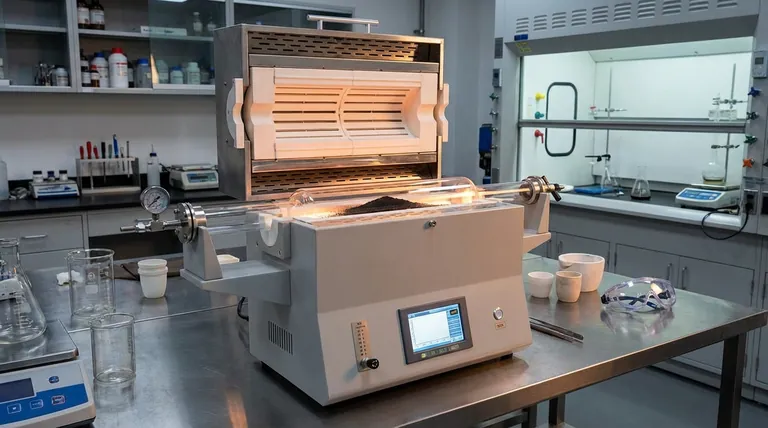
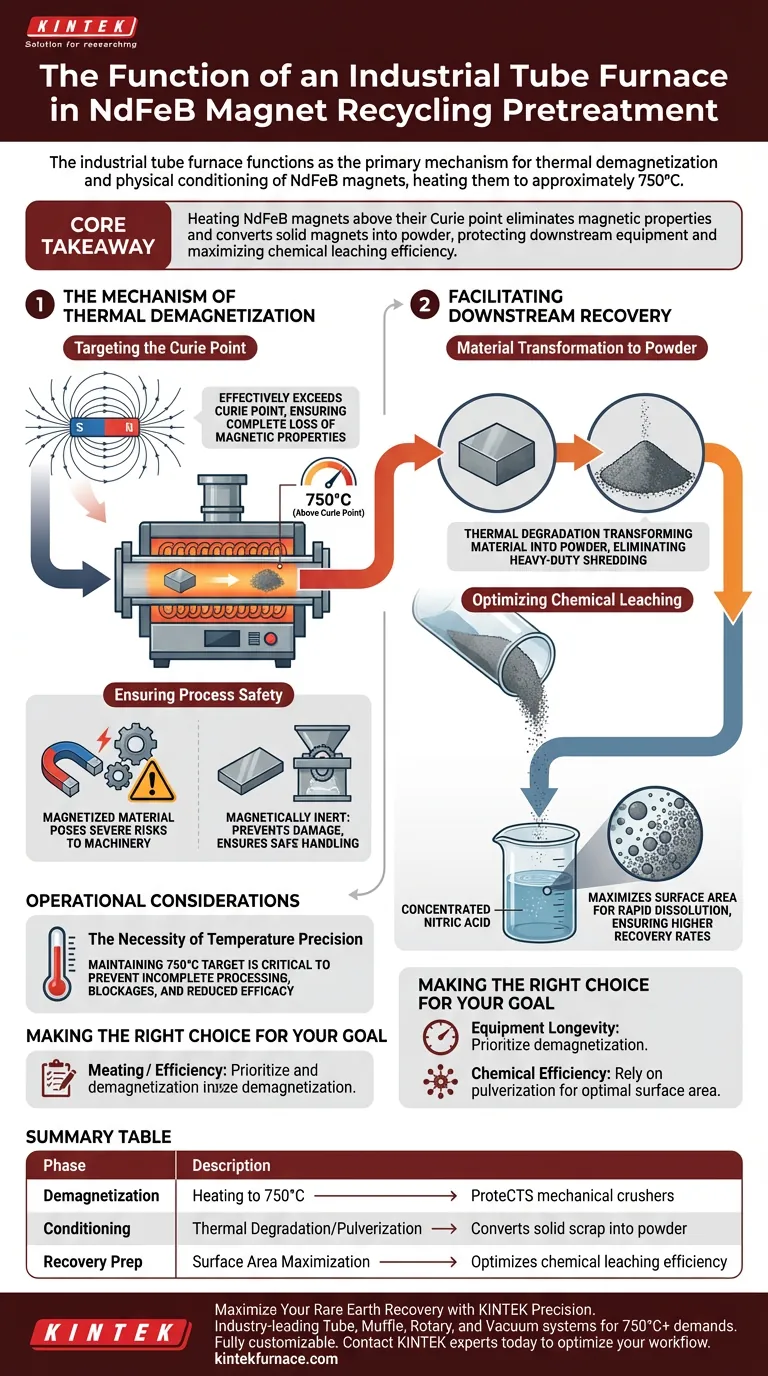
The industrial tube furnace functions as the primary mechanism for thermal demagnetization and physical conditioning in the recycling of NdFeB (Neodymium-Iron-Boron) magnets. By subjecting the magnets to temperatures of approximately 750°C, the furnace neutralizes their magnetic field and structurally degrades the material into a manageable state.
Core Takeaway By heating NdFeB magnets above their Curie point, the tube furnace eliminates magnetic properties and converts solid magnets into powder. This thermal pretreatment is essential for protecting downstream mechanical equipment and maximizing the efficiency of chemical leaching.
The Mechanism of Thermal Demagnetization
Targeting the Curie Point
To strip a permanent magnet of its magnetic field, it must be heated beyond a specific thermal threshold known as the Curie point.
The industrial tube furnace is calibrated to operate at approximately 750°C. This temperature effectively exceeds the Curie point of NdFeB magnets, ensuring the complete loss of magnetic properties.
Ensuring Process Safety
Attempting to crush or process fully magnetized materials poses severe risks to industrial machinery due to magnetic attraction and resistance.
By utilizing the tube furnace for pretreatment, you render the material magnetically inert. This prevents damage to mechanical crushers and ensures safe handling during subsequent stages.
Facilitating Downstream Recovery
Material Transformation to Powder
The function of the tube furnace extends beyond simple demagnetization; it induces a physical transformation of the feedstock.
The high-temperature exposure causes the solid magnets to break down, effectively transforming the material into a powder form. This eliminates the need for heavy-duty shredding of solid blocks.
Optimizing Chemical Leaching
The efficiency of the recycling process relies heavily on how well the material dissolves in chemical reagents.
By converting the magnet into powder, the furnace maximizes the surface area available for reaction. This significantly facilitates the dissolution process in concentrated nitric acid, ensuring higher recovery rates of rare earth elements.
Operational Considerations
The Necessity of Temperature Precision
The effectiveness of this pretreatment phase relies entirely on maintaining the thermal profile.
If the furnace fails to sustain the 750°C target, the material may retain residual magnetism. This incomplete processing can cause blockages in the mechanical crushing line and reduce the efficacy of the acid leaching stage.
Making the Right Choice for Your Goal
- If your primary focus is Equipment Longevity: Prioritize the demagnetization capability to prevent magnetic forces from damaging your mechanical crushers.
- If your primary focus is Chemical Efficiency: Rely on the furnace's ability to pulverize the material, creating the optimal surface area for rapid nitric acid dissolution.
The industrial tube furnace is the prerequisite step that converts hazardous, solid scrap into a safe, reactive feedstock for rare earth recovery.
Summary Table:
| Process Phase | Furnace Function | Key Benefit |
|---|---|---|
| Demagnetization | Heating to 750°C (Above Curie Point) | Protects mechanical crushers from magnetic damage |
| Conditioning | Thermal Degradation/Pulverization | Converts solid scrap into high-surface-area powder |
| Recovery Prep | Surface Area Maximization | Optimizes chemical leaching efficiency in nitric acid |
Maximize Your Rare Earth Recovery with KINTEK Precision
Efficiency in NdFeB recycling starts with precise thermal control. KINTEK provides industry-leading Tube, Muffle, Rotary, and Vacuum systems designed to meet the rigorous 750°C+ demands of magnet pretreatment. Backed by expert R&D and manufacturing, our high-temp furnaces are fully customizable to your specific lab or industrial volume requirements.
Ready to optimize your recycling workflow?
Contact KINTEK experts today to discover how our advanced thermal solutions can enhance your material processing and protect your downstream equipment.
Visual Guide
References
- Sandeep Bose, Parisa A. Ariya. Neodymium recovery from NdFeB magnets: a sustainable, instantaneous, and cost-effective method. DOI: 10.1039/d3gc03756h
This article is also based on technical information from Kintek Furnace Knowledge Base .
Related Products
- Magnesium Extraction and Purification Condensing Tube Furnace
- Vertical Laboratory Quartz Tube Furnace Tubular Furnace
- Multi Zone Laboratory Quartz Tube Furnace Tubular Furnace
- Inclined Rotary Plasma Enhanced Chemical Deposition PECVD Tube Furnace Machine
- Inclined Rotary Plasma Enhanced Chemical Deposition PECVD Tube Furnace Machine
People Also Ask
- What are the advantages of using a condensing tube furnace for magnesium extraction? Achieve High Purity and Efficient Metal Recovery
- What are the common applications of tube furnaces? Unlock Precision in Material Processing
- What is the purpose of sulfur-enriched environments for MoS2-WS2 heterojunctions? Ensure Optimal Crystal Stoichiometry
- How does a two-stage heating process in a laboratory tube furnace contribute to the structural formation of SiCN(Ni)/BN?
- What is the uniform length of a tube furnace? Maximize Thermal Stability for Reliable Results



















