
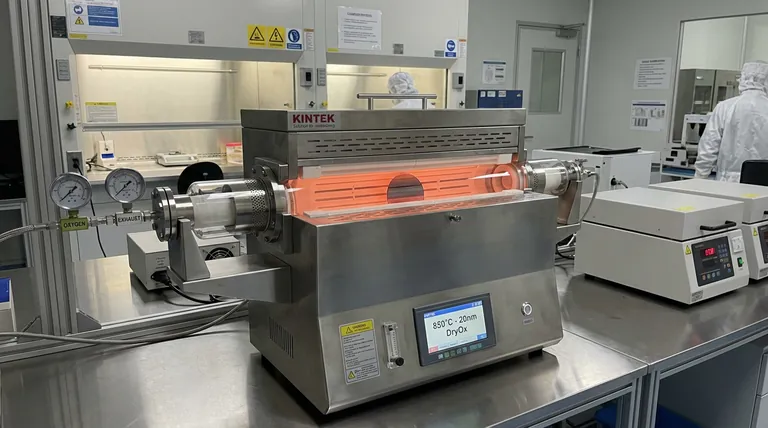
The primary function of a Quartz Tube Furnace in this context is to provide a strictly controlled environment for growing a high-quality thermal oxide (SiO2) layer on single-crystal silicon wafers. By maintaining a precise temperature of approximately 850°C in a pure oxygen atmosphere, the furnace facilitates the chemical reaction necessary to create a uniform, standardized oxide layer. This process is a critical prerequisite for advanced analysis, such as studying plasma-induced damage mechanisms.
In dry thermal oxidation, the Quartz Tube Furnace acts as a high-precision reactor that combines stable heat and pure oxygen to grow a standardized 20 nm SiO2 layer, serving as a reliable baseline for evaluating silicon wafer properties.
The Mechanics of Oxide Growth
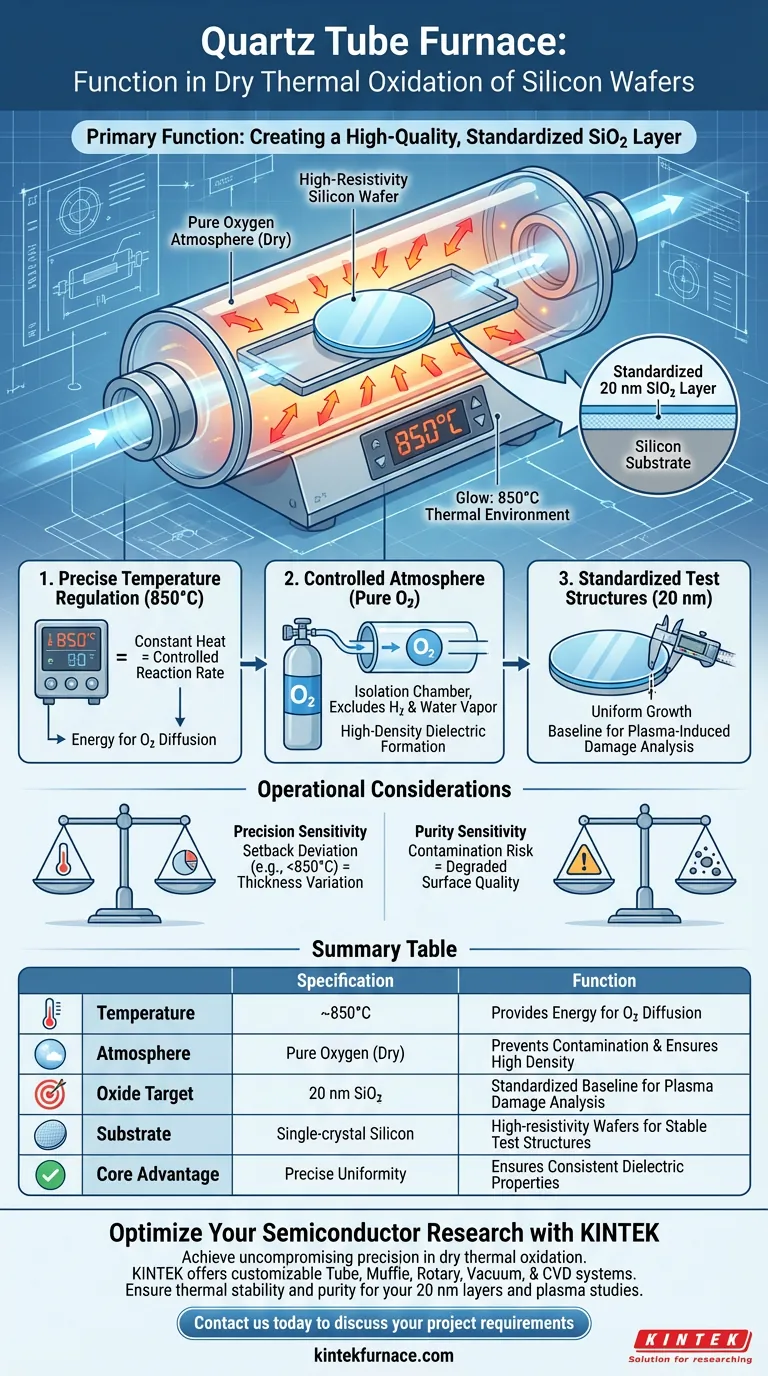
Precise Temperature Regulation
The core capability of the Quartz Tube Furnace is its ability to maintain a rigorous thermal environment, typically centered around 850°C.
This specific high-temperature setting provides the energy required for oxygen molecules to diffuse into the silicon surface.
Consistent heat is vital to ensure the reaction proceeds at a controlled rate across the entire wafer.
Controlled Atmosphere Creation
The "dry" in dry thermal oxidation refers specifically to the use of a pure oxygen atmosphere within the tube.
The quartz tube serves as an isolation chamber, protecting the high-resistivity silicon wafers from external contaminants.
By excluding hydrogen or water vapor, the furnace ensures the formation of a dense, high-quality dielectric layer.
Creating Standardized Test Structures
Ensuring Uniformity
For research into sensitive topics like plasma-induced damage, the physical dimensions of the test structure must be exact.
The furnace allows for the uniform growth of the oxide layer, typically targeting a precise thickness of 20 nm.
This uniformity ensures that any variations observed in later testing are due to the experimental variables, not defects in the initial wafer structure.
High-Quality Dielectric Formation
The interaction between single-crystal silicon and pure oxygen creates a superior interface compared to other methods.
This results in a robust thermal oxide (SiO2) layer that is electrically stable.
Such stability is essential when using high-resistivity wafers for creating standardized initial structures.
Operational Considerations and Trade-offs
The Necessity of Precision
While the Quartz Tube Furnace yields high-quality results, it relies entirely on the stability of process parameters.
A deviation from the 850°C setpoint can alter the growth rate, leading to variations in the target 20 nm thickness.
Sensitivity to Purity
The advantage of using a pure oxygen atmosphere is lost if the environment is compromised.
The quartz tube must be maintained meticulously to prevent particulate contamination, which would degrade the quality of the single-crystal silicon surface.
Applying This to Your Process
To maximize the utility of a Quartz Tube Furnace for silicon wafer processing, align your operational controls with your specific outcomes:
- If your primary focus is Research Consistency: Strictly calibrate the furnace to 850°C to ensure the resulting 20 nm oxide layer is identical across all sample batches.
- If your primary focus is Defect Analysis: Prioritize the purity of the oxygen supply to rule out contamination as a source of damage during plasma studies.
By leveraging the precise environment of a Quartz Tube Furnace, you establish the fundamental baseline required for accurate semiconductor analysis.
Summary Table:
| Parameter | Specification | Function |
|---|---|---|
| Temperature | ~850°C | Provides energy for oxygen diffusion |
| Atmosphere | Pure Oxygen (Dry) | Prevents contamination and ensures high density |
| Oxide Target | 20 nm SiO2 | Standardized baseline for plasma damage analysis |
| Substrate | Single-crystal Silicon | High-resistivity wafers for stable test structures |
| Core Advantage | Precise Uniformity | Ensures consistent dielectric properties across batches |
Optimize Your Semiconductor Research with KINTEK
Achieve uncompromising precision in your dry thermal oxidation processes with KINTEK’s industry-leading thermal solutions. Backed by expert R&D and manufacturing, KINTEK offers high-performance Tube, Muffle, Rotary, Vacuum, and CVD systems—all fully customizable to meet your unique laboratory requirements.
Whether you are growing 20 nm oxide layers or conducting advanced plasma-induced damage studies, our equipment ensures the thermal stability and purity your research demands. Contact us today to discuss your project requirements and see how our expert-engineered furnaces can elevate your material analysis.
Visual Guide
References
- Shota Nunomura, Masaru Hori. O2 and Ar plasma processing over SiO2/Si stack: Effects of processing gas on interface defect generation and recovery. DOI: 10.1063/5.0184779
This article is also based on technical information from Kintek Furnace Knowledge Base .
Related Products
- Laboratory Quartz Tube Furnace RTP Heating Tubular Furnace
- 1200℃ Split Tube Furnace Laboratory Quartz Tube Furnace with Quartz Tube
- Vertical Laboratory Quartz Tube Furnace Tubular Furnace
- Multi Zone Laboratory Quartz Tube Furnace Tubular Furnace
- High Pressure Laboratory Vacuum Tube Furnace
People Also Ask
- What physical conditions does a laboratory Tube Furnace provide for SOEC? Precision Heat for Solid Oxide Characterization
- What are the main features and functions of a laboratory tube furnace? Unlock Precise High-Temp Control for Your Lab
- What parameters must be controlled when calcining freeze-dried oxide precursors in a laboratory tube furnace? A Guide
- What conditions does a tube furnace provide for post-ion-implantation? Achieve Precise Microstructural Repair
- Why is a laboratory tube furnace necessary for BiVO4/RGO synthesis? Achieve Precise Nano-Structure Control



















