
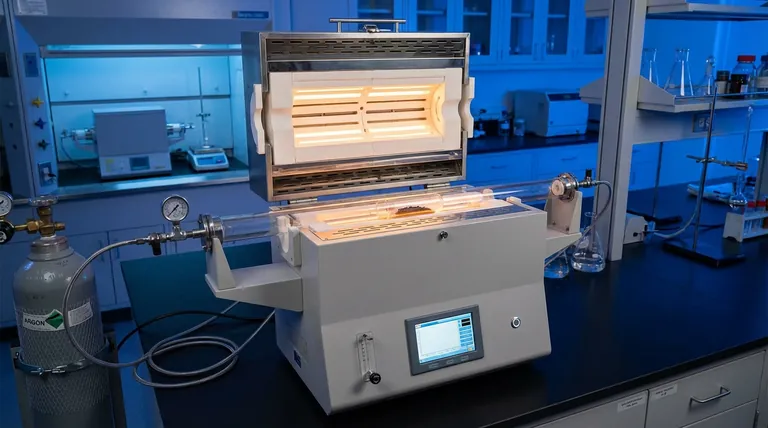
The critical necessity of an inert atmosphere tube furnace in this process is to prevent the uncontrolled oxidation of chromium ions. During the high-temperature calcination phase at 900°C, the furnace utilizes a high-purity argon flow to shield the synthesis from ambient oxygen. This protection is the only way to ensure the formation of a pure P3-type layered oxide structure with precise stoichiometry.
The inert atmosphere acts as a chemical barrier, stopping chromium from reacting with oxygen in the air; this control is the defining factor in achieving the correct crystal structure and avoiding impurity phases.
The Chemistry of High-Temperature Synthesis
Preventing Chromium Oxidation
The presence of chromium ions in the precursor material presents a specific challenge during synthesis.
At the required calcination temperature of 900°C, chromium is highly reactive and susceptible to oxidation if exposed to air.
The inert tube furnace removes ambient oxygen, ensuring that chromium remains in its intended valence state rather than oxidizing further.
Ensuring Precise Stoichiometry
Solid-state synthesis requires an exact ratio of elements to form the P3-type lattice.
Unintended oxidation alters the chemical composition, effectively breaking the required stoichiometry of the final product.
By maintaining an inert environment, you ensure the atomic ratios remain fixed exactly as weighed in the precursor stage.
Structural and Physical Integrity
Achieving Phase Purity
A "P3-type" layered oxide refers to a specific crystal stacking arrangement.
If oxidation occurs, the material may degrade into unwanted secondary phases or structural defects.
The inert atmosphere guarantees a high-purity structure, free from the defects that commonly arise from side reactions with oxygen.
Surface Quality and Homogeneity
Beyond the core chemistry, an inert atmosphere generally minimizes surface scaling and discoloration.
This results in a cathode material with improved homogeneity, which is essential for consistent electrochemical performance.
It eliminates the need for post-treatment processes like cleaning or polishing to remove oxidized layers.
Understanding the Trade-offs
The Requirement for Gas Purity
Ideally, an inert atmosphere solves all oxidation problems, but it relies heavily on the quality of the input gas.
Using standard argon rather than high-purity argon can introduce trace moisture or oxygen, enough to ruin sensitive P3 syntheses.
System Integrity Risks
The effectiveness of the furnace is limited by its seal and flow rate capabilities.
Even a minor leak in the tube seals can compromise the entire batch, as the positive pressure of the inert gas must strictly overcome any ingress of ambient air.
Making the Right Choice for Your Goal
To maximize the success of your material synthesis, align your equipment settings with your chemical objectives:
- If your primary focus is P3-Type Layered Oxides: You must use high-purity argon to strictly prevent chromium oxidation and preserve stoichiometry.
- If your primary focus is General Heat Treatment: An inert atmosphere is still recommended to prevent surface scaling and improve overall material integrity.
The inert atmosphere is not merely a protective measure; it is an active variable in the synthesis equation that defines the final phase of your material.
Summary Table:
| Feature | Importance in P3-Type Synthesis | Impact of Failure |
|---|---|---|
| Atmosphere Control | Prevents uncontrolled chromium oxidation at 900°C | Formation of unwanted impurity phases |
| Gas Purity (Argon) | Maintains precise chemical stoichiometry | Altered atomic ratios and degraded performance |
| Structural Integrity | Ensures correct P3-type crystal stacking | Structural defects and secondary phases |
| Surface Quality | Guarantees homogeneity and prevents scaling | Poor electrochemical consistency and surface damage |
Elevate Your Advanced Material Synthesis with KINTEK
Precision is the defining factor in high-temperature solid-state synthesis. KINTEK provides state-of-the-art Tube, Muffle, Vacuum, and CVD systems specifically engineered to maintain the rigorous atmosphere control required for P3-type layered oxide cathode materials.
Backed by expert R&D and world-class manufacturing, our lab furnaces offer:
- High-Purity Gas Integration: Optimized for argon flow to prevent oxidation of sensitive ions like chromium.
- Superior Seal Integrity: Maintaining strict positive pressure to eliminate oxygen ingress.
- Customizable Solutions: Tailored configurations to meet your unique stoichiometry and phase purity requirements.
Don't compromise your crystal structure. Contact KINTEK today to discover how our customizable high-temperature furnaces can ensure the success of your next synthesis.
References
- Wonseok Ko, Jongsoon Kim. Structural and electrochemical stabilization enabling high‐energy P3‐type Cr‐based layered oxide cathode for K‐ion batteries. DOI: 10.1002/cey2.454
This article is also based on technical information from Kintek Furnace Knowledge Base .
Related Products
- 1200℃ Controlled Inert Nitrogen Atmosphere Furnace
- 1400℃ Controlled Inert Nitrogen Atmosphere Furnace
- 1700℃ Controlled Inert Nitrogen Atmosphere Furnace
- Controlled Inert Nitrogen Hydrogen Atmosphere Furnace
- Mesh Belt Controlled Atmosphere Furnace Inert Nitrogen Atmosphere Furnace
People Also Ask
- What controlled-atmosphere furnace conditions are required for sintering powder metallurgy copper alloy compacts? Ideal Setup
- What are the four main types of controlled atmospheres used in these furnaces? Optimize Your Heat Treatment Processes
- What are the advantages of a controlled atmosphere furnace over tube furnaces? Superior Process Control for Sensitive Materials
- What Roles Do a Controlled Atmosphere Furnace and Oil Quenching Tank Play in AISI 5140 Steel Heat Treatment?
- How Sintering Temp Affects Density & Resistivity of Cu-Oxide Composites



















