
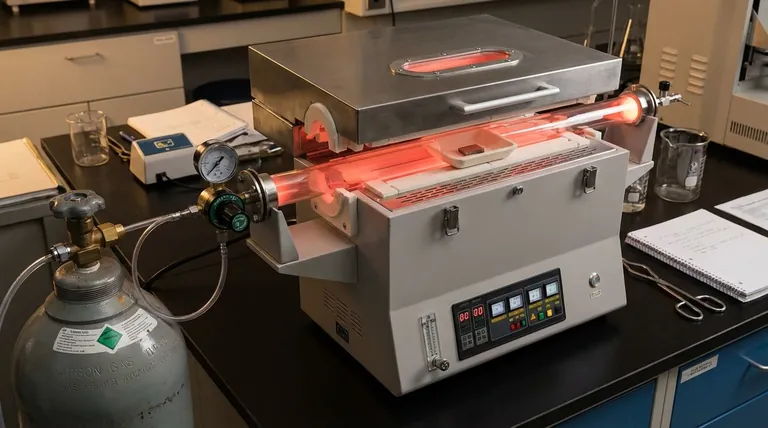
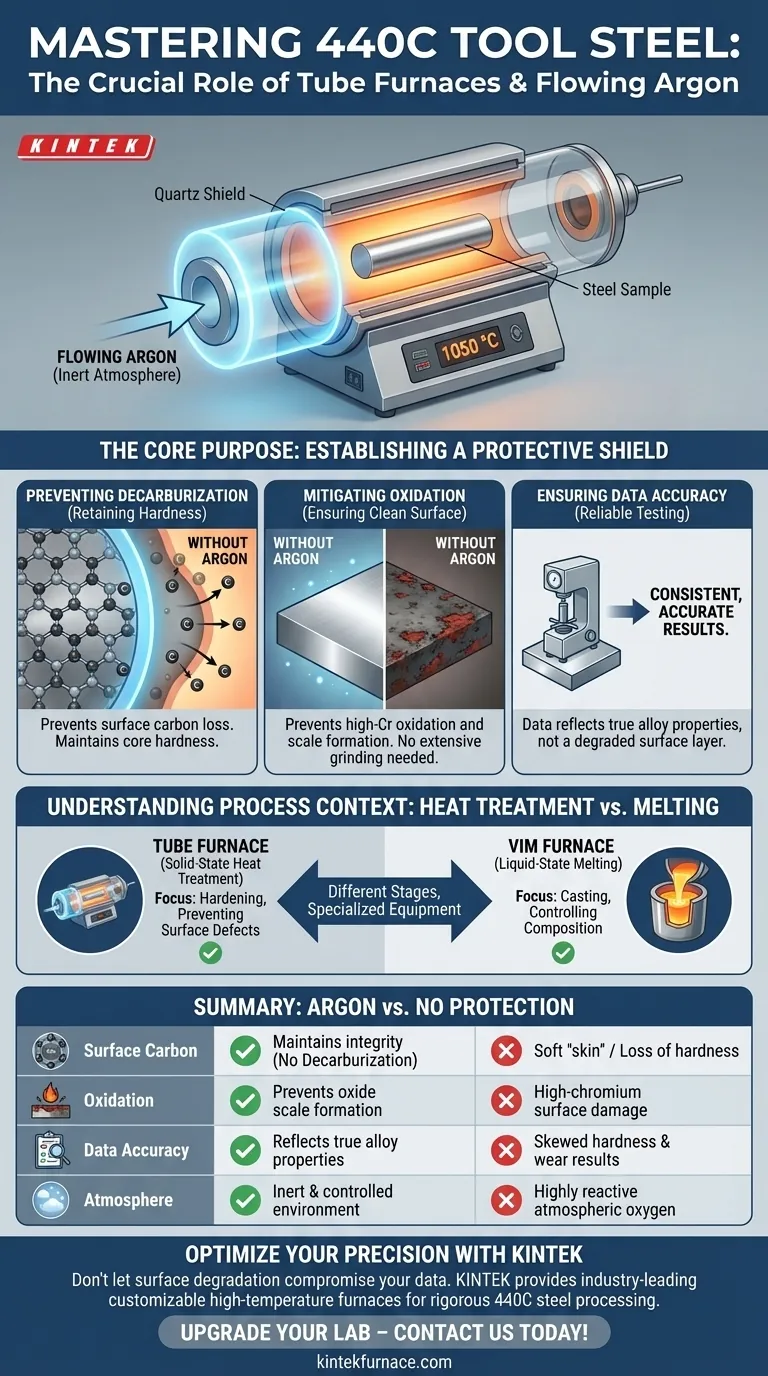
The primary purpose of using a tube furnace with flowing argon is to establish a strictly controlled, inert atmosphere during the high-temperature austenitizing process at 1050 °C. This protection is critical for preventing chemical interactions between the steel surface and the surrounding air, which would otherwise compromise the material's integrity.
Core Takeaway High-chromium steels like 440C are highly reactive at heat treatment temperatures. Flowing argon acts as a protective shield, preventing surface carbon loss (decarburization) and oxidation to ensure that subsequent hardness and wear tests measure the true properties of the alloy, not a degraded surface layer.
Preserving Chemical Integrity at High Heat
The Threat of High Temperatures
Heat treating 440C tool steel requires an austenitizing temperature of approximately 1050 °C.
At this extreme heat, the alloy becomes highly reactive. Without protection, the surface elements—specifically carbon and chromium—will react rapidly with atmospheric oxygen.
Preventing Decarburization
The most critical risk during this phase is decarburization.
This occurs when carbon atoms diffuse out of the steel surface to react with oxygen. Since carbon is the primary element responsible for hardness in 440C steel, losing it results in a soft "skin" on the material. Flowing argon creates a barrier that stops this diffusion, maintaining the correct carbon content right up to the surface.
Mitigating High-Temperature Oxidation
Simultaneously, the argon atmosphere prevents the formation of oxide scales.
440C is a high-chromium steel. While chromium provides corrosion resistance at room temperature, it can oxidize rapidly at 1050 °C if exposed to air. Argon protection ensures the sample emerges from the furnace clean, avoiding surface damage that would require extensive grinding to remove.
Ensuring Accurate Research Data
Consistency for Testing
The ultimate goal of using this setup is to ensure data validity.
For researchers and metallurgists to accurately measure hardness and wear resistance, the surface microstructural state must be consistent with the core material.
Eliminating Surface Variables
If a sample suffers from oxidation or decarburization, test results will be skewed.
By maintaining the surface chemical composition before and after heat treatment, the tube furnace setup guarantees that any performance data reflects the inherent properties of the heat-treated microstructure, not a compromised surface defect.
Understanding the Process Context
Heat Treatment vs. Melting
It is important to distinguish this heat treatment step from the initial material preparation.
While a Vacuum Induction Melting (VIM) furnace is used to prevent oxidation during the melting and casting phase (often at low pressures like 0.133 Pa), the tube furnace is specifically for the solid-state heat treatment phase.
Operational Trade-offs
While flowing argon provides excellent protection, it requires a continuous supply of gas.
Furthermore, the system relies entirely on the integrity of the tube seals. Even a minor leak can introduce enough oxygen to taint the sample surface at 1050 °C, rendering the protection ineffective.
Making the Right Choice for Your Goal
To maximize the reliability of your 440C tool steel processing, align your equipment with your specific processing stage:
- If your primary focus is Heat Treatment (Hardening): Use a tube furnace with flowing argon to prevent surface decarburization and ensure accurate hardness testing results.
- If your primary focus is Material Preparation (Casting): Use a Vacuum Induction Melting (VIM) furnace to control chemical composition and prevent inclusions during the liquid alloy phase.
By strictly controlling the atmosphere during heat treatment, you transform a variable process into a precise scientific standard.
Summary Table:
| Feature | Effect of Argon Protection | Impact Without Protection |
|---|---|---|
| Surface Carbon | Maintains integrity (No Decarburization) | Soft "skin" / Loss of hardness |
| Oxidation | Prevents oxide scale formation | High-chromium surface damage |
| Data Accuracy | Reflects true alloy properties | Skewed hardness & wear results |
| Atmosphere | Inert & controlled environment | Highly reactive atmospheric oxygen |
Optimize Your Heat Treatment Precision with KINTEK
Don't let surface degradation compromise your metallurgical data. KINTEK provides industry-leading Tube, Muffle, and Vacuum systems backed by expert R&D and manufacturing. Our high-temperature furnaces are fully customizable to meet the rigorous demands of 440C steel processing and beyond. Ensure consistent, high-purity results for your lab by partnering with thermal processing experts.
Upgrade your lab’s capabilities—Contact us today!
Visual Guide
References
- Vania Rodríguez Herrejon, Venkata Karthik Nadimpalli. Comparative Analysis of Wear Properties of 440C Tool Steel Fabricated by Spray Forming and Conventional Casting. DOI: 10.1007/s11665-025-11860-9
This article is also based on technical information from Kintek Furnace Knowledge Base .
Related Products
- Vacuum Sealed Continuous Working Rotary Tube Furnace Rotating Tube Furnace
- 1400℃ High Temperature Laboratory Tube Furnace with Alumina Tube
- 1700℃ High Temperature Laboratory Tube Furnace with Alumina Tube
- 1200℃ Split Tube Furnace Laboratory Quartz Tube Furnace with Quartz Tube
- Vertical Laboratory Quartz Tube Furnace Tubular Furnace
People Also Ask
- What is the purpose of rotary tube furnaces? Achieve Uniform Heat Treatment for Powders and Granules
- What are the key advantages of using a rotary tube furnace? Achieve Dynamic, Uniform Heating for Powders
- How does the amount of material processed vary between batch and continuous rotary tube furnaces? Scale Your Production Efficiently
- What are the advantages of rotary tube furnaces in fuel compatibility? Boost Efficiency and Cut Costs
- What is the temperature range of some rotary tube furnaces? Achieve Uniform Heating Up to 1200°C



















