
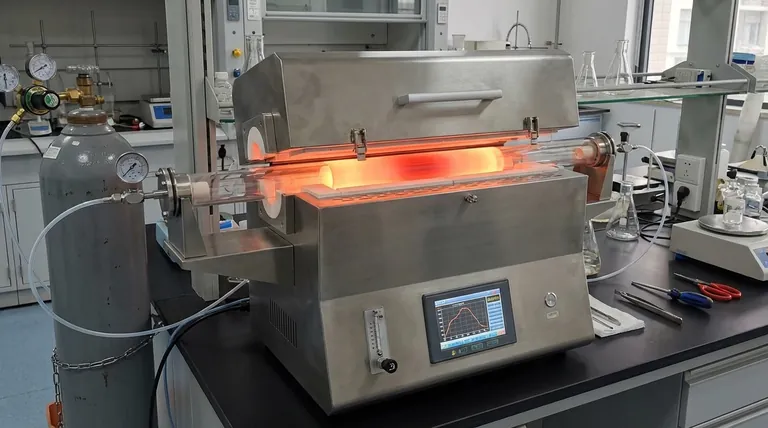
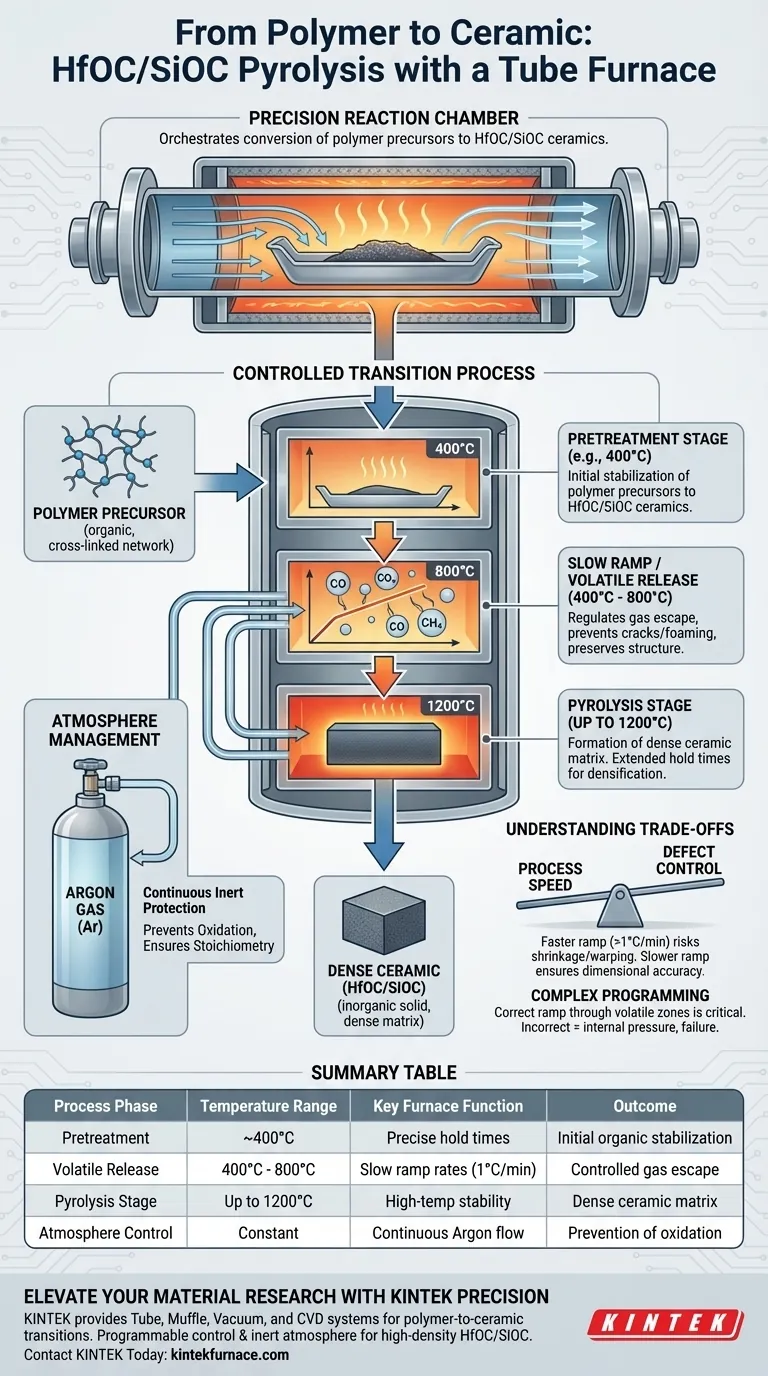
The high-temperature tube furnace functions as a precision reaction chamber that orchestrates the conversion of polymer precursors into HfOC/SiOC ceramics. It utilizes complex, multi-stage heating programs under continuous argon gas protection to manage the thermal decomposition from 400 °C up to 1200 °C. By rigorously controlling the temperature ramp, the furnace regulates the release of volatile gases, ensuring the organic network transforms into a dense, stable ceramic matrix.
The critical challenge in polymer-to-ceramic transition is managing the stress of volume loss. The tube furnace solves this by synchronizing temperature rise with mass loss, preventing structural collapse during the shift from an organic cross-linked network to an inorganic solid.
The Role of Precision Temperature Control
Executing Multi-Stage Heating
The transition from polymer to ceramic is not linear; it occurs in distinct phases. The tube furnace utilizes high-precision temperature controllers to execute complex heating programs rather than a simple, continuous blast of heat.
This programming capability allows for specific hold times at critical thresholds, such as a 400 °C pretreatment stage and a 1200 °C constant-temperature pyrolysis stage.
Regulating Volatile Release
As the polymer decomposes, it releases volatile components, specifically CO, CO2, and CH4.
If these gases are released too quickly, the material will crack or foam. The furnace’s controlled heating rate ensures these volatiles escape gradually, preserving the structural integrity of the material.
Monitoring Mass Loss
The automatic control system provides temperature compensation that correlates with mass loss characteristics.
By matching the heat input to the material's evaporation and pyrolysis stages (primary and secondary), the furnace directly influences the development of the final pore structure.
Atmosphere Management and Material Integrity
Ensuring Inert Protection
For HfOC/SiOC composites, the presence of oxygen during pyrolysis would ruin the stoichiometry.
The tube furnace maintains a continuous flow of argon gas, creating a stable, inert environment. This protects the material from oxidation and ensures the chemistry remains strictly focused on the conversion of the polymer backbone.
Achieving High Density
The ultimate goal of this process is to create a dense ceramic matrix.
By combining the inert atmosphere with the controlled removal of organic components, the furnace facilitates the formation of a dense HfOC/SiOC structure, rather than a porous or brittle char.
Understanding the Trade-offs
Process Speed vs. Defect Control
There is a direct tension between processing time and material quality.
While the furnace can reach high temperatures quickly, accelerating the ramp rate (e.g., faster than 1 °C per minute in sensitive ranges) can lead to high shrinkage and warping. You must trade processing speed for dimensional accuracy.
Complexity of Programming
The "multi-stage" capability is powerful but introduces complexity.
Incorrectly programming the ramp rates through the critical mass-loss zones (typically 400 °C – 800 °C) can result in trapped volatiles. This leads to internal pressure buildup and catastrophic failure of the ceramic part.
Making the Right Choice for Your Goal
To maximize the effectiveness of a high-temperature tube furnace for HfOC/SiOC pyrolysis, align your heating program with your specific material objectives:
- If your primary focus is structural density: Prioritize a slower ramp rate and extended hold times at 1200 °C to maximize the densification of the ceramic matrix.
- If your primary focus is dimensional accuracy: Utilize a highly segmented heating program with lower ramp rates (e.g., 1 °C/min) during the peak volatile release window to minimize shrinkage stress.
Precise thermal management is the difference between a high-performance ceramic component and a pile of carbonized dust.
Summary Table:
| Process Phase | Temperature Range | Key Furnace Function | Outcome |
|---|---|---|---|
| Pretreatment | ~400 °C | Precise hold times | Initial organic stabilization |
| Volatile Release | 400 °C - 800 °C | Slow ramp rates (1 °C/min) | Controlled gas escape (CO, CH4) |
| Pyrolysis Stage | Up to 1200 °C | High-temp stability | Formation of dense ceramic matrix |
| Atmosphere Control | Constant | Continuous Argon flow | Prevention of oxidation/stoichiometry loss |
Elevate Your Material Research with KINTEK Precision
Don't let volatile release or thermal stress compromise your advanced ceramics. KINTEK provides industry-leading Tube, Muffle, Vacuum, and CVD systems specifically engineered for the rigorous demands of polymer-to-ceramic transitions.
Backed by expert R&D and manufacturing, our systems offer the programmable multi-stage control and inert atmosphere management required for high-density HfOC/SiOC composites. Whether you need a standard setup or a fully customizable high-temperature furnace for your unique research goals, our team is ready to deliver the reliability your lab deserves.
Ready to achieve superior material density and dimensional accuracy?
Contact KINTEK Today to Discuss Your Custom Solution
Visual Guide
References
- Arijit Roy, Gurpreet Singh. Preparation and characterization of HfOC/SiOC composite powders and fibermats <i>via</i> the polymer pyrolysis route. DOI: 10.1039/d5ra02006a
This article is also based on technical information from Kintek Furnace Knowledge Base .
Related Products
- 1400℃ High Temperature Laboratory Tube Furnace with Alumina Tube
- 1700℃ High Temperature Laboratory Tube Furnace with Alumina Tube
- 1200℃ Split Tube Furnace Laboratory Quartz Tube Furnace with Quartz Tube
- Vertical Laboratory Quartz Tube Furnace Tubular Furnace
- 1700℃ High Temperature Muffle Oven Furnace for Laboratory
People Also Ask
- How does zone-melting in tube furnaces synthesize bismuth micro-wires? Master Single-Crystal Thermoelectric Growth
- How do high-temperature laboratory tube furnaces ensure environmental stability? Precision Thermal Reduction Tips
- How are high-temp tube furnaces used to measure diffusion coefficients per Fick's law? Master Precision Annealing
- How are high-temperature laboratory tube furnaces applied in long-term vacuum homogenization heat treatments for intermetallic samples?
- How are high-temperature tube furnaces applied in testing ceramic-supported alloy membranes? Insights



















