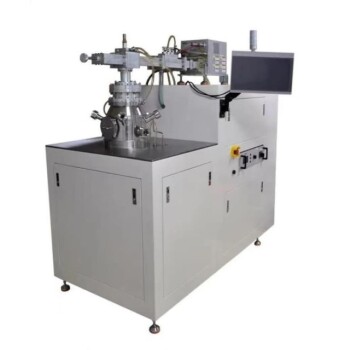
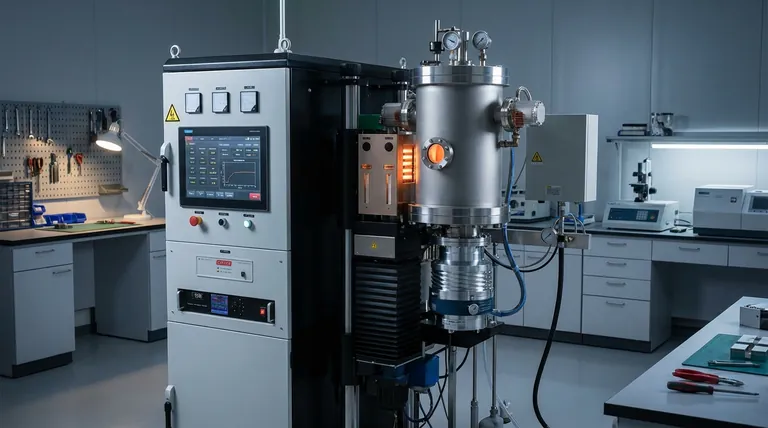
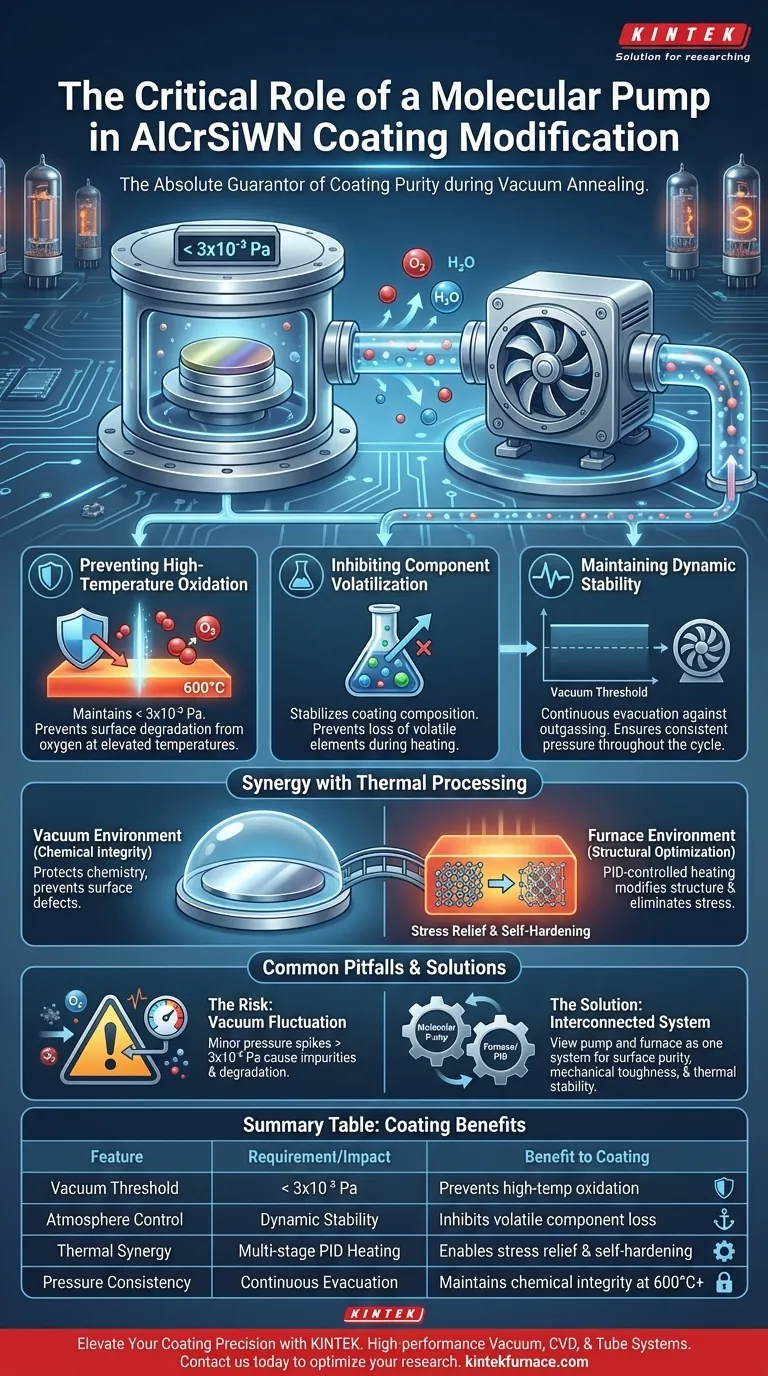
The molecular pump unit is the absolute guarantor of coating purity. It is critical for the modification of AlCrSiWN coatings because it maintains a dynamic vacuum level below 3x10^-3 Pa throughout the annealing cycle. This specific pressure threshold prevents the coating from oxidizing or losing volatile components at high temperatures, ensuring the material's chemical integrity remains intact while its structure is optimized.
By sustaining a high-vacuum environment, the molecular pump allows the annealing process to alter the physical structure of the coating without degrading its chemical surface. It serves as the defensive barrier against high-temperature oxidation during the crucial heating phase.
The Role of High Vacuum in Coating Modification
Preventing High-Temperature Oxidation
The primary danger to AlCrSiWN coatings during annealing is exposure to oxygen at elevated temperatures.
At operating temperatures such as 600°C, standard atmospheric conditions would cause immediate surface degradation. The molecular pump actively removes gas molecules to prevent these chemical reactions.
Inhibiting Component Volatilization
Beyond oxidation, complex coatings are susceptible to losing specific elements through volatilization when heated.
The molecular pump maintains a consistent vacuum environment that stabilizes the coating's composition. This ensures that the stoichiometry of the AlCrSiWN layer remains as intended, rather than altering due to the evaporation of volatile components.
Maintaining Dynamic Stability
The vacuum requirement is not static; it must be maintained continuously against potential outgassing.
The "dynamic" nature of the vacuum provided by the molecular pump ensures that even as the furnace heats up and materials potentially release gases, the pressure remains strictly below the 3x10^-3 Pa threshold.
Synergy with Thermal Processing
Enabling Effective Stress Relief
While the vacuum pump protects the chemistry, the furnace environment addresses the mechanical properties.
According to supplementary data, the vacuum tube furnace utilizes PID controllers to eliminate brittle residual stresses generated during deposition. The molecular pump creates the safe environment necessary for this stress relief to occur without side effects.
Facilitating Self-Hardening Effects
The annealing process is designed to induce a self-hardening effect and improve thermal stability.
These structural improvements rely on precise multi-stage heating and isothermal holding. The molecular pump ensures that these delicate thermal cycles modify the internal structure without compromising the surface quality.
Common Pitfalls to Avoid
The Risk of Vacuum Fluctuation
If the molecular pump fails to maintain the pressure below 3x10^-3 Pa, the integrity of the process is compromised.
Even minor fluctuations in pressure at 600°C can introduce impurities. This can lead to a coating that is mechanically stress-relieved but chemically degraded on the surface.
Over-Reliance on Thermal Control Alone
A precise PID controller and heating program are insufficient without the molecular pump.
Perfect thermal management cannot compensate for a poor vacuum. Without the molecular pump effectively evacuating the chamber, the precise heat treatment becomes a catalyst for oxidation rather than optimization.
Ensuring Process Success
To maximize the performance of your AlCrSiWN coatings, you must view the vacuum unit and the furnace as an interconnected system.
- If your primary focus is Surface Purity: Ensure your molecular pump is calibrated to sustain pressures strictly below 3x10^-3 Pa to prevent oxidation.
- If your primary focus is Mechanical Toughness: Verify that the vacuum stability allows the PID controller to complete the full multi-stage heating cycle to eliminate residual stresses.
- If your primary focus is Thermal Stability: Utilize the interference-free environment created by the pump to allow for prolonged isothermal holding periods.
The molecular pump is not just an accessory; it is the foundational component that makes high-temperature structural optimization possible.
Summary Table:
| Feature | Requirement/Impact | Benefit to Coating |
|---|---|---|
| Vacuum Threshold | < 3x10^-3 Pa | Prevents high-temperature oxidation |
| Atmosphere Control | Dynamic Stability | Inhibits volatile component loss |
| Thermal Synergy | Multi-stage PID Heating | Enables stress relief & self-hardening |
| Pressure Consistency | Continuous Evacuation | Maintains chemical integrity at 600°C+ |
Elevate Your Coating Precision with KINTEK
Don't let oxidation compromise your advanced material research. KINTEK’s industry-leading thermal solutions—including our high-performance Vacuum, CVD, and Tube systems—are engineered to provide the stable, high-vacuum environments required for delicate AlCrSiWN modification.
Backed by expert R&D and manufacturing, our systems are fully customizable to meet your unique laboratory needs. Contact us today to discover how our specialized high-temperature furnaces can optimize your material's chemical integrity and mechanical performance.
Visual Guide
References
- Feng Guo. Research on the Performance of AlCrSiWN Tool Coatings for Hardened Steel Cutting. DOI: 10.62051/ijmee.v6n2.01
This article is also based on technical information from Kintek Furnace Knowledge Base .
Related Products
- Stainless Steel Quick Release Vacuum Chain Three Section Clamp
- Multi Heating Zones CVD Tube Furnace Machine for Chemical Vapor Deposition Equipment
- 915MHz MPCVD Diamond Machine Microwave Plasma Chemical Vapor Deposition System Reactor
- Slide PECVD Tube Furnace with Liquid Gasifier PECVD Machine
- Multi Zone Laboratory Quartz Tube Furnace Tubular Furnace
People Also Ask
- What is the function of quartz vacuum encapsulation in RhSeCl CVT? Mastering Pure Crystal Growth
- What type of pump is used in water circulating vacuum pumps and how is it installed? Discover Robust Fluid-Based Vacuum Solutions
- What role do vacuum-sealed high-purity silica ampoules play in phase equilibrium experiments? Enhance Sample Integrity
- What is the operating principle of a vacuum freeze-dryer in the fabrication of carbon aerogels? Master Sublimation
- What role does a vacuum atmosphere play in Sn-Ag-Co TLP soldering? Optimize Bond Purity and Joint Strength