
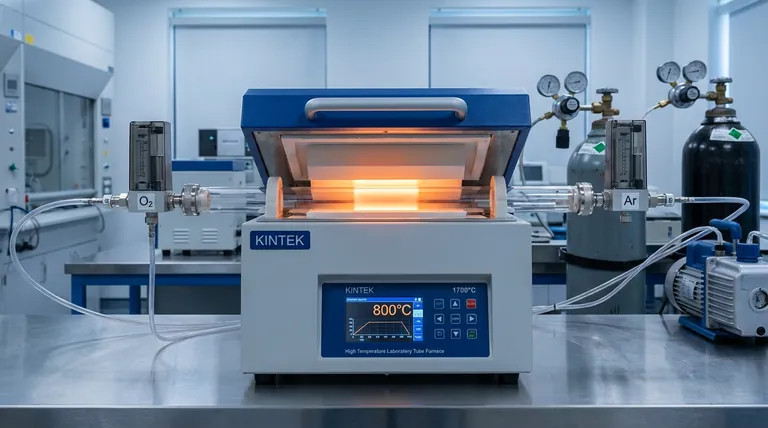
The primary role of a high-temperature tube furnace is to facilitate the critical phase transition of gallium oxide (Ga2O3) thin films. It provides a strictly controlled thermal environment that supplies the necessary energy to convert the material from a disordered amorphous state into a highly ordered polycrystalline structure.
The tube furnace acts as a kinetic enabler, maintaining constant temperatures (such as 800°C) to drive atomic migration. This rearrangement of gallium and oxygen atoms into proper lattice positions is the fundamental mechanism that releases internal stress, eliminates structural defects, and defines the film's final crystalline quality.
The Mechanics of Structural Transformation
Driving the Amorphous-to-Polycrystalline Transition
In its as-deposited state, a gallium oxide thin film often exists in an amorphous phase, lacking long-range order. The tube furnace provides the thermal energy required to overcome the activation barrier for crystallization.
By subjecting the film to a sustained high temperature, the furnace forces the material to undergo a physical phase transition. This shifts the internal structure from a disordered state to a stable polycrystalline state, which is a prerequisite for reliable semiconductor performance.
Facilitating Atomic Migration
The core function of the furnace is to mobilize atoms. At elevated temperatures, gallium and oxygen atoms gain sufficient kinetic energy to migrate within the material.
This mobility allows the atoms to rearrange themselves, moving from random positions into energetically favorable lattice sites. This reorganization is what constitutes the "healing" of the crystal structure.
Eliminating Defects and Internal Stress
During the deposition process, thin films often accumulate significant internal stress and structural flaws. The annealing process acts as a relaxation mechanism.
As atoms settle into their correct lattice positions, internal stresses are released. Simultaneously, the density of structural defects is significantly reduced, resulting in a film with higher structural integrity and fewer distinct imperfections.
The Critical Role of Atmosphere Control
Managing Oxygen Vacancies
Beyond simple heating, a tube furnace allows for precise control over the gaseous environment surrounding the sample. This is particularly vital for gallium oxide, which is prone to oxygen vacancies (missing oxygen atoms in the lattice).
By introducing an oxygen-rich atmosphere during the annealing process, the furnace enables environmental oxygen atoms to diffuse into the film. These atoms fill the vacancy defects, effectively repairing the stoichiometry of the crystal.
Enhancing Optoelectronic Response
The reduction of defects directly translates to device performance. High concentrations of oxygen vacancies can act as carrier traps, degrading the material's electrical properties.
Controlled atmosphere annealing can drastically reduce oxygen vacancy concentrations—potentially lowering them from over 21% to roughly 6.5%. This reduction significantly improves the response speed and overall sensitivity of optoelectronic detectors made from the film.
Understanding the Trade-offs
Temperature versus Substrate Stability
While high temperatures (e.g., 800°C) are beneficial for maximizing crystallinity, they impose strict requirements on the substrate.
The tube furnace applies heat to everything inside it. Consequently, the chosen substrate must be thermally stable enough to withstand the annealing process without warping, melting, or chemically reacting with the gallium oxide film.
Atmosphere Selection Limitations
The choice of gas within the furnace dictates the outcome. While oxygen repairs vacancies in oxides, inert gases like argon are used when oxidation must be prevented.
Using an inert atmosphere when an oxidizing one is needed (or vice versa) can lock in defects rather than fixing them. The furnace’s ability to control this variable is only as effective as the operator’s selection of the correct gas for the specific chemical goal.
Making the Right Choice for Your Goal
The configuration of your annealing process should be dictated by the specific material property you need to optimize.
- If your primary focus is Structural Integrity: Prioritize a stable, high-temperature plateau (approx. 800°C) to maximize the amorphous-to-polycrystalline transition and release internal stress.
- If your primary focus is Device Performance (Detectors): Utilize an oxygen-controlled atmosphere during annealing to aggressively fill oxygen vacancies and enhance response speed.
Ultimately, the tube furnace is not just a heater; it is a reactor that rearranges the atomic landscape to engineer specific material properties.
Summary Table:
| Process Objective | Furnace Role & Mechanism | Material Outcome |
|---|---|---|
| Phase Transition | Provides thermal energy (e.g., 800°C) | Converts amorphous Ga2O3 to polycrystalline |
| Stress Relief | Drives atomic migration & rearrangement | Releases internal stress & heals crystal lattice |
| Stoichiometry Repair | Enables controlled O2 atmosphere | Fills oxygen vacancies and reduces defects |
| Device Optimization | Precise atmosphere & thermal control | Improves optoelectronic response and sensitivity |
Elevate Your Material Research with KINTEK Precision
Ready to achieve the perfect crystalline structure for your Ga2O3 thin films? Backed by expert R&D and manufacturing, KINTEK offers high-performance Muffle, Tube, Rotary, Vacuum, and CVD systems designed for the rigorous demands of semiconductor annealing.
Our furnaces provide the thermal stability and atmospheric precision necessary to eliminate defects and optimize your lab's efficiency. Whether you need a standard setup or a fully customizable system for unique research needs, our team is here to help.
Contact KINTEK today to discuss your high-temperature furnace requirements.
References
- Wen-Jie Chen, Qing‐Chun Zhang. Influence of annealing pretreatment in different atmospheres on crystallization quality and UV photosensitivity of gallium oxide films. DOI: 10.1039/d3ra07568k
This article is also based on technical information from Kintek Furnace Knowledge Base .
Related Products
- 1700℃ High Temperature Laboratory Tube Furnace with Alumina Tube
- 1400℃ High Temperature Laboratory Tube Furnace with Alumina Tube
- 1200℃ Split Tube Furnace Laboratory Quartz Tube Furnace with Quartz Tube
- Vertical Laboratory Quartz Tube Furnace Tubular Furnace
- 1700℃ Controlled Inert Nitrogen Atmosphere Furnace
People Also Ask
- How does zone-melting in tube furnaces synthesize bismuth micro-wires? Master Single-Crystal Thermoelectric Growth
- How are high-temperature laboratory tube furnaces applied in long-term vacuum homogenization heat treatments for intermetallic samples?
- How are high-temp tube furnaces used to measure diffusion coefficients per Fick's law? Master Precision Annealing
- How do high-temperature laboratory tube furnaces ensure environmental stability? Precision Thermal Reduction Tips
- How are high-temperature tube furnaces applied in testing ceramic-supported alloy membranes? Insights



















