
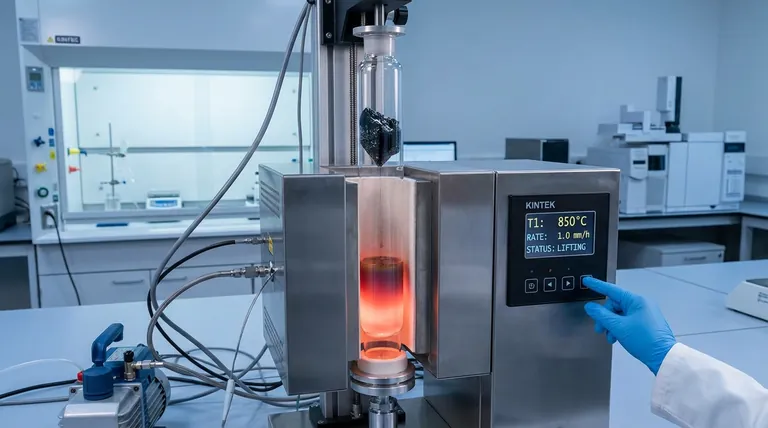
Precise mechanical translation through a thermal gradient is the primary mechanism by which a vertical single-temperature zone tube furnace facilitates the growth of Palladium Diselenide (PdSe2).
By combining high-temperature soaking with an extremely slow lifting motion, the system forces the molten material to cool directionally, transitioning from liquid to solid in a controlled manner that aligns the crystal lattice structure.
Core Takeaway The vertical single-temperature zone tube furnace employs the vertical Bridgman-type growth method to grow PdSe2. Success depends on moving a quartz tube through the furnace's natural thermal gradient at a specific rate (1 mm/h), rather than simply lowering the furnace temperature globally.
Establishing the Thermal Foundation
Achieving a Uniform Melt
Before growth can begin, the raw materials must be completely homogenized.
The furnace is programmed to heat the materials to 850°C.
Once this temperature is reached, it is maintained for a 50-hour soaking period.
Removing Thermal History
This extended soaking phase is critical for erasing any previous thermal history in the raw materials.
It ensures that the melt is chemically uniform and free of un-melted particles that could act as unwanted nucleation sites later.
The Mechanics of Crystallization
The Vertical Bridgman-Type Method
Unlike methods that rely solely on lowering the thermostat, this furnace utilizes a vertical lifting mechanism.
The physical movement of the sample is the driver of crystallization, known as the Bridgman technique.
Utilizing the Natural Thermal Gradient
A single-zone furnace creates a "hot zone" in the center, but the temperature naturally drops off toward the top and bottom openings.
This drop-off is the natural thermal gradient.
By lifting the quartz tube containing the melt out of the central hot zone and into the cooler upper region, the material is forced to cool.
Directional Solidification
Because the tube moves vertically, cooling occurs from one end of the tube to the other.
This creates a directional solidification front.
The crystal grows layer by layer, which prevents random nucleation and results in a single, continuous crystal structure.
Controlling the Growth Rate
Extremely Slow Translation
The speed at which the tube is lifted dictates the quality of the crystal.
For PdSe2, the optimal rate is 1 mm/h.
Minimizing Defects
This slow pace is essential for maintaining a stable crystallization front.
If the tube moves too fast, the melt cools too quickly, trapping stresses or causing polycrystalline defects.
The slow 1 mm/h rate allows the atoms sufficient time to arrange themselves into a perfect lattice, resulting in high-quality, large single crystals.
Understanding the Trade-offs
Time Intensity
The primary drawback of this method is the time required.
With a lift rate of only 1 mm/h, growing a crystal of significant length takes days or even weeks, independent of the 50-hour pre-soak.
Mechanical Stability Risks
Because the method relies on physical movement, the lifting mechanism must be vibration-free.
Any mechanical jitter in the lift motor can disturb the liquid-solid interface, introducing defects into the crystal structure precisely when stability is most needed.
Making the Right Choice for Your Goal
This furnace setup is specialized for high-quality outcomes rather than rapid production. Consider the following when setting up your growth protocol:
- If your primary focus is Crystal Purity: Ensure the 50-hour soaking period at 850°C is strictly observed to guarantee a completely homogeneous melt before lifting begins.
- If your primary focus is Structural Integrity: Verify that your vertical lifting mechanism is calibrated to exactly 1 mm/h, as deviations can induce stress and grain boundaries.
Success in growing PdSe2 lies not just in high heat, but in the patience of the cooling process.
Summary Table:
| Parameter | Specification | Purpose |
|---|---|---|
| Soaking Temperature | 850°C | Homogenizes raw materials & removes thermal history |
| Soaking Duration | 50 Hours | Ensures chemical uniformity & prevents unwanted nucleation |
| Growth Method | Vertical Bridgman-type | Utilizes natural thermal gradients for directional solidification |
| Translation Rate | 1 mm/h | Slow cooling for stable lattice arrangement & defect minimization |
| Key Mechanism | Mechanical Lifting | Moves sample through gradient to control the solid-liquid interface |
Elevate Your Material Research with KINTEK
Precision is the foundation of high-quality crystal growth. KINTEK provides industry-leading Muffle, Tube (Horizontal & Vertical), Rotary, and Vacuum CVD systems designed to meet the rigorous demands of researchers growing PdSe2 and other advanced materials.
Backed by expert R&D and specialized manufacturing, our furnaces offer the mechanical stability and precise thermal control required for successful Bridgman-type growth. Whether you need a standard setup or a customizable solution tailored to your unique experimental parameters, KINTEK delivers the reliability your lab deserves.
Ready to achieve superior crystallization results? Contact our technical experts today to find your perfect furnace solution!
References
- Y. Zhang, Chun Ning Lau. Quantum octets in high mobility pentagonal two-dimensional PdSe2. DOI: 10.1038/s41467-024-44972-2
This article is also based on technical information from Kintek Furnace Knowledge Base .
Related Products
- Vertical Laboratory Quartz Tube Furnace Tubular Furnace
- Custom Made Versatile CVD Tube Furnace Chemical Vapor Deposition CVD Equipment Machine
- Vacuum Sealed Continuous Working Rotary Tube Furnace Rotating Tube Furnace
- Slide PECVD Tube Furnace with Liquid Gasifier PECVD Machine
- Split Chamber CVD Tube Furnace with Vacuum Station CVD Machine
People Also Ask
- What are the key differences between single-zone and multi-zone vertical tube furnaces? Choose the Right Furnace for Your Lab
- How are metal support wires selected for sample suspension? Expert Guide to High-Temp Furnace Materials
- What is a vertical tube furnace and how does it function? Optimize Material Processing with Precision
- What makes a vertical tube furnace easy to operate? Discover Intuitive Automation for Precision Heating
- What are the main characteristics of vertical tube furnaces? Optimize Your Lab with Space-Saving, Uniform Heating



















