
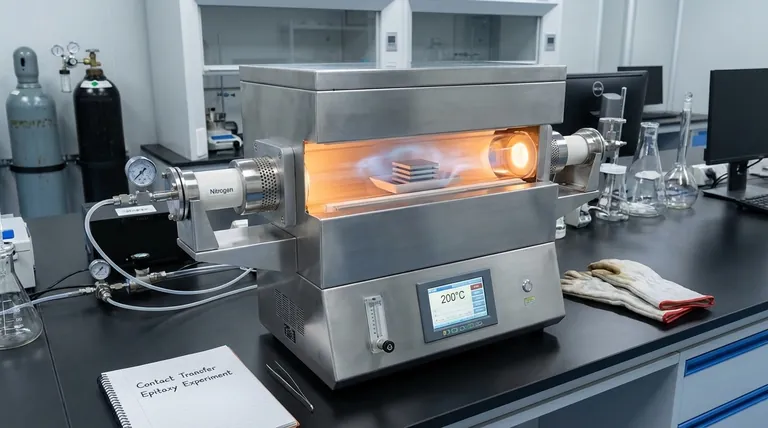
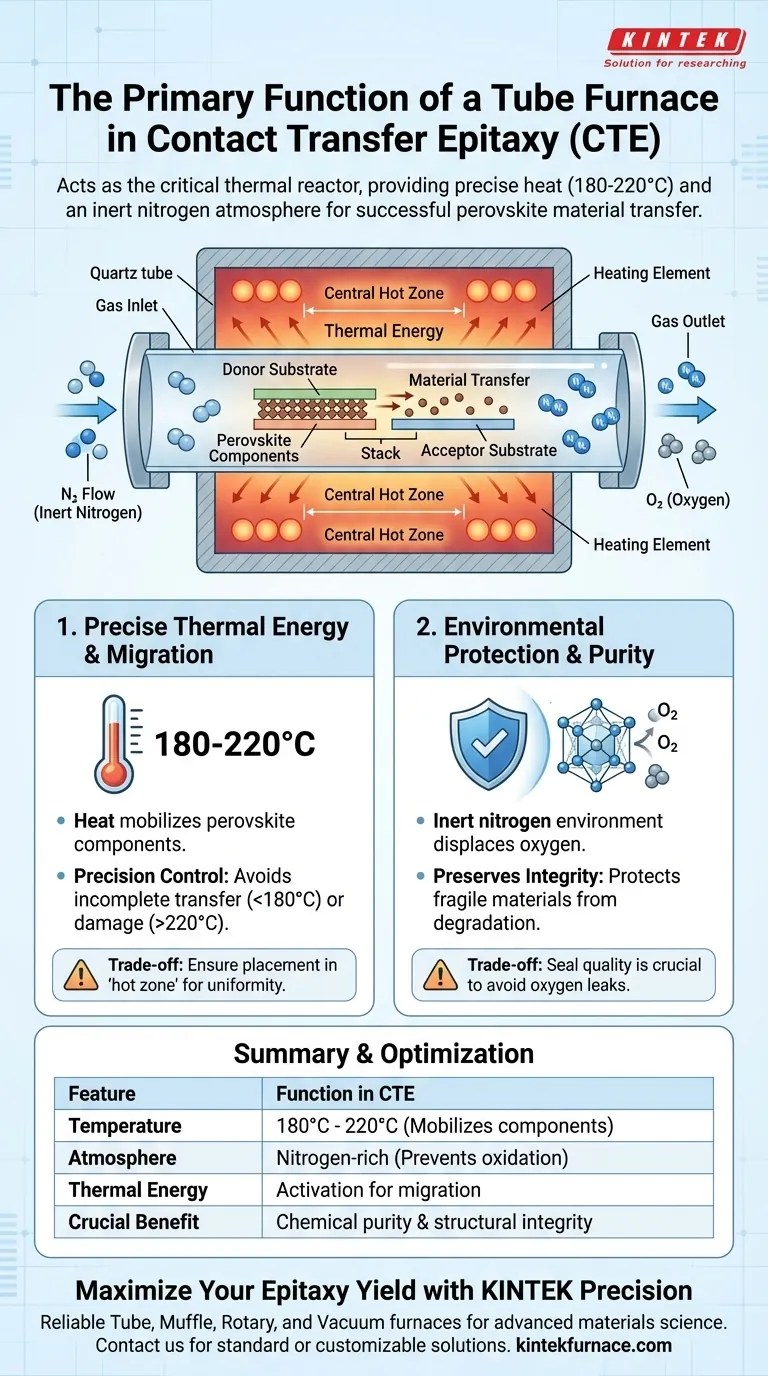
The tube furnace acts as the critical thermal reactor in the contact transfer epitaxy process. Its primary function is to generate a precise high-temperature environment—typically between 180 and 220 °C—which provides the thermal energy required to transfer perovskite components from a donor substrate to an acceptor substrate. Beyond heating, it simultaneously maintains a controlled nitrogen atmosphere to prevent the chemical degradation of these sensitive materials.
The tube furnace serves a dual purpose: it supplies the exact thermal energy needed to drive material transfer between contacting substrates while isolating the process in an inert environment to preserve chemical purity.
The Mechanics of Thermal Transfer
Driving Component Migration
The core mechanism of this process relies on bringing donor and acceptor substrates into direct physical contact. The tube furnace is responsible for heating this "stack" of materials.
When the furnace reaches the target range of 180 to 220 °C, the thermal energy mobilizes the perovskite components. This activation energy allows the material to physically transfer from the donor source to the target acceptor surface.
Precision Temperature Control
Success in this process depends on maintaining a specific temperature window. The tube furnace provides the stability required to hold the temperature steady.
If the temperature drops below 180 °C, the transfer energy may be insufficient for a complete coating. If it exceeds 220 °C, you risk damaging the substrate or decomposing the material.
Environmental Protection and Purity
Preventing Oxidation
Perovskite materials are chemically fragile when exposed to heat in standard air. They are particularly susceptible to oxidation, which ruins their electronic properties.
The tube furnace mitigates this by allowing for a controlled gas environment. The design enables the introduction of a continuous nitrogen flow during the heating cycle.
Preserving Material Integrity
By displacing oxygen with nitrogen, the furnace creates an inert processing zone. This ensures that as the perovskite heats up and transfers, it does not react with the atmosphere.
This protective step is essential for ensuring that the final transferred layer retains its intended structure without degradation.
Understanding the Trade-offs
Thermal Uniformity Challenges
While tube furnaces provide excellent temperature control, they can suffer from thermal gradients near the ends of the tube.
If the substrate stack is not positioned deep within the central "hot zone," the actual temperature at the sample site may differ from the setpoint. This can lead to partial or uneven material transfer.
Atmosphere Integrity Risks
The protective function of the furnace is entirely dependent on the seal quality and gas purity.
Even a minor leak in the nitrogen line or the tube flanges can introduce enough oxygen to degrade the perovskite at these elevated temperatures. Constant monitoring of gas flow is required to ensure the "inert" environment is actually inert.
Optimizing Your CTE Setup
To ensure successful contact transfer epitaxy, align your equipment usage with your specific processing goals:
- If your primary focus is transfer completeness: Calibrate your furnace to identify the exact center of the hot zone, ensuring your substrates reach the full 180–220 °C required for migration.
- If your primary focus is material purity: Purge the tube with nitrogen thoroughly before beginning the heating ramp to eliminate any residual oxygen that could cause oxidation.
Mastering the thermal and atmospheric parameters of your tube furnace is the single most important factor in achieving high-quality perovskite transfer.
Summary Table:
| Feature | Function in Contact Transfer Epitaxy (CTE) |
|---|---|
| Temperature Range | Operates between 180°C and 220°C to mobilize components |
| Atmospheric Control | Provides nitrogen-rich inert environment to prevent oxidation |
| Thermal Energy | Provides the activation energy for donor-to-acceptor migration |
| Crucial Benefit | Ensures chemical purity and structural integrity of perovskite |
| Key Constraint | Requires precise 'hot zone' placement for thermal uniformity |
Maximize Your Epitaxy Yield with KINTEK Precision
Don't let thermal gradients or atmospheric leaks compromise your perovskite research. KINTEK provides industry-leading Tube, Muffle, Rotary, and Vacuum furnaces designed for the rigorous demands of advanced materials science. Backed by expert R&D and manufacturing, our systems offer the precision temperature control and gas-tight integrity required for successful contact transfer epitaxy.
Whether you need a standard setup or a customizable solution tailored to your unique lab specifications, KINTEK delivers the reliability you need to achieve consistent results.
Ready to elevate your thermal processing? Contact us today to speak with a specialist.
Visual Guide
References
- Hongyu Sun, Erik C. Garnett. Contact Transfer Epitaxy of Halide Perovskites. DOI: 10.1002/adma.202308892
This article is also based on technical information from Kintek Furnace Knowledge Base .
Related Products
- Vacuum Sealed Continuous Working Rotary Tube Furnace Rotating Tube Furnace
- 1400℃ High Temperature Laboratory Tube Furnace with Alumina Tube
- 1700℃ High Temperature Laboratory Tube Furnace with Alumina Tube
- 1200℃ Split Tube Furnace Laboratory Quartz Tube Furnace with Quartz Tube
- Vertical Laboratory Quartz Tube Furnace Tubular Furnace
People Also Ask
- What is the purpose of rotary tube furnaces? Achieve Uniform Heat Treatment for Powders and Granules
- What are the key advantages of using a rotary tube furnace? Achieve Dynamic, Uniform Heating for Powders
- How does the amount of material processed vary between batch and continuous rotary tube furnaces? Scale Your Production Efficiently
- What are the advantages of rotary tube furnaces in fuel compatibility? Boost Efficiency and Cut Costs
- What is the temperature range of some rotary tube furnaces? Achieve Uniform Heating Up to 1200°C



















