
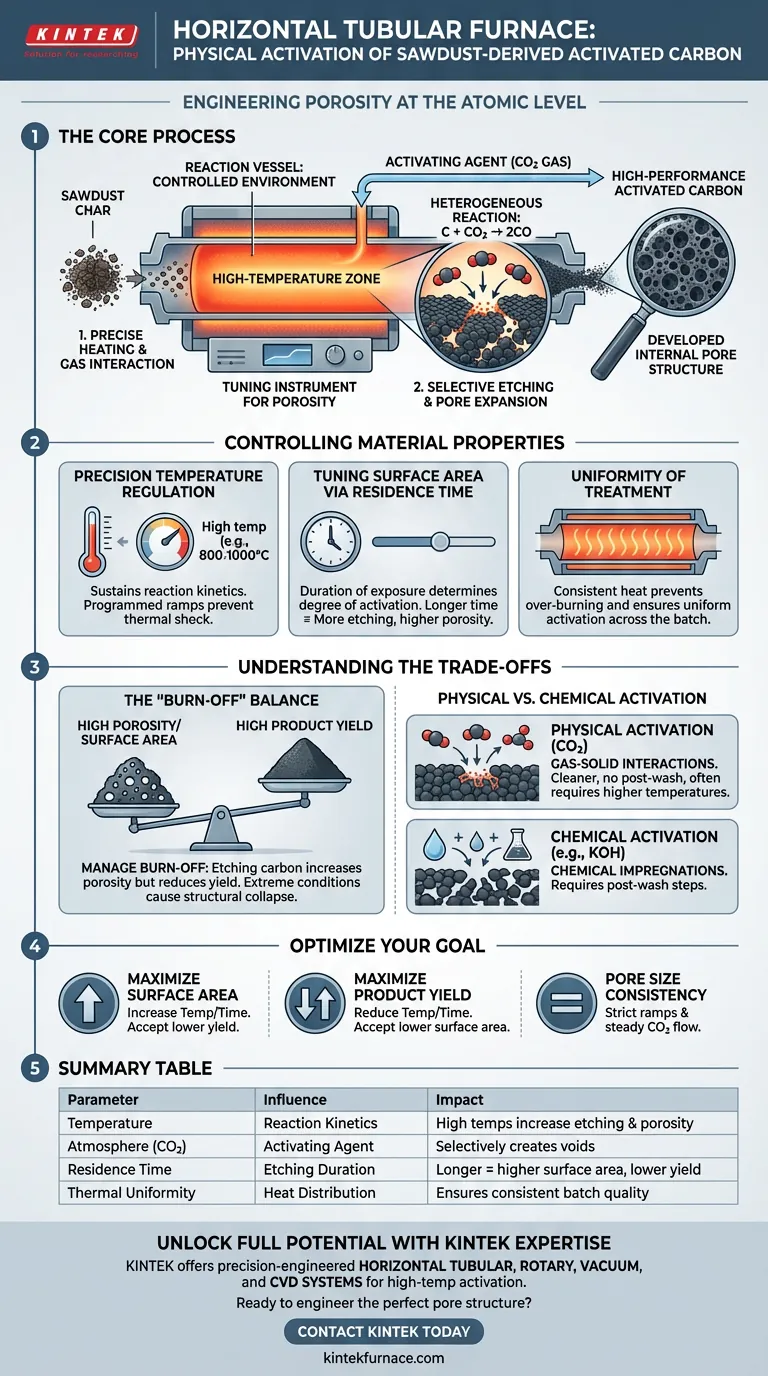
A Horizontal Tubular Furnace acts as the critical reaction vessel for converting sawdust-derived char into high-performance activated carbon. It creates a precisely controlled environment where high-temperature carbon dioxide (CO2) gas interacts with the carbon material. This process, known as physical activation, selectively removes specific carbon atoms to hollow out the material and develop an extensive internal pore structure.
The furnace function goes beyond simple heating; it serves as a tuning instrument for porosity. By strictly regulating the interaction between the gas atmosphere and the carbon skeleton, the furnace controls the "etching" process that defines the final surface area and adsorption capacity of the material.
The Mechanism of Physical Activation
Creating the Reactive Atmosphere
The primary contribution of the Horizontal Tubular Furnace is the maintenance of a specific atmospheric condition.
While pre-carbonization requires an inert atmosphere (like Nitrogen or Argon) to prevent burning, physical activation introduces an activating agent, typically carbon dioxide (CO2). The furnace ensures this gas flows continuously over the material at high temperatures.
The Heterogeneous Reaction
Within the furnace, a heterogeneous reaction occurs between the solid carbon and the gaseous CO2.
The high thermal energy drives the CO2 to attack the amorphous carbon matrix. This reaction selectively etches carbon atoms from the structure, effectively "eating away" parts of the material to create voids.
Pore Expansion
This etching process does not merely create holes; it actively expands existing pore diameters.
As the reaction progresses, closed pores are opened and existing micropores are widened. This transforms the dense, sawdust-derived char into a highly porous structure with a vast internal surface area.
Controlling Material Properties
Precision Temperature Regulation
The furnace provides the high thermal stability required to sustain reaction kinetics.
Physical activation typically requires maintaining precise high temperatures to ensure the activation energy for the C-CO2 reaction is met. The furnace allows for programmed temperature ramps, ensuring the material reaches the activation phase without thermal shock.
Tuning Surface Area via Residence Time
The specific surface area of the final product is determined by how long the material remains in the furnace.
By regulating the residence time (the duration of exposure to heat and CO2), operators can finely tune the degree of activation. Longer residence times generally lead to more etching and higher porosity.
Uniformity of Treatment
The horizontal tubular design facilitates consistent heat distribution across the sample.
This ensures that the sawdust-derived material is activated uniformly, preventing scenarios where some particles are over-burned (turned to ash) while others remain under-activated.
Understanding the Trade-offs
The "Burn-off" Balance
The most critical trade-off in using a tubular furnace for physical activation is managing "burn-off."
To increase surface area (porosity), you must etch away carbon atoms, which inevitably reduces the total yield (mass) of the product. Operating the furnace at extreme temperatures or for too long can destroy the pore walls entirely, leading to structural collapse and loss of valuable product.
Physical vs. Chemical Activation
It is important to distinguish the method described here from chemical activation.
While the furnace hardware is capable of both, physical activation relies on gas-solid interactions (CO2) rather than chemical impregnations (like KOH). Physical activation inside the furnace is generally cleaner and requires no post-wash steps, but it often demands higher temperatures than chemical methods to achieve similar porosity.
Making the Right Choice for Your Goal
To optimize the physical activation of sawdust-derived carbon, you must adjust the furnace parameters based on your desired outcome.
- If your primary focus is Maximizing Surface Area: Increase the furnace temperature or residence time to deepen the etching effect, accepting a lower total yield.
- If your primary focus is Maximizing Product Yield: Reduce the activation time or temperature to preserve the carbon skeleton, accepting a lower specific surface area.
- If your primary focus is Pore Size Consistency: Utilize strict temperature ramps and a steady CO2 flow rate to ensure a uniform heterogeneous reaction throughout the batch.
Mastering the Horizontal Tubular Furnace allows you to engineer the internal architecture of carbon at the atomic level.
Summary Table:
| Parameter | Influence on Activation | Impact on Activated Carbon |
|---|---|---|
| Temperature | Controls reaction kinetics | High temps increase etching & porosity |
| Atmosphere (CO2) | Acts as the activating agent | Selectively removes carbon to create voids |
| Residence Time | Defines duration of etching | Longer time increases surface area/reduces yield |
| Thermal Uniformity | Ensures consistent heat distribution | Prevents over-burning and ensures batch quality |
Optimize Your Carbon Activation with KINTEK Expertise
Unlock the full potential of your sawdust-derived materials with KINTEK’s precision engineering. Backed by expert R&D and manufacturing, KINTEK offers Horizontal Tubular, Rotary, Vacuum, and CVD systems tailored for high-temperature physical and chemical activation.
Whether you are aiming for record-breaking surface areas or consistent industrial yields, our customizable lab furnaces provide the stability and atmospheric control your research demands.
Ready to engineer the perfect pore structure? Contact KINTEK Today to Discuss Your Custom Solution
Visual Guide
References
- Xiaoyang Guo, Steven T. Boles. Holistic Processing of Sawdust to Enable Sustainable Hybrid Li-Ion Capacitors. DOI: 10.1007/s11837-024-06542-1
This article is also based on technical information from Kintek Furnace Knowledge Base .
Related Products
- Vertical Laboratory Quartz Tube Furnace Tubular Furnace
- Multi Zone Laboratory Quartz Tube Furnace Tubular Furnace
- Laboratory Quartz Tube Furnace RTP Heating Tubular Furnace
- High Pressure Laboratory Vacuum Tube Furnace
- 1700℃ High Temperature Laboratory Tube Furnace with Alumina Tube
People Also Ask
- What are the key differences between single-zone and multi-zone vertical tube furnaces? Choose the Right Furnace for Your Lab
- What is the purpose of using an industrial-grade vertical tube furnace in phosphorus recovery? High-Fidelity Simulation
- What makes a vertical tube furnace easy to operate? Discover Intuitive Automation for Precision Heating
- What are the main characteristics of vertical tube furnaces? Optimize Your Lab with Space-Saving, Uniform Heating
- How does a vertical single-temperature zone tube furnace facilitate the growth of high-quality PdSe2 single crystals?



















