
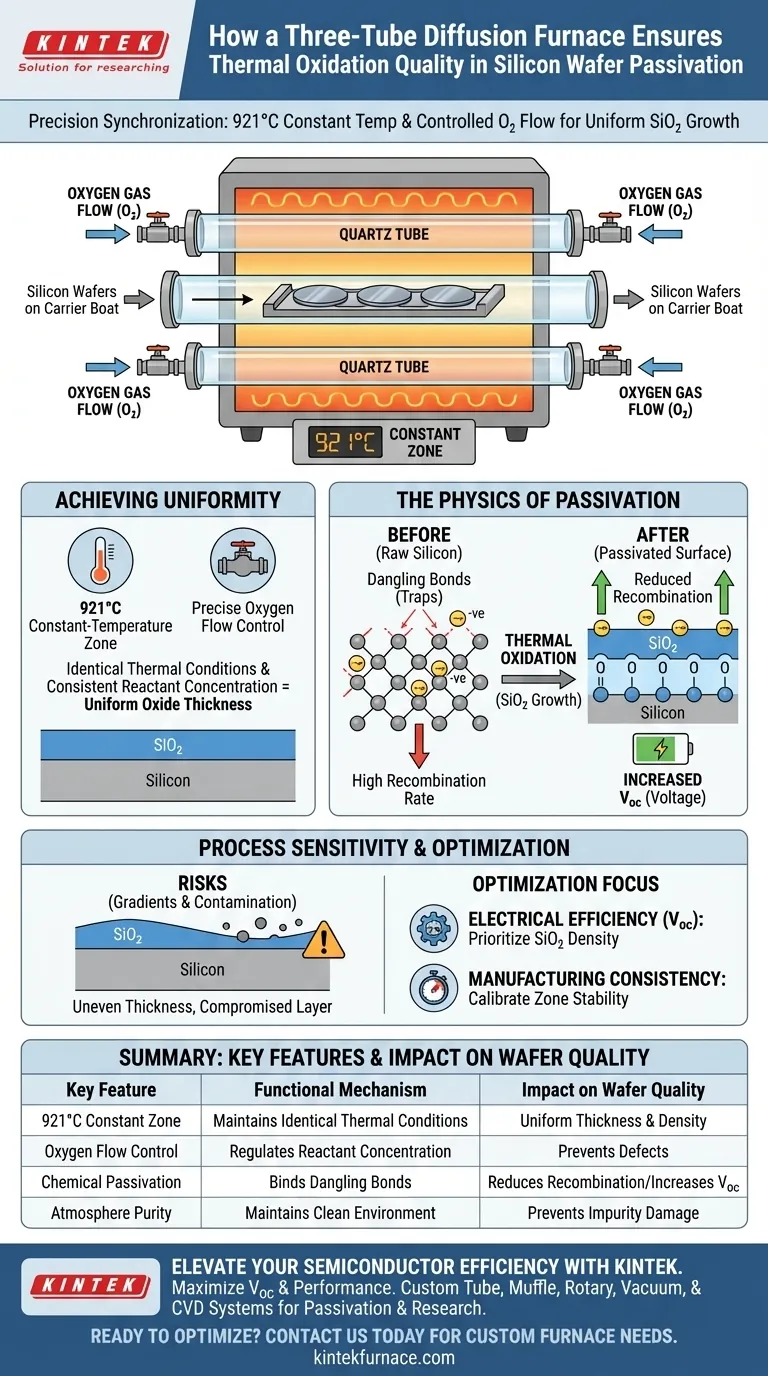
The quality of thermal oxidation layers in a three-tube diffusion furnace is ensured by the precise synchronization of oxygen gas flow and high-precision temperature regulation. By maintaining a strict constant-temperature zone, typically around 921°C, the system grows a dense, uniformly thick silicon dioxide (SiO2) layer that is critical for wafer performance.
Core Insight: The primary value of this furnace is not just heating, but chemical "passivation." By creating a uniform oxide barrier, the furnace effectively neutralizes surface defects, preventing electron loss and directly increasing the battery's open-circuit voltage (Voc).
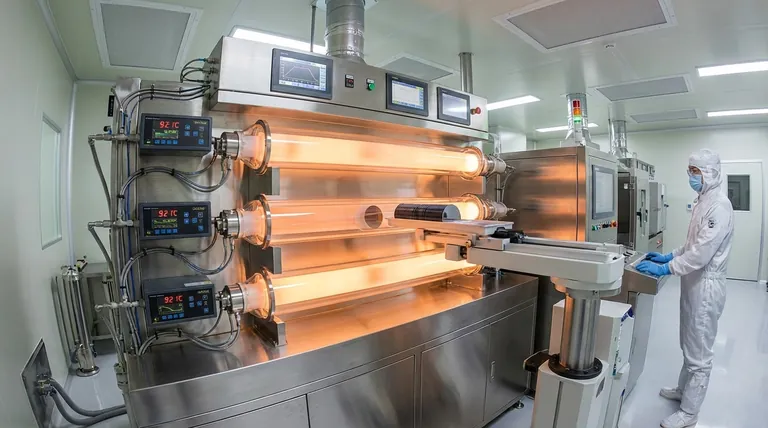
Achieving Layer Uniformity
The Constant-Temperature Zone
The furnace relies on an extended constant-temperature zone to ensure every part of the silicon wafer is exposed to identical thermal conditions.
Operating at high temperatures, such as the 921°C benchmark, creates the ideal environment for stable oxide growth.
Controlling Gas Flow
Uniformity is further guaranteed by the strict regulation of oxygen gas flow into the tube.
This control ensures that the reactant concentration is consistent across the wafer surface, preventing variations in the thickness of the silicon dioxide layer.
The Physics of Passivation
Fixing "Dangling Bonds"
Raw silicon surfaces contain atomic defects known as "dangling bonds," which are essentially broken chemical connections.
The thermal oxidation process uses the grown SiO2 layer to chemically bind with these defects. This process is known as passivation.
Reducing Surface Recombination
When dangling bonds are left unchecked, they act as traps for charge carriers, leading to a high "surface recombination rate."
By passivating the surface, the furnace drastically lowers this recombination rate, ensuring that generated electrons are collected rather than lost.
Impact on Voltage (Voc)
The direct result of lower recombination is an increase in the open-circuit voltage (Voc).
This metric is essential for the overall efficiency of the device, making the quality of the thermal oxidation layer a determining factor in final battery performance.
Understanding Process Sensitivity
The Risk of Thermal Gradients
The effectiveness of the passivation layer is entirely dependent on the stability of the temperature zone.
Any fluctuation or gradient within the "constant" zone will lead to uneven oxide thickness, compromising the layer's density and protective qualities.
Purity and Contamination
While the diffusion process introduces oxygen intentionally, the environment must remain free of unwanted contaminants.
Just as vacuum furnaces are used in other contexts to prevent corrosion and impurity, the diffusion furnace must maintain a clean environment to ensure the SiO2 layer remains pure and structurally sound.
Optimizing for Device Performance
To maximize the benefits of a three-tube diffusion furnace, your operational focus should align with your specific efficiency goals.
- If your primary focus is Electrical Efficiency (Voc): Prioritize the density of the SiO2 layer to ensure maximum neutralization of dangling bonds.
- If your primary focus is Manufacturing Consistency: Focus on calibrating the length and stability of the constant-temperature zone to guarantee uniform thickness across all wafers.
Ultimately, the three-tube diffusion furnace transforms raw silicon into a high-efficiency component by turning a delicate surface chemical reaction into a controlled, repeatable industrial process.
Summary Table:
| Key Feature | Functional Mechanism | Impact on Wafer Quality |
|---|---|---|
| 921°C Constant Zone | Maintains identical thermal conditions across the tube | Ensures uniform oxide thickness and density |
| Oxygen Flow Control | Regulates reactant concentration during growth | Prevents thickness variations and layer defects |
| Chemical Passivation | Binds dangling bonds on silicon surfaces | Reduces surface recombination and increases Voc |
| Atmosphere Purity | Maintains a clean, controlled environment | Prevents impurities from compromising the SiO2 structure |
Elevate Your Semiconductor Efficiency with KINTEK
Maximize your device performance and open-circuit voltage (Voc) with KINTEK’s advanced thermal solutions. Backed by expert R&D and precision manufacturing, KINTEK offers high-performance Tube, Muffle, Rotary, Vacuum, and CVD systems, all customizable to your specific laboratory or industrial high-temperature needs. Whether you require absolute temperature stability for passivation or high-purity environments for material research, our furnaces provide the consistency your process demands.
Ready to optimize your thermal oxidation process? Contact us today to discuss your custom furnace needs!
Visual Guide
References
- Nurul Aqidah Mohd Sinin, Mohd Adib Ibrahim. Electrical performance for in-situ doping of phosphorous in silver paste screen-printed contact on p-type silicon solar cell. DOI: 10.61435/ijred.2025.60822
This article is also based on technical information from Kintek Furnace Knowledge Base .
Related Products
- Custom Made Versatile CVD Tube Furnace Chemical Vapor Deposition CVD Equipment Machine
- Split Chamber CVD Tube Furnace with Vacuum Station CVD Machine
- Laboratory Quartz Tube Furnace RTP Heating Tubular Furnace
- Vacuum Sealed Continuous Working Rotary Tube Furnace Rotating Tube Furnace
- Multi Heating Zones CVD Tube Furnace Machine for Chemical Vapor Deposition Equipment
People Also Ask
- Why are CVD tube furnace sintering systems indispensable for 2D material research and production? Unlock Atomic-Scale Precision
- What is a CVD tube furnace and what is its primary function? Discover Precision Thin-Film Deposition
- How does CVD tube furnace sintering enhance graphene growth? Achieve Superior Crystallinity and High Electron Mobility
- Which industries and research fields benefit from CVD tube furnace sintering systems for 2D materials? Unlock Next-Gen Tech Innovations
- What improvements can be made to the bonding force of gate dielectric films using a CVD tube furnace? Enhance Adhesion for Reliable Devices



















