
The primary function of using a high-temperature tube furnace for FePt thin films is to drive a specific structural phase transition and physically shape the material.
By maintaining a controlled thermal environment of approximately 700°C, the furnace provides the energy required to transform the film from a disordered state into the desired $L1_0$ hard magnetic phase. Simultaneously, this heat treatment serves a lithographic purpose by thermally decomposing polystyrene microsphere templates, leaving behind clean, firmly attached FePt bases ready for further structural growth.
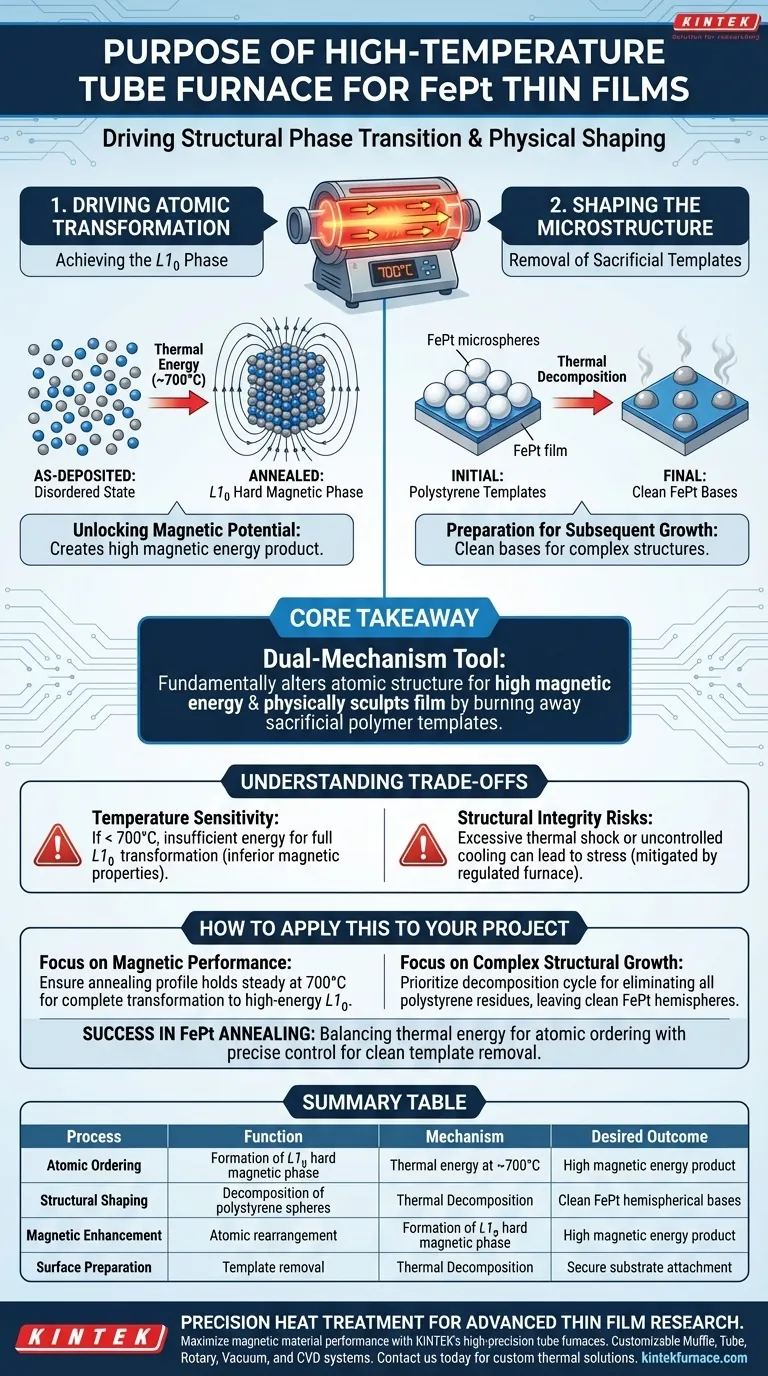
Core Takeaway The annealing process acts as a dual-mechanism tool: it fundamentally alters the atomic structure to create a high magnetic energy product and physically sculpts the film by burning away sacrificial polymer templates.
Driving Atomic Transformation
Achieving the $L1_0$ Phase
The most critical objective of this annealing step is atomic ordering. As-deposited FePt films often exist in a chemically disordered state, which lacks the desired magnetic properties.
The Role of Thermal Energy
The tube furnace supplies the necessary thermal energy (around 700°C) to mobilize iron and platinum atoms. This allows them to migrate and rearrange into a specific tetragonal superlattice known as the $L1_0$ phase.
Unlocking Magnetic Potential
This structural rearrangement is directly responsible for the material's performance. The transition to the $L1_0$ phase creates a material with a high magnetic energy product, turning the thin film into a robust hard magnet.
Shaping the Microstructure
Removal of Sacrificial Templates
Beyond atomic ordering, the furnace performs a critical cleaning function. The FePt synthesis described relies on polystyrene microsphere templates to define the film's initial shape.
Thermal Decomposition
The high temperatures within the tube furnace cause these polystyrene spheres to decompose completely. This effectively "develops" the structure, removing the polymer without damaging the metal film.
Preparation for Subsequent Growth
Once the templates are removed, the process leaves behind FePt hemispherical bases. These bases are firmly attached to the substrate, serving as the foundational anchors for the subsequent growth of complex structures, such as magnesium-zinc spirals.
Understanding the Trade-offs
Temperature Sensitivity
The success of this process relies heavily on precise thermal regulation. If the temperature falls significantly below 700°C, the atoms may not possess enough energy to achieve the full $L1_0$ transformation, leaving the film with inferior magnetic properties.
Structural Integrity Risks
While high heat is necessary for template removal, excessive thermal shock or uncontrolled cooling can lead to stress. However, a properly regulated tube furnace mitigates this, ensuring the final hemispherical bases remain intact and adhered to the substrate.
How to Apply This to Your Project
If your primary focus is Magnetic Performance:
- Ensure your annealing profile holds steady at 700°C to guarantee the complete transformation from the disordered phase to the high-energy $L1_0$ hard magnetic phase.
If your primary focus is Complex Structural Growth:
- Prioritize the decomposition cycle to ensure all polystyrene residues are eliminated, leaving behind clean FePt hemispheres for the magnesium-zinc spiral growth step.
Success in FePt annealing requires balancing the thermal energy needed for atomic ordering with the precise control required for clean template removal.
Summary Table:
| Process Function | Mechanism | Desired Outcome |
|---|---|---|
| Atomic Ordering | Thermal energy at ~700°C | Formation of $L1_0$ hard magnetic phase |
| Structural Shaping | Decomposition of polystyrene spheres | Clean FePt hemispherical bases |
| Magnetic Enhancement | Atomic rearrangement | High magnetic energy product |
| Surface Preparation | Template removal | Secure substrate attachment for future growth |
Precision Heat Treatment for Advanced Thin Film Research
Maximize your magnetic material performance with KINTEK’s high-precision tube furnaces. Backed by expert R&D and manufacturing, we offer customizable Muffle, Tube, Rotary, Vacuum, and CVD systems designed to meet the rigorous thermal demands of $L1_0$ phase transitions and sacrificial template removal.
Whether you are a researcher or an industrial manufacturer, KINTEK provides the reliability and temperature uniformity needed for complex material synthesis. Contact us today to find your custom thermal solution and see how our lab high-temp furnaces can empower your next breakthrough.
Visual Guide
References
- Florian Peter, Peer Fischer. Degradable and Biocompatible Magnesium Zinc Structures for Nanomedicine: Magnetically Actuated Liposome Microcarriers with Tunable Release. DOI: 10.1002/adfm.202314265
This article is also based on technical information from Kintek Furnace Knowledge Base .
Related Products
- 1700℃ High Temperature Laboratory Tube Furnace with Alumina Tube
- 1400℃ High Temperature Laboratory Tube Furnace with Alumina Tube
- 1200℃ Split Tube Furnace Laboratory Quartz Tube Furnace with Quartz Tube
- Vertical Laboratory Quartz Tube Furnace Tubular Furnace
- High Temperature Muffle Oven Furnace for Laboratory Debinding and Pre Sintering
People Also Ask
- How does zone-melting in tube furnaces synthesize bismuth micro-wires? Master Single-Crystal Thermoelectric Growth
- How do high-temperature laboratory tube furnaces ensure environmental stability? Precision Thermal Reduction Tips
- How are high-temperature laboratory tube furnaces applied in long-term vacuum homogenization heat treatments for intermetallic samples?
- How are high-temp tube furnaces used to measure diffusion coefficients per Fick's law? Master Precision Annealing
- How are high-temperature tube furnaces applied in testing ceramic-supported alloy membranes? Insights



















