
Independent thermal regulation is the defining function of a double-temperature zone tube furnace in the synthesis of 2D epsilon-Fe2O3 nanosheets. By separating the heating chamber into two distinct regions, this equipment allows you to simultaneously control the evaporation rate of the precursor (such as FeCl2·4H2O) in the first zone and the nucleation kinetics of the nanosheets in the second.
The dual-zone configuration effectively decouples the source material's evaporation from the product's formation. This separation creates a tunable temperature gradient essential for balancing the vapor supply with the specific energy requirements needed to grow high-quality, morphologically consistent 2D nanosheets.
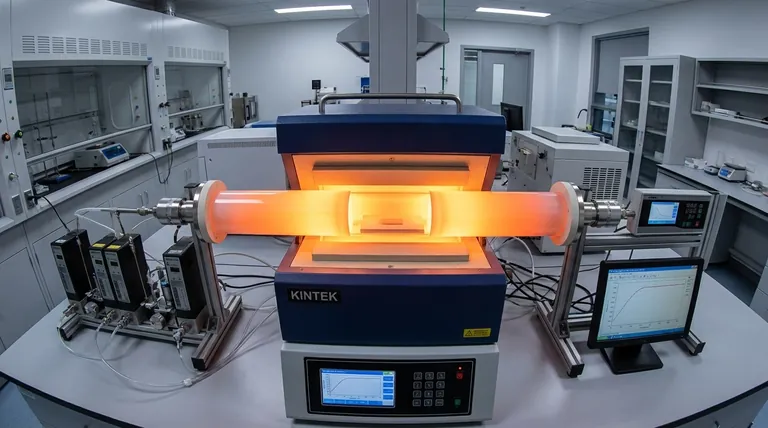
The Mechanism of Dual-Zone Control
In a standard Chemical Vapor Deposition (CVD) process, the conditions required to vaporize a solid precursor rarely match the conditions required to grow a crystal on a substrate. A double-temperature zone furnace solves this by isolating these two critical phases.
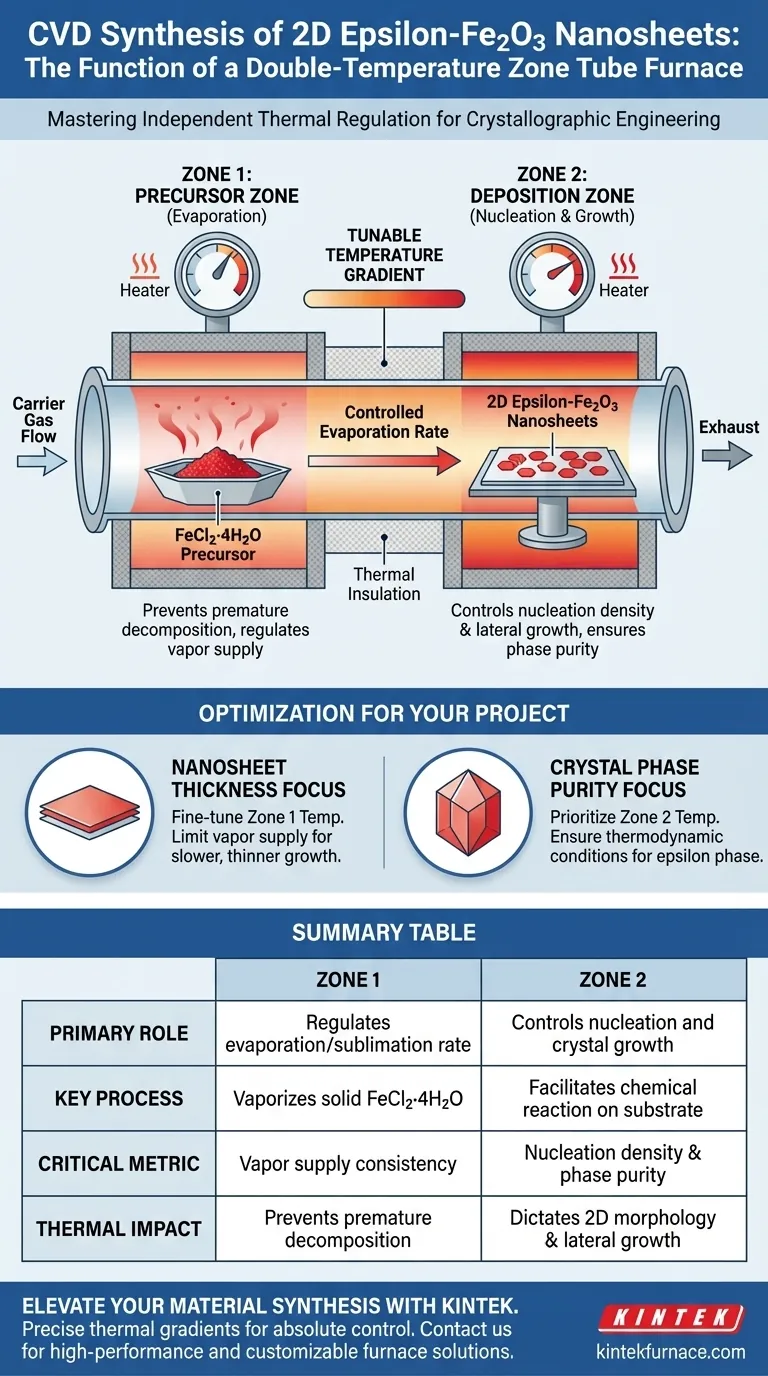
Zone 1: Regulating Precursor Evaporation
The first zone is dedicated to the precursor material, typically FeCl2·4H2O in this specific synthesis.
The function of this zone is to heat the source material to a precise point where it sublimates or evaporates at a controlled rate.
By maintaining this zone independently, you prevent the precursor from decomposing too early or vaporizing too rapidly, which would flood the system with excess reactant.
Zone 2: Controlling Deposition Kinetics
The second zone is the deposition zone, where the substrate is located and the actual synthesis of 2D epsilon-Fe2O3 occurs.
This zone is maintained at a different, often higher, temperature designed specifically to facilitate the chemical reaction and subsequent crystallization on the substrate.
Precise thermal control here dictates the nucleation density and the lateral growth of the nanosheets, ensuring the formation of the specific epsilon phase rather than other iron oxide polymorphs.
The Role of the Temperature Gradient
Between these two zones lies a critical temperature gradient.
This gradient, combined with the flow of a carrier gas, guides the vaporized precursor from the source zone to the deposition zone.
Proper management of this gradient ensures that the vapor travels downstream without condensing prematurely on the tube walls before reaching the target substrate.
Understanding the Trade-offs
While a double-temperature zone furnace offers superior control compared to a single-zone setup, it introduces complexity that must be managed carefully.
Complexity of Parameter Optimization
With two independent heating zones, you double the number of thermal variables you must stabilize.
You must find the perfect ratio between the evaporation temperature (Zone 1) and the reaction temperature (Zone 2).
A mismatch can lead to poor morphology; for example, if Zone 1 is too hot relative to Zone 2, the substrate may become oversaturated, leading to bulk growth rather than thin 2D nanosheets.
Optimization for Your Project
To maximize the utility of a double-temperature zone furnace for epsilon-Fe2O3 synthesis, align your thermal settings with your specific structural goals.
- If your primary focus is Nanosheet Thickness: Focus on fine-tuning the precursor zone temperature to limit the vapor supply rate, ensuring slower, thinner growth.
- If your primary focus is Crystal Phase Purity: Prioritize the precision of the deposition zone temperature to ensure the thermodynamic conditions strictly favor the epsilon-Fe2O3 phase over others.
By mastering the gradient between these two zones, you transition from simple heating to true crystallographic engineering.
Summary Table:
| Feature | Zone 1 (Precursor Zone) | Zone 2 (Deposition Zone) |
|---|---|---|
| Primary Role | Regulates evaporation/sublimation rate | Controls nucleation and crystal growth |
| Key Process | Vaporizes solid FeCl2·4H2O | Faciliates chemical reaction on substrate |
| Critical Metric | Vapor supply consistency | Nucleation density & phase purity |
| Thermal Impact | Prevents premature decomposition | Dictates 2D morphology & lateral growth |
Elevate Your Material Synthesis with KINTEK
Precise thermal gradients are the key to mastering 2D material synthesis. Backed by expert R&D and manufacturing, KINTEK offers high-performance Muffle, Tube, Rotary, Vacuum, and CVD systems designed to give you absolute control over your research parameters. Whether you need standard configurations or a customizable solution for your unique high-temperature lab needs, our furnaces deliver the stability and accuracy your project demands.
Ready to optimize your CVD process? Contact us today to find your perfect furnace solution!
Visual Guide
References
- Wuhong Xue, Xiaohong Xu. Stable antivortices in multiferroic ε-Fe2O3 with the coalescence of misaligned grains. DOI: 10.1038/s41467-025-55841-x
This article is also based on technical information from Kintek Furnace Knowledge Base .
Related Products
- Multi Heating Zones CVD Tube Furnace Machine for Chemical Vapor Deposition Equipment
- Custom Made Versatile CVD Tube Furnace Chemical Vapor Deposition CVD Equipment Machine
- Split Chamber CVD Tube Furnace with Vacuum Station CVD Machine
- Magnesium Extraction and Purification Condensing Tube Furnace
- Slide PECVD Tube Furnace with Liquid Gasifier PECVD Machine
People Also Ask
- What is the function of a multi-zone tube furnace in CVD synthesis? Master 2D In2Se3 Nanosheet Precision
- What environmental protection applications utilize multi zone tube furnaces? Unlock Precision in Waste Treatment and Green Tech
- What role do multi zone tube furnaces play in new energy research? Unlock Precise Thermal Control for Innovation
- Why are multi zone tube furnaces particularly useful for nanomaterial research? Unlock Precise Thermal Control for Advanced Synthesis
- What temperature-related capabilities make multi zone tube furnaces valuable for research? Unlock Precision Thermal Control



















