
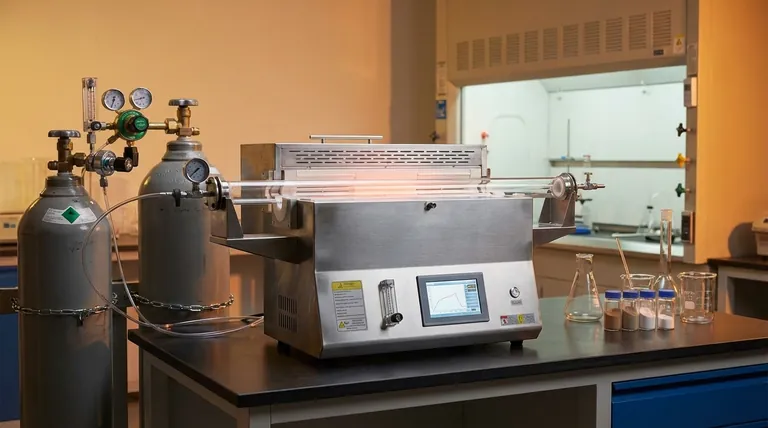
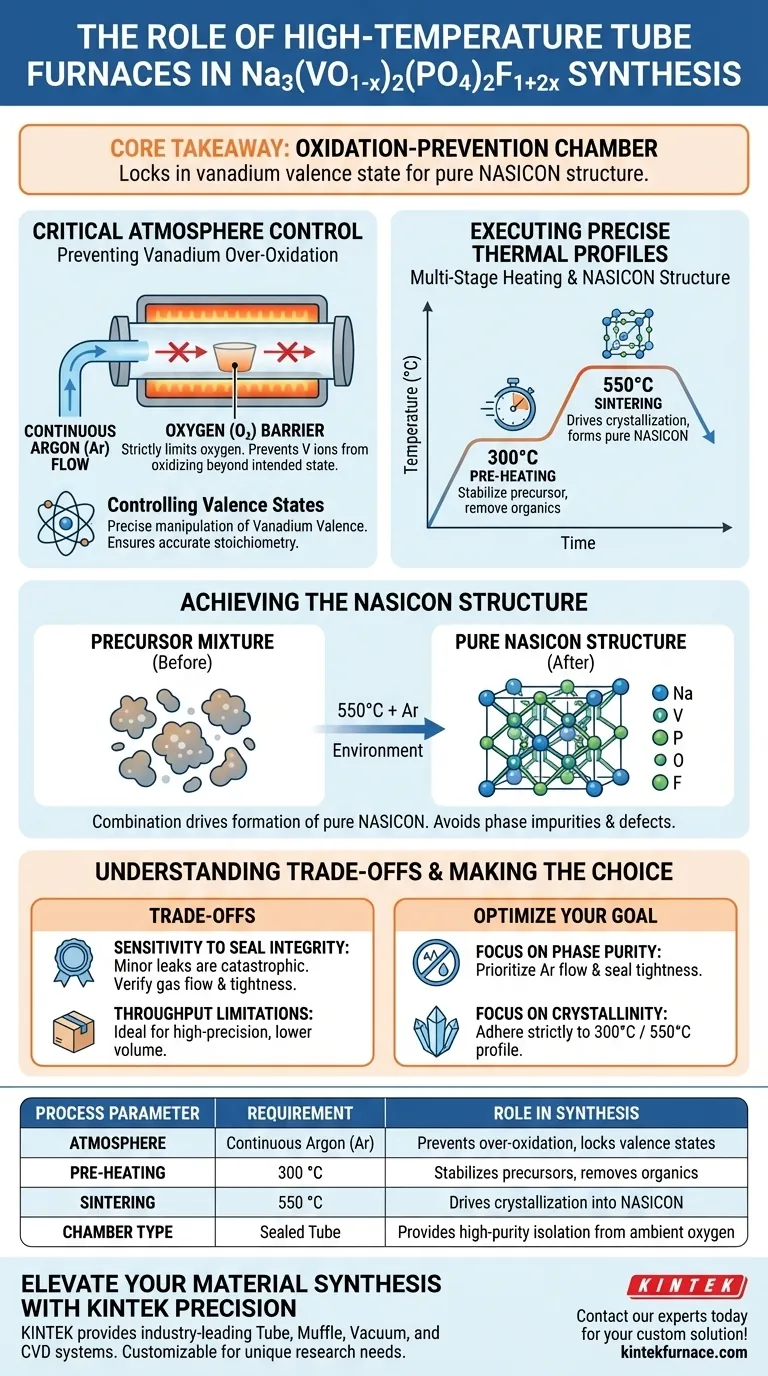
A high-temperature tube furnace serves as the precision environment required to finalize the synthesis of Na3(VO1-x)2(PO4)2F1+2x by providing a strictly controlled inert atmosphere and specific thermal ramping. It executes a dual-stage heating process—pre-heating at 300 °C followed by sintering at 550 °C—under a continuous flow of Argon (Ar) to dictate the material's final chemical and structural state.
Core Takeaway The tube furnace is not merely a heat source; it is an oxidation-prevention chamber that locks in the specific vanadium valence state required to crystallize a pure NASICON structure.
The Critical Role of Atmosphere Control
Preventing Vanadium Over-Oxidation
The primary function of the tube furnace in this context is to act as a barrier against oxygen.
Vanadium ions are highly reactive and sensitive to oxygen at elevated temperatures.
By maintaining a continuous Argon (Ar) inert atmosphere, the furnace strictly limits oxygen levels, preventing the vanadium from oxidizing beyond the intended state.
Controlling Valence States
The electrical and structural properties of the final material depend heavily on the specific valence state of the metal ions.
The inert environment allows for precise manipulation of the vanadium valence state.
This control is essential for ensuring the stoichiometry of the compound remains accurate during the high-energy sintering phase.
Executing Precise Thermal Profiles
The Necessity of Multi-Stage Heating
The tube furnace is utilized to execute a specific, multi-step thermal recipe rather than a simple ramp-to-peak.
The process involves pre-heating at 300 °C, likely to stabilize the precursor or remove residual organics, followed by sintering at 550 °C.
This staged approach ensures that intermediate reactions occur in the correct sequence before the final structure is formed.
Achieving the NASICON Structure
The ultimate goal of this thermal treatment is crystallization.
The combination of the 550 °C sintering temperature and the oxygen-free environment drives the formation of the pure NASICON structure.
Without this precise thermal and atmospheric combination, the material would likely suffer from phase impurities or structural defects.
Understanding the Trade-offs
Sensitivity to Seal Integrity
The effectiveness of a tube furnace is entirely dependent on the integrity of its seals.
Even a minor leak in the flanges can introduce trace amounts of oxygen, which is catastrophic for vanadium-based compounds.
Operators must diligently verify gas flow and seal tightness, as the furnace provides no protection if the inert barrier is breached.
Throughput Limitations
Tube furnaces offer superior atmosphere control but generally have lower volume capacities compared to box furnaces.
This makes them ideal for high-precision, high-purity synthesis where quality outweighs quantity.
However, scaling this process for mass production often requires significant changes to equipment or methodology.
Making the Right Choice for Your Goal
To optimize the synthesis of Na3(VO1-x)2(PO4)2F1+2x, align your equipment usage with your specific processing needs:
- If your primary focus is Phase Purity: Prioritize the integrity of the Argon flow and seal tightness to prevent any deviation in the vanadium valence state.
- If your primary focus is Crystallinity: Ensure your thermal profile strictly adheres to the 300 °C pre-heat and 550 °C sintering schedule to achieve the correct NASICON structure.
The tube furnace determines the success of this synthesis by coupling thermal energy with strict atmospheric isolation.
Summary Table:
| Process Parameter | Requirement | Role in Synthesis |
|---|---|---|
| Atmosphere | Continuous Argon (Ar) | Prevents vanadium over-oxidation & locks valence states |
| Pre-heating | 300 °C | Stabilizes precursors and removes residual organics |
| Sintering | 550 °C | Drives crystallization into the pure NASICON structure |
| Chamber Type | Sealed Tube | Provides high-purity isolation from ambient oxygen |
Elevate Your Material Synthesis with KINTEK Precision
Achieving the perfect NASICON structure requires absolute atmospheric integrity and thermal accuracy. KINTEK provides industry-leading Tube, Muffle, Vacuum, and CVD systems specifically designed for sensitive chemical synthesis.
Backed by expert R&D and world-class manufacturing, our high-temperature furnaces are fully customizable to meet your unique research or production needs. Whether you are controlling vanadium valence states or scaling up complex powders, KINTEK ensures your materials reach their peak performance.
Ready to optimize your thermal processing? Contact our experts today to find your custom solution!
Visual Guide
References
- Oskar Grabowski, A. Czerwiński. Solution-combustion synthesis of Na3(VO1-x)2(PO4)2F1+2x as a positive electrode material for sodium-ion batteries. DOI: 10.1038/s44172-025-00471-w
This article is also based on technical information from Kintek Furnace Knowledge Base .
Related Products
- 1200℃ Controlled Inert Nitrogen Atmosphere Furnace
- 1400℃ Controlled Inert Nitrogen Atmosphere Furnace
- 1700℃ Controlled Inert Nitrogen Atmosphere Furnace
- Mesh Belt Controlled Atmosphere Furnace Inert Nitrogen Atmosphere Furnace
- Controlled Inert Nitrogen Hydrogen Atmosphere Furnace
People Also Ask
- What controlled-atmosphere furnace conditions are required for sintering powder metallurgy copper alloy compacts? Ideal Setup
- What Roles Do a Controlled Atmosphere Furnace and Oil Quenching Tank Play in AISI 5140 Steel Heat Treatment?
- How Sintering Temp Affects Density & Resistivity of Cu-Oxide Composites
- What causes discrepancies between theoretical and experimental grain boundary mobility during ceramic sintering? Explained
- What types of gases are used in controlled atmosphere furnaces? Optimize Material Protection and Transformation



















