
At their core, rotary tube furnaces are specialized for the continuous thermal processing of free-flowing solid materials. They are most widely used in metallurgy, chemical production, and advanced materials industries for critical processes like calcination, sintering, reduction, and dynamic drying of powders and granules.
The defining advantage of a rotary tube furnace is its ability to continuously tumble materials during heating. This dynamic movement guarantees exceptional temperature uniformity and consistent gas-solid interaction, making it the ideal choice for processes where every particle must be treated identically.
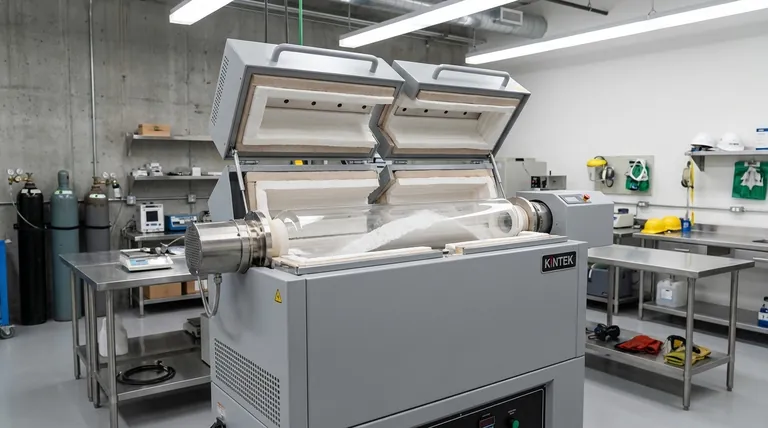
The Principle of Operation: Why Rotation Matters
To understand the applications of a rotary tube furnace, you must first understand its fundamental design advantage. Unlike a static furnace where materials sit still, the gentle rotation is the key to its effectiveness.
Ensuring Unparalleled Thermal Uniformity
In a static process, the material at the edges of a container heats faster than the material in the center. The rotation of the furnace tube constantly mixes the material, preventing hot spots and ensuring every single particle is exposed to the same temperature profile.
Maximizing Gas-Solid Interaction
For many chemical processes, such as reducing metal oxides or activating catalysts, a specific gas atmosphere is required. By tumbling the material, the furnace constantly exposes fresh particle surfaces to the process gas, dramatically increasing the efficiency and completeness of the reaction.
Enabling Continuous Throughput
Most industrial rotary tube furnaces can be tilted. This allows for raw material to be continuously fed into the high end of the tube and for the processed material to be discharged from the low end, creating a seamless, scalable production line.
Key Industrial Applications by Sector
The unique benefits of rotary tube furnaces make them indispensable in several high-value industries for processing powders, granules, and other bulk solids.
Metallurgy and Mining
This is a primary domain for rotary furnaces. They are used for calcination, a process that uses heat to cause thermal decomposition, such as converting metal ores into their oxides before they are reduced to pure metal. They are also used for the direct reduction of metal oxides into high-purity metal powders.
Chemical and Catalyst Production
The chemical industry relies on rotary furnaces for synthesizing and treating a wide range of materials. Common applications include the production of zinc oxide and silica gel, and the thermal activation of catalysts, which require precise temperature control and gas exposure to achieve the desired surface properties.
Advanced and Battery Materials
Modern manufacturing leverages these furnaces for next-generation materials. They are used for sintering ceramic powders to create dense components and for processing critical materials used in lithium-ion batteries, where particle consistency directly impacts performance and safety.
Environmental and Energy Sectors
Rotary furnaces are applied in waste remediation and energy production. They can be used for the thermal treatment of contaminated soils, the pyrolysis of biomass to create biofuels, or the roasting of materials to drive off volatile compounds in a controlled manner.
Understanding the Trade-offs
While highly effective, a rotary tube furnace is not a universal solution. Understanding its limitations is critical for proper application.
Not Suitable for Static or Large Parts
These furnaces are designed exclusively for free-flowing bulk solids. They cannot be used to heat-treat single, large components, fixed objects, or materials that would be damaged by tumbling. For those applications, a box or static tube furnace is necessary.
Mechanical Complexity and Maintenance
The rotation mechanism, including the motor, drive system, and especially the gas-tight seals, adds mechanical complexity compared to a static furnace. These seals are critical for maintaining a controlled atmosphere and can be a point of failure or require regular maintenance.
Potential for Particle Abrasion
The tumbling action, while beneficial for heat transfer, can cause attrition or mechanical breakdown of very fragile or abrasive materials. The suitability of the material for this dynamic processing must be evaluated to prevent unwanted changes in particle size or shape.
Making the Right Choice for Your Process
Your specific goal determines whether a rotary tube furnace is the correct tool.
- If your primary focus is processing powders or granules with the highest possible temperature uniformity: The continuous tumbling action of a rotary tube furnace is superior to static alternatives for ensuring every particle is treated identically.
- If your goal is efficient gas-solid chemical reactions like reduction or oxidation: A rotary tube furnace provides the ideal environment by constantly exposing new material surfaces to the process atmosphere, accelerating reaction rates.
- If you are heat-treating large, singular components or extremely delicate materials: A static box furnace or a standard, non-rotating tube furnace would be a more appropriate choice to avoid mechanical movement and potential damage.
Ultimately, selecting a rotary tube furnace is a strategic decision for processes that demand dynamic material mixing and exceptional uniformity at an industrial scale.
Summary Table:
| Application Area | Key Processes | Key Benefits |
|---|---|---|
| Metallurgy and Mining | Calcination, Reduction | High temperature uniformity, efficient gas-solid interaction |
| Chemical and Catalyst Production | Catalyst activation, Synthesis | Consistent particle treatment, scalable production |
| Advanced and Battery Materials | Sintering, Material processing | Enhanced reaction efficiency, precise control |
| Environmental and Energy Sectors | Pyrolysis, Roasting | Continuous throughput, controlled atmosphere handling |
Ready to optimize your thermal processing with precision? Leveraging exceptional R&D and in-house manufacturing, KINTEK provides diverse laboratories with advanced high-temperature furnace solutions. Our product line, including Muffle, Tube, Rotary Furnaces, Vacuum & Atmosphere Furnaces, and CVD/PECVD Systems, is complemented by our strong deep customization capability to precisely meet unique experimental requirements. Contact us today to discuss how our rotary tube furnaces can enhance your efficiency and results in metallurgy, chemicals, or materials science!
Visual Guide

Related Products
- Vacuum Sealed Continuous Working Rotary Tube Furnace Rotating Tube Furnace
- Laboratory Vacuum Tilt Rotary Tube Furnace Rotating Tube Furnace
- Split Multi Heating Zone Rotary Tube Furnace Rotating Tube Furnace
- Inclined Rotary Plasma Enhanced Chemical Deposition PECVD Tube Furnace Machine
- Inclined Rotary Plasma Enhanced Chemical Deposition PECVD Tube Furnace Machine
People Also Ask
- What is the purpose of rotary tube furnaces? Achieve Uniform Heat Treatment for Powders and Granules
- What are the key advantages of using a rotary tube furnace? Achieve Dynamic, Uniform Heating for Powders
- How does the amount of material processed vary between batch and continuous rotary tube furnaces? Scale Your Production Efficiently
- What are the advantages of rotary tube furnaces in fuel compatibility? Boost Efficiency and Cut Costs
- What is the temperature range of some rotary tube furnaces? Achieve Uniform Heating Up to 1200°C



















