
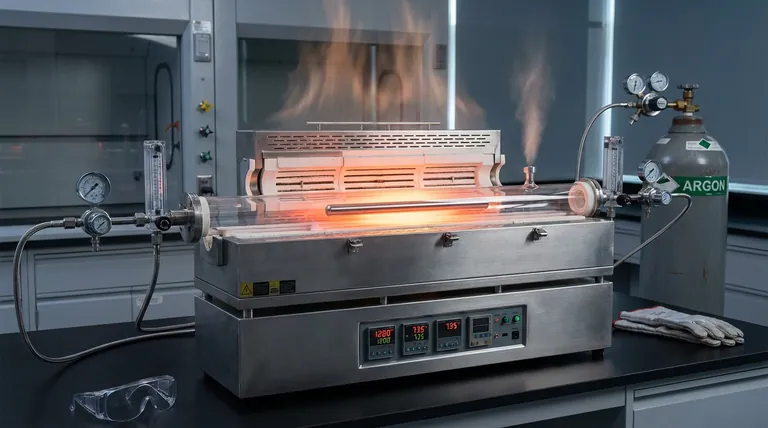
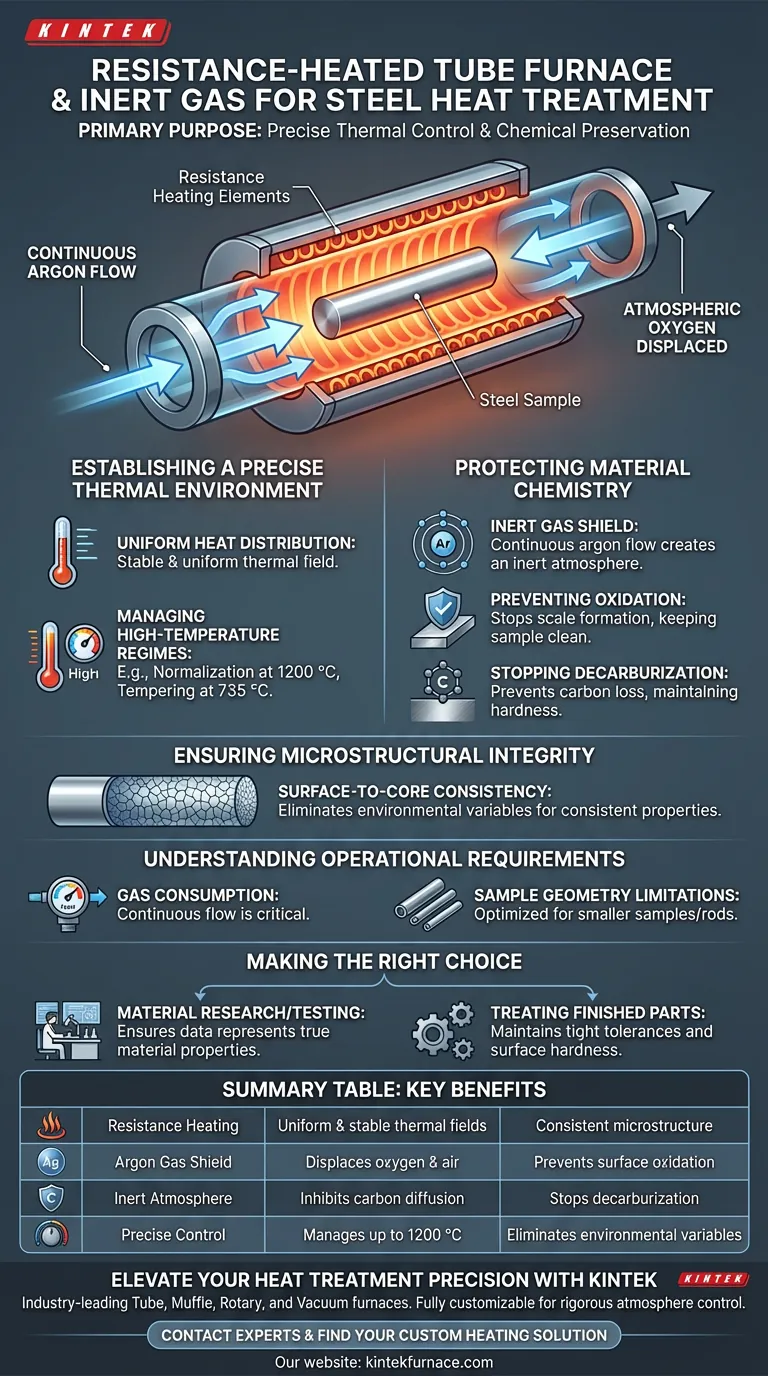
The primary purpose is twofold: precise thermal control and chemical preservation. A resistance-heated tube furnace with an inert gas system allows steel to undergo high-temperature treatments—such as normalization and tempering—without degrading its surface properties. This specific setup creates a controlled environment that isolates the material from atmospheric oxygen, ensuring that the physical changes in the steel are driven solely by temperature, not by unwanted chemical reactions.
By combining a stable thermal field with a continuous flow of argon, this setup effectively prevents surface defects, ensuring that the steel's microstructural characteristics remain consistent from the surface to the core.
Establishing a Precise Thermal Environment
Uniform Heat Distribution
For heat treatment to be effective, the temperature must be consistent throughout the heating zone. A resistance-heated tube furnace is designed to provide a stable and uniform thermal field.
Managing High-Temperature Regimes
This equipment is capable of sustaining the extreme temperatures required for critical steel processing steps. It reliably handles processes such as normalization at 1200 °C and tempering at 735 °C without fluctuations that could alter the material's properties.
Protecting Material Chemistry
The Role of Inert Gas
High temperatures naturally accelerate chemical reactions between steel and air. The integration of a continuous-flow argon protection system displaces oxygen within the tube, creating an inert atmosphere around the sample.
Preventing Oxidation
Without protection, steel heated to these temperatures would react with oxygen to form scale (oxides) on the exterior. The argon shield effectively prevents surface oxidation, keeping the sample clean and dimensionally accurate.
Stopping Decarburization
Carbon is the most critical alloying element in steel; losing it changes the material's hardness and strength. The inert atmosphere prevents decarburization, a phenomenon where carbon atoms diffuse out of the steel surface into the atmosphere.
Ensuring Microstructural Integrity
Eliminating Variables
The ultimate goal of using this apparatus is to remove environmental variables from the heat treatment equation. By controlling the atmosphere, you ensure the results observed are due to the thermal cycle alone.
Surface-to-Core Consistency
When oxidation and decarburization are eliminated, the material properties at the surface match those at the center. This ensures that microstructural characteristics remain consistent between the surface and the core, which is vital for accurate testing and performance verification.
Understanding the Operational Requirements
Gas Consumption
The system relies on a continuous flow of argon to maintain the inert barrier. If the flow is interrupted or insufficient, atmospheric air can backstream into the tube, immediately compromising the sample.
Sample Geometry Limitations
While tube furnaces offer excellent uniformity, the physical geometry of the "tube" limits the size and shape of the steel samples that can be treated. This setup is generally optimized for smaller samples or rods rather than large, complex industrial parts.
Making the Right Choice for Your Goal
This setup is not merely about heating; it is about preserving the fidelity of the material during thermal stress.
- If your primary focus is material research or testing: This system is essential to ensure your data represents the true material properties, not surface defects or altered chemistry.
- If your primary focus is treating finished parts: Use this setup to maintain tight dimensional tolerances and surface hardness by preventing scale formation and carbon loss.
Ultimately, the resistance-heated tube furnace with inert gas protection is the standard for isolating thermal effects from chemical degradation.
Summary Table:
| Feature | Function in Steel Heat Treatment | Key Benefit |
|---|---|---|
| Resistance Heating | Provides uniform and stable thermal fields | Consistent microstructure from surface to core |
| Argon Gas Shield | Displaces oxygen and atmospheric air | Prevents surface oxidation and scale formation |
| Inert Atmosphere | Inhibits carbon diffusion out of the material | Stops decarburization and maintains surface hardness |
| Precise Control | Manages regimes up to 1200 °C (Normalization) | Eliminates environmental variables for accurate results |
Elevate Your Heat Treatment Precision with KINTEK
Don't let oxidation or decarburization compromise your material research. KINTEK provides industry-leading Tube, Muffle, Rotary, and Vacuum furnaces designed to deliver the rigorous atmosphere control your steel processing requires. Backed by expert R&D and manufacturing, our systems are fully customizable to meet your specific thermal and chemical preservation needs.
Ready to ensure surface-to-core consistency in your samples? Contact our experts today to find your custom heating solution.
Visual Guide
References
- Russell Goodall, Jack Haley. Development of a boron-containing reduced activation Ferritic-Martensitic (B-RAFM) steel. DOI: 10.1177/03019233241273484
This article is also based on technical information from Kintek Furnace Knowledge Base .
Related Products
- 1200℃ Controlled Inert Nitrogen Atmosphere Furnace
- 1700℃ High Temperature Laboratory Tube Furnace with Alumina Tube
- 1400℃ High Temperature Laboratory Tube Furnace with Alumina Tube
- Laboratory Quartz Tube Furnace RTP Heating Tubular Furnace
- Mesh Belt Controlled Atmosphere Furnace Inert Nitrogen Atmosphere Furnace
People Also Ask
- What controlled-atmosphere furnace conditions are required for sintering powder metallurgy copper alloy compacts? Ideal Setup
- What Roles Do a Controlled Atmosphere Furnace and Oil Quenching Tank Play in AISI 5140 Steel Heat Treatment?
- How do surface oxide layers on ceramic powders like silicon nitride affect sintering? Master Atmosphere Control
- How Sintering Temp Affects Density & Resistivity of Cu-Oxide Composites
- What are the operational advantages of using a controlled atmosphere furnace? Boost Quality and Efficiency in Heat Treatment



















