
High-temperature tube furnaces facilitate precise growth control by strictly regulating the temperature field distribution, vacuum levels, and the flow rates of precursors like sulfur powder and molybdenum trioxide. By integrating these thermal controls with a Low-Pressure Chemical Vapor Deposition (LPCVD) environment, the system creates the specific kinetic conditions required for the epitaxial growth of Molybdenum Disulfide (MoS2) on complex nanotube templates.
The core advantage of this setup is the manipulation of the reaction gas's mean free path. By operating at low pressures within a stable thermal field, the furnace ensures high crystallinity and uniform coating, avoiding the irregularities common in atmospheric deposition.
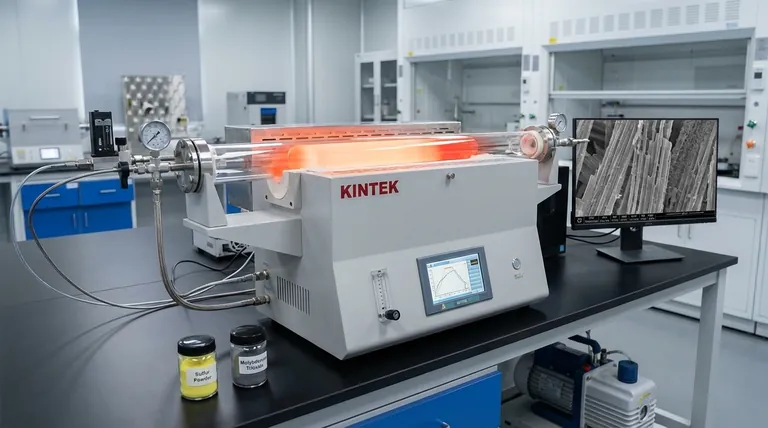
Creating the Ideal Kinetic Environment
To achieve controlled growth of MoS2 nanotubes, the furnace must simultaneously manage thermal energy and material supply.
Precision Temperature Distribution
The furnace maintains a specific temperature field distribution throughout the reaction chamber.
This thermal consistency is critical for triggering the reaction between sulfur powder and molybdenum trioxide (MoO3) at the correct rate.
Without this precise thermal profile, the thermodynamic conditions necessary for epitaxial growth would be unstable, leading to uneven deposition.
Regulating Precursor Flow
The tube furnace system controls the flow rates of the precursors entering the chamber.
By fine-tuning the introduction of sulfur and molybdenum sources, the system dictates the speed of the reaction.
This ensures that the material is deposited onto the Single-Walled Carbon Nanotube-Boron Nitride Nanotube (SWCNT-BNNT) templates in a controlled, layer-by-layer manner.
The Role of Low Pressure (LPCVD)
While temperature drives the reaction, the pressure environment determines the quality of the final nanostructure.
Increasing Mean Free Path
The LPCVD environment significantly increases the mean free path of the reaction gases.
This means gas molecules travel longer distances without colliding with other gas molecules compared to atmospheric pressure conditions.
This extended path allows precursors to reach and interact with the nanotube templates more effectively.
Enhancing Crystallinity and Uniformity
The specific combination of low pressure and high temperature results in high crystallinity for the MoS2 layers.
This environment facilitates a uniform coating over the one-dimensional SWCNT-BNNT templates.
The result is a consistent, high-quality nanotube structure that adheres strictly to the geometry of the underlying template.
Understanding the Trade-offs
While high-temperature tube furnaces offer superior control, there are inherent challenges in the LPCVD process.
Dependence on Template Quality
The process relies heavily on the quality of the SWCNT-BNNT templates.
Because the growth is epitaxial (growing in alignment with the substrate), any defect in the template will likely propagate through the MoS2 layer, regardless of furnace precision.
Complexity of Variable Synchronization
Success requires the simultaneous synchronization of vacuum levels, flow rates, and temperature gradients.
A deviation in one parameter—such as a fluctuation in precursor flow or a drop in vacuum pressure—can disrupt the kinetic conditions.
This sensitivity demands rigorous calibration and monitoring to prevent the formation of amorphous or uneven layers.
Making the Right Choice for Your Goal
To maximize the effectiveness of a high-temperature tube furnace for MoS2 growth, focus on the parameter most relevant to your specific objective.
- If your primary focus is Structural Integrity: Prioritize the precision of the temperature field distribution to ensure consistent thermodynamic conditions for epitaxial growth.
- If your primary focus is Coating Uniformity: Concentrate on optimizing the vacuum levels to maximize the mean free path of the reaction gases.
By leveraging the furnace's ability to maintain a high-vacuum, thermally stable environment, you ensure the successful synthesis of highly crystalline MoS2 nanotubes.
Summary Table:
| Parameter | Role in MoS2 Growth | Impact on Result |
|---|---|---|
| Temperature Field | Regulates thermodynamic reaction rates | Ensures epitaxial growth and high crystallinity |
| Vacuum (LPCVD) | Increases mean free path of reaction gases | Promotes uniform coating and eliminates irregularities |
| Precursor Flow | Manages sulfur and molybdenum supply | Controls layer-by-layer deposition speed |
| Template Quality | Provides the geometric substrate | Determines the final structural integrity |
Elevate Your Nanomaterial Synthesis with KINTEK
Precise control over thermal and kinetic environments is non-negotiable for high-quality MoS2 nanotube growth. KINTEK provides industry-leading high-temperature tube and vacuum systems designed to master complex LPCVD processes. Backed by expert R&D and manufacturing, we offer customizable Tube, Muffle, Rotary, and CVD systems tailored to your unique laboratory needs.
Ready to achieve superior crystallinity and uniformity? Contact us today to consult with our experts and find the perfect high-temp solution for your research.
Visual Guide

References
- Chunxia Yang, Rong Xiang. Janus MoSSe Nanotubes on 1D SWCNT‐BNNT van der Waals Heterostructure. DOI: 10.1002/smll.202412454
This article is also based on technical information from Kintek Furnace Knowledge Base .
Related Products
- 1400℃ High Temperature Laboratory Tube Furnace with Alumina Tube
- 1700℃ High Temperature Laboratory Tube Furnace with Alumina Tube
- 1200℃ Split Tube Furnace Laboratory Quartz Tube Furnace with Quartz Tube
- Molybdenum Vacuum Heat Treat Furnace
- High Temperature Muffle Oven Furnace for Laboratory Debinding and Pre Sintering
People Also Ask
- How does zone-melting in tube furnaces synthesize bismuth micro-wires? Master Single-Crystal Thermoelectric Growth
- How are high-temp tube furnaces used to measure diffusion coefficients per Fick's law? Master Precision Annealing
- How are high-temperature laboratory tube furnaces applied in long-term vacuum homogenization heat treatments for intermetallic samples?
- How do high-temperature laboratory tube furnaces ensure environmental stability? Precision Thermal Reduction Tips
- How are high-temperature tube furnaces applied in testing ceramic-supported alloy membranes? Insights



















